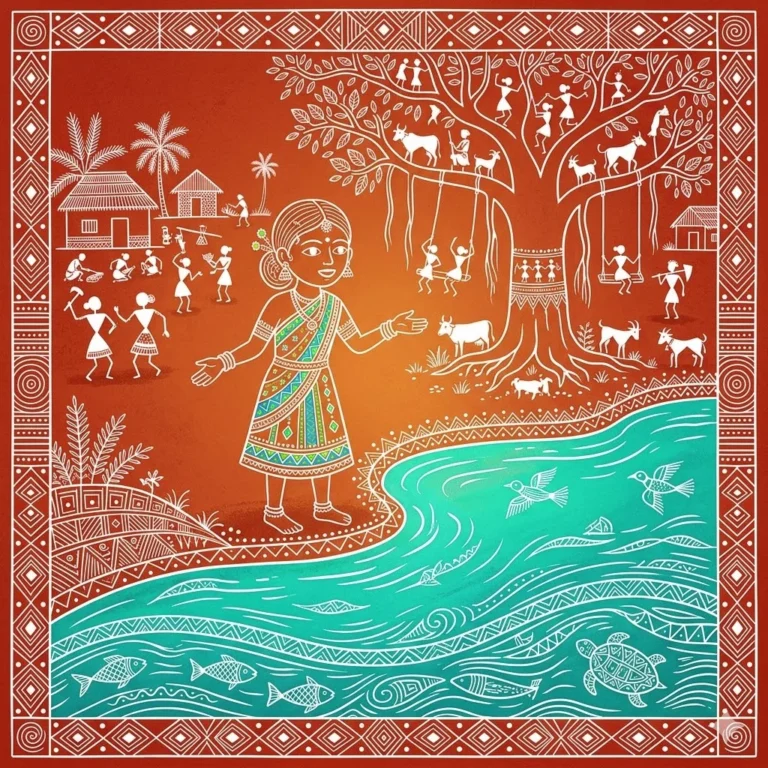
The Girl Who Spoke to Rivers
—
In the village of Sona Khet, where the mango trees grew so heavy with fruit they bowed like old men at prayer, there lived a girl named Ananya. Her name meant *without equal*, and though her father was only a potter and her mother sold jasmine strings at the temple gate, Ananya carried herself as though she had been told a secret the rest of the world was still searching for.
That summer, the river shrank.
It happened slowly at first — a narrowing, like the river was drawing a long breath. Then faster, until one morning the women came to fill their clay pots and found only cracked mud and the smell of warm stone and dying fish. The sun overhead was the colour of a copper coin, merciless and bright. The air tasted of dust. Even the mango trees drooped their heavy heads and went still.
The village elder, a bent man named Dharma, called everyone beneath the banyan tree. Its roots hung like the beards of a hundred wise men, and beneath them the villagers gathered, sweating and afraid.
Into this gathering rode a merchant on a white horse. His robes were the colour of fresh cream, and he smelled of sandalwood and money.
"I know of a spring," the merchant said, his voice smooth as oiled silk. "Deep in the Ashoka forest. I have tasted its water — cold as winter, clear as truth. I will lead you there, for a price. Half of everything you harvest this season. Half of your grain, your pottery, your flowers, your silk."
A murmur moved through the crowd like wind through wheat.
"That is nearly everything we have," said Dharma.
"Yes," said the merchant, smiling pleasantly. "But water is worth more than everything."
The villagers looked at one another — dry-lipped, frightened. Some began to nod.
Ananya stepped forward from the edge of the crowd. She was twelve years old and barefoot, her dark braid tied with a red thread, her eyes the colour of the deepest part of a well.
"Which direction does this spring lie?" she asked.
The merchant looked down at her with the patient amusement of someone who has never taken a child seriously. "East of the forest's heart, girl. But the path is full of thorns and wild peacocks and one very large rock you cannot climb. That is why you need me."
"Thank you," said Ananya.
She turned and walked away from the banyan tree, away from the crowd, toward the line of trees where the forest began its dark green conversation with the sky.
"Ananya!" her mother called after her. "You cannot go alone!"
"I am not going alone," Ananya called back, without turning. "I am going with my ears."
—
Inside the Ashoka forest, the light changed. It fell in long golden shafts between the trees, and the ground smelled of wet leaves and something older — something that had been breathing long before people arrived to name it. Monkeys chattered overhead. Somewhere, a woodpecker worked at a tree like a little carpenter.
Ananya walked east, as the merchant had said. She felt the thorns catch her dupatta, tiny fingers of the forest, and she moved carefully through them. Her feet were tough from years of walking unpaved paths, but here the ground was uneven, knotted with roots, and she had to pay close attention to every step.
Then she heard it.
Not water. Not yet. But a bird — a small brown fantail perched on a low branch, its tail fanning open and shut like a hand waving. It sang three rising notes, then paused, then sang them again.
Ananya had spent her whole childhood listening. Listening to her father hum as he worked clay. Listening to her mother negotiate prices at the temple. Listening to the river — before it had gone quiet.
She turned slightly north of east, following the bird.
The ground grew soft beneath her feet, darker, colder. The air shifted — a faint coolness, like the shadow of a cloud, except the sky above the treetops was blazing and clear.
And then she heard it. Water. Not the big rushing sound of a river, but something more private, more careful — a trickling, like a secret being told in a low voice.
She pushed through a curtain of hanging vines that smelled of crushed green and damp moss, and there it was: a spring rising from the base of a grey rock, water so clear she could count the tiny pebbles at the bottom, each one the colour of a pearl.
She tasted it. Cold. Sweet. Real.
She cupped her hands and drank until her whole chest felt like morning.
—
When Ananya returned to the village — leading a line of men and women carrying clay pots, guiding them east and then north, through the thorns, past the great rock that was easily walked around — the merchant on the white horse watched with an expression no longer pleasant.
"How did you find it?" he demanded. "The forest has no trail."
"I listened," Ananya said simply, filling her mother's pot to the brim.
"That is not an answer," he said, frowning.
Ananya looked up at him, shading her eyes against the copper sun. "Then maybe," she said, "you were asking the wrong question."
The merchant sat very still on his horse for a long moment. Then, without another word, he turned and rode away, his cream robes disappearing into the shimmering heat.
📚 Recommended Books
Handpicked for readers like you
As an Amazon Associate, we earn from qualifying purchases. These recommendations are personalized based on this story's themes and your reading history.
Old Dharma filled his pot last, slowly, and watched the water rise to the rim. The sound of it was the loveliest thing in all of Sona Khet — cool and clear and endlessly patient, like an answer that had been waiting all along for someone willing to be quiet enough to hear it.