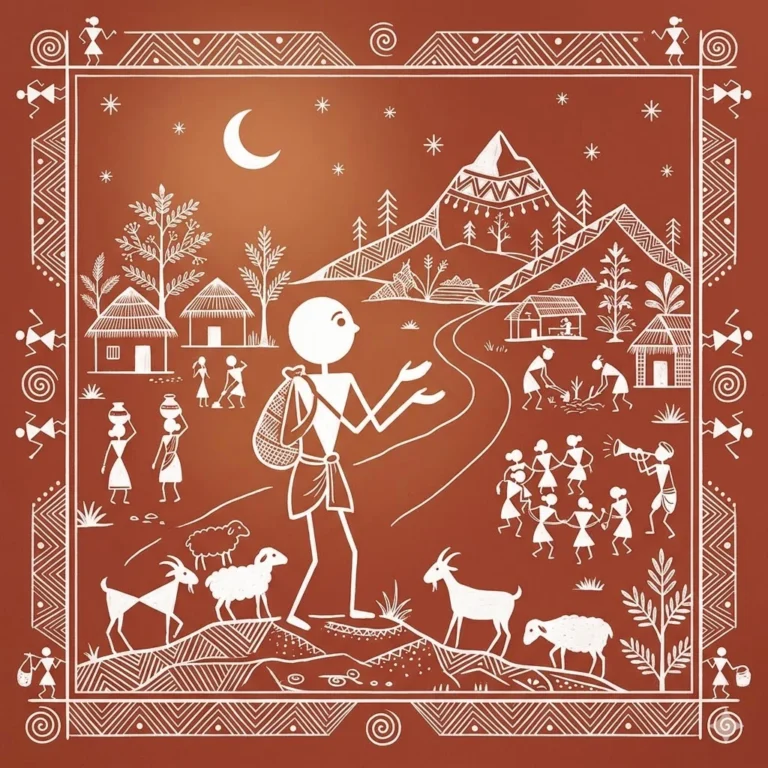
The Boy Who Spoke to the Mountain
That spring, the river ran angry.
Rains upstream had swollen Sharada until she roared and foamed and pressed her muddy shoulders against the ancient stone walls that protected Sundarvana's fields. The elders gathered beneath the great peepal tree, their voices low and troubled, the bark rough beneath their palms, the smell of wet earth hanging everywhere like a promise — or a threat. They spoke of Sage Bimaldev, who lived at the peak of Rudra Hill and who, it was said, had turned rivers with nothing but a word.
"Someone must climb to find him," said old Panditji, his voice thin as smoke. "Before the walls give way."
Every grown person in Sundarvana looked up at the hill — at its steep, cloud-wrapped shoulders — and found reasons to look away.
Every grown person except Kiran's mother, who found her son's eyes instead.
"I'll go," Kiran said. He was eleven years old. He had heard enough moral lessons wrapped in his grandmother's stories to know that courage is not the absence of fear — it is the decision that something matters more than the fear.
—
He set out at dawn, a cloth bag over his shoulder smelling of his mother's cardamom rotis, wet grass soaking his sandals as the path climbed. The peepal tree at the village edge shivered its heart-shaped leaves over him in farewell.
By mid-morning, he reached the Rope Bridge.
It was a trembling thing of woven vines that swayed above a gorge so deep that the bottom was nothing but shadow and the sound of water striking stone far below. A crow sat on the post, black as a burnt seed.
"Turn back, little shepherd," it croaked. "The bridge is old. The sage is not worth dying for."
Kiran gripped the vine railing. His heart knocked against his ribs like something trying to escape. The wooden planks groaned even before he stepped. He looked down — just once — and felt the world tilt sideways beneath him.
Then he looked across. The other side was solid. Possible.
"The people in my village are worth crossing for," he said — to the crow, to himself, to the gorge — and he walked forward, one careful step at a time, the bridge swaying like a river-cradle, cold mist rising against his face and the roar climbing through his feet and into his bones.
He made it.
The crow said nothing more.
—
The path narrowed further. The air turned cool as river silk. By afternoon, Kiran arrived at a fork in the road, where a very old woman sat mending a sari the colour of autumn marigolds. Her eyes were sharp as a hawk's in the middle of a wrinkled, kind face.
"Which path leads to Sage Bimaldev?" Kiran asked.
"Both do," she said pleasantly, without looking up from her needle. "One takes three hours. One takes three days."
"How do I know which is which?"
"You don't," she said. "That is rather the point."
Kiran sat down beside her on the flat stone and thought. He studied both paths: the left was wide and smooth, worn down by many feet; the right was narrow and overgrown, threaded with spiderwebs that caught the afternoon light like tiny, perfect nets of gold.
"The wide path looks easier," he said, slowly. "But an easy path up a holy mountain seems wrong. A sage would not want every idle person finding him without effort."
The old woman finally looked up.
"And the spiderwebs?" she asked, one eyebrow rising.
"No one has broken them in a long time," Kiran said. "Which means the right path is less walked. Harder. But more honest."
The old woman bit her thread. She smiled with her whole face. "Go on, then."
She was still smiling when he glanced back from the first bend. Or perhaps she wasn't there at all.
—
The right path was thorns and loose shale and a thick carpet of pine needles that smelled of resin and old rain. But within two hours, Kiran pushed through a last curtain of bamboo and stepped into a small clearing where smoke rose in a thin blue thread from a clay hearth. A man sat beside it — ancient, still, draped in white, eyes closed, a brass water pot gleaming at his knee like a small captured sun.
Kiran did not shout. He sat down in the pine-needle quiet and waited, the way you wait for a fire to speak before you add wood.
At last, the sage opened his eyes. They were the warm brown of river clay.
"You crossed the bridge," said Sage Bimaldev. Not a question.
"I did."
"You chose the right path."
"I believe so."
"Why have you come, boy?"
Kiran described it all — the flood swelling Sharada, the stone walls trembling, the fear sitting on every adult face like a second skin. The sage listened the way mountains listen: completely, without hurry, without judgment.
Then he spoke.
"Above your village, where the Sharada bends east, there is a cluster of three great boulders shaped like sleeping elephants. Remove the middle one. It blocks a natural channel the river has been searching for. Once freed, the water will follow that channel and bypass your walls entirely."
Kiran blinked. "That is all?"
The sage's eyes warmed. "Wisdom is often that simple. It only appears complicated because people are too frightened to look closely at what is actually in front of them." He gestured toward a clay pot of rice and lentils gleaming with a spoonful of ghee. "Eat first. Then carry what you know home."
The food was plain as field dust — and it tasted, as Kiran would tell children ages 6-12 for the rest of his long life, like the finest meal ever cooked under the sky.
—
He reached Sundarvana by nightfall. A team of men, emboldened now that they had a direction and a reason, went at the boulders with iron bars and two great oxen. Torches flickered orange against the wet stone. The smell of smoke and river mud filled the darkness.
The middle boulder shifted.
It groaned once — deep and earthen, like a sleeping giant rolling over — and rolled aside.
The Sharada found her channel.
She slipped through the opening with a sound like a long, slow exhale.
The roaring eased. The walls stood. The fields held.
And in Sundarvana, when children asked for years afterward what had saved the village, the answer was always the same, offered quietly, like a lamp placed in the window:
📚 Recommended Books
Handpicked for readers like you
As an Amazon Associate, we earn from qualifying purchases. These recommendations are personalized based on this story's themes and your reading history.
*"A boy who was afraid — and went anyway. And who stopped to think before he chose."*