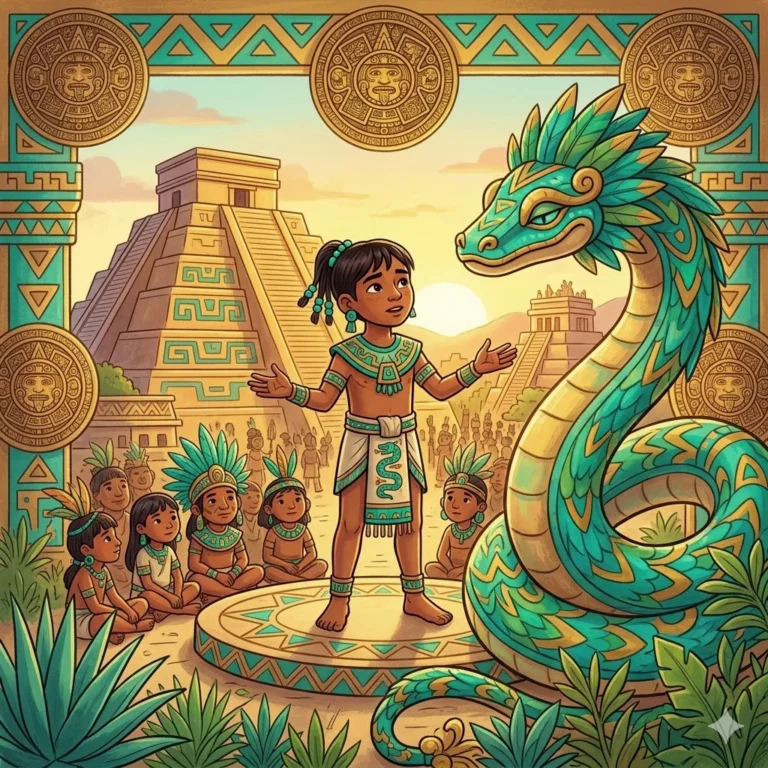
The Boy Who Spoke to Serpents
The village of Xochitlan sat beside a sacred spring whose waters ran cold and blue as the sky above Popocatépetl. Every morning, Itzli's grandmother carried her clay pot to that spring, and the sound of the water filling it — a bright, musical rushing — was the first sound he ever loved. The air around the spring smelled of wet stone and marigolds, and the moss there was so soft that pressing your palm against it felt like touching a sleeping animal.
Then one dry season, the spring went silent.
—
"Someone must climb to the source," said the elder Tepetl, his voice rough as grinding stone. "The Sacred Serpent guards the mountain's heart. Many have tried. None returned with water."
The warriors studied their sandals. The strongest hunters examined the horizon.
"I will go," said Itzli.
He was ten years old and no taller than a cornstalk's knee.
Tepetl frowned. "Boy, the serpent—"
"I will go," Itzli said again, quietly, which made it somehow harder to argue with.
—
That night, his grandmother pressed both hands around his face the way she did when she wanted him to truly listen.
"Are you frightened?" she asked.
"Yes," he said. He thought about lying, then decided against it.
She smiled — a slow, certain smile, like sunrise. "Good. Fear is a messenger. It tells you: *pay attention here.* But courage is what you do *after* you listen." She pressed something into his palm: a small jade bead carved in the shape of a rabbit. "Wisdom first, Itzli. Always wisdom first."
—
He left before dawn. The mountain path smelled of pine resin and damp earth, and every step sent small stones skittering away into darkness. The air grew thinner and colder as he climbed — thin enough to make his chest ache, cold enough to turn his breath to silver mist. Above him, the volcano's peak wore a cap of cloud the color of old ash.
He found the serpent where the path ended at a great black pool.
It was longer than four men laid end to end, its scales the deep green of jade, each one edged in gold that caught the pale morning light. Its eyes were the amber of copal resin burning in a temple, and they were fixed — entirely, horribly — on Itzli.
His grandmother's voice came back to him: *Wisdom first.*
He did not run. He did not raise the sharp stone he'd carried in case of jaguars. He knelt.
"Great one," he said, and his voice only trembled a little. "The village below has no water. I have come to understand why."
The serpent's tongue flicked — a dark ribbon tasting the cold air. When it spoke, its voice was not loud. It was the sound of water moving under stone.
"You are the first to kneel," it said. "The others came with weapons."
"Weapons are for when you have already stopped thinking," Itzli answered. He wasn't entirely sure where the words came from. Perhaps from his grandmother. Perhaps from fear, refined by the long climb into something steadier.
The serpent lowered its great head until one amber eye was level with the boy's face. Itzli could feel warmth radiating from the scales — surprising, like sun-baked stone — and the creature smelled of deep rain and dark earth.
"The water does not flow," the serpent said, "because a man filled the channel with rocks three moons ago. He wanted the spring for his fields alone. I have guarded this mountain since before your grandfather's grandfather drew breath. But I cannot move the rocks. I have no hands."
Itzli stared. "And you let no one pass because—"
"Because everyone who came brought a weapon," the serpent said, and something almost tired moved through its ancient voice. "I do not harm those who come in peace. I have been waiting for someone to simply *ask.*"
Itzli's face went hot with something between embarrassment and wonder — the particular feeling of realizing the answer was simpler than you expected. "Then — will you show me the rocks?"
The serpent turned. Itzli followed.
—
The blocked channel lay behind a shelf of black volcanic stone, hidden from the path. Someone had wedged a dozen heavy rocks into the narrow throat of the spring with terrible deliberate care. Itzli worked for the better part of the morning, his fingers scraped raw by rough obsidian edges, sweat cold on his back in the thin mountain air. The serpent coiled nearby, patient as the mountain itself, its golden-edged scales rising and falling with slow, steady breath.
This is the sort of story — for kids ages 6-12 — that rewards those who stay awake to see how it ends.
When the last rock came free, the water did not trickle. It *burst* — cold and bright and roaring — and the sound of it was the finest thing Itzli had ever heard. It smelled exactly like his grandmother's clay pot in the early morning. He laughed. He couldn't help it.
He carried no water back to the village. He didn't need to. By the time he reached the bottom of the path, he could hear the spring singing in the valley below, could see the children already running toward its sound.
—
The elder Tepetl met him at the village edge. For a long moment the old man simply looked at the boy — at his scraped hands, his muddy knees, his grandmother's jade rabbit still clutched in one fist.
"What did you say to the serpent?" Tepetl asked at last.
Itzli thought about it honestly.
"I said hello," he answered. "And then I listened."
📚 Recommended Books
Handpicked for readers like you
As an Amazon Associate, we earn from qualifying purchases. These recommendations are personalized based on this story's themes and your reading history.
Tepetl opened his mouth, then closed it again, the way people do when they realize the lesson has already been delivered.