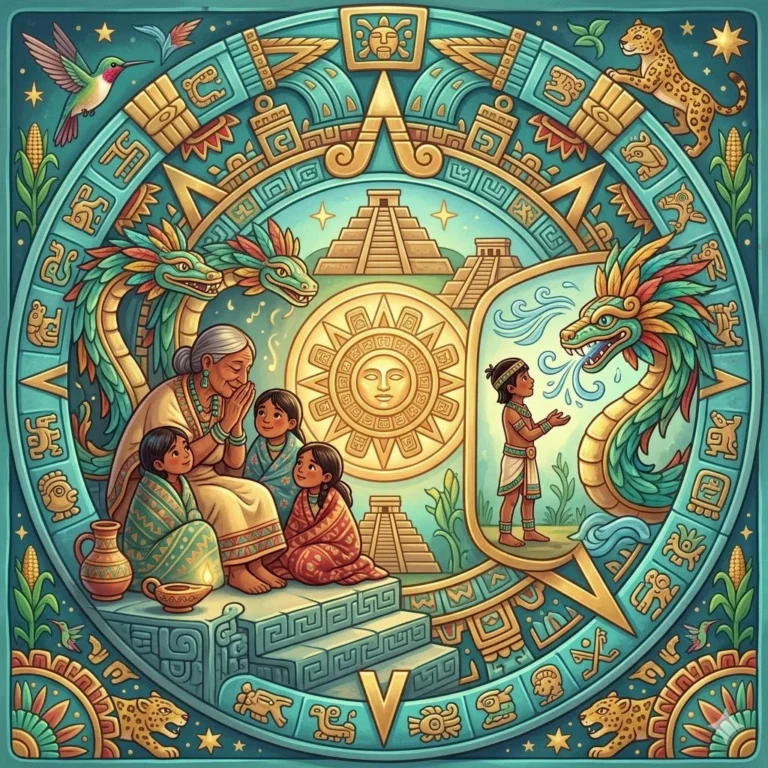
The Boy Who Asked the Serpent
—
In the time before clocks and calendars, when the great city of Tenochtitlán rose like a jewel from the middle of a shimmering lake, there lived a boy named Citlal. His name meant *little star*, though he felt anything but bright. He was thin, and often quiet, and the older boys in the marketplace called him *Smoke Boy* because, they said, he disappeared whenever anything difficult blew his way.
The market smelled of roasting maize and dried chili and the damp green sweetness of cut flowers the vendors stacked in towers of crimson and gold. Citlal loved it there. He loved the noise — the barking of traders, the slap of sandals on stone, the low rumble of drums from the temple hill above. He just did not love being noticed.
One morning, a messenger ran breathless through the market shouting news that made every vendor go still.
"The Sacred Serpent of the Eastern Spring has woken! The water has gone dark! Not a drop can be drawn!"
The Eastern Spring fed half the city. Without it, the great canals would shrink. The crops would suffer. The children would go thirsty.
The high priests declared that someone must climb to the serpent's cave and ask why she had closed the spring. But the cave sat at the top of a steep hill covered in sharp black volcanic rock, and the serpent — *Chalchiuh-Coatl*, the Jade Serpent — was known to speak in riddles that could tie your mind in knots.
Three warriors volunteered first.
Citlal watched them leave, their feathered headdresses blazing orange in the morning sun. He felt the warm press of the crowd around him, heard the excited chatter, smelled the nervous sweat in the air. He stayed behind.
The warriors came back before midday. Their sandals were cut from the black rock, and their faces were pale.
"She asked us a question," the tallest warrior said, his voice oddly small. "She said: *What is stronger — the mountain or the river?* We answered the mountain. She did not open the spring."
The priests frowned and sent two scholars next, men who carried scrolls and smelled of ink and knew the old songs by heart.
They returned by evening.
"She asked us the same thing," the elder scholar said, rubbing his temples. "We said the river — because it carves the mountain away over many years. She looked at us a long time. Then she said: *You know the answer with your heads, but not your hands.* The spring stayed shut."
That night, Citlal could not sleep. He lay on his mat listening to the sounds of the city — the distant lap of lake water, the creak of wooden bridges, someone's baby crying two houses away, thirsty. The darkness pressed on his chest like a flat stone.
He thought about the riddle. *What is stronger — the mountain or the river?*
And then a small, shy idea came to him. Not a grand idea. Just a quiet one.
In the gray hour before sunrise, he slipped out of the house while his mother still slept.
The climb was terrible. The black volcanic rock bit at his palms and knees like tiny teeth. The air smelled of sulfur and cold stone. By the time the cave entrance appeared — a wide mouth in the hillside draped with roots that hung like dark curtains — Citlal's legs were shaking. He stood at the entrance and breathed in the damp, ancient smell of the cave: moss and mineral water and something older than both.
"Come in, little star," said a voice like water running over smooth pebbles.
He pushed through the roots. The cave glowed faintly green, the light coming from the scales of the Jade Serpent herself. She was enormous. Coil upon coil of her rested on the cave floor, and her head was level with his own, her eyes like two polished obsidian mirrors.
Citlal's heart hammered. But his feet stayed planted.
"Ask your question," she said.
"Before I do," Citlal heard himself say, "may I answer the riddle?"
The serpent tilted her great head. Her scales clicked softly, like rain on a clay roof. "You may try."
Citlal took one step forward. "The mountain and the river are both strong," he said, "but neither of them is the answer. The *water in the spring* is the answer. Because it is patient underground, it gives life without fighting, and it finds its way through stone not by force — but by choosing where to go."
Silence filled the cave like water filling a vessel.
"The warriors had muscle," the serpent said slowly. "The scholars had knowledge." She lowered her head until her nose nearly touched his. He could feel the cool breath of her, smell the metallic shimmer of ancient stone on her scales. "But what do *you* have, Smoke Boy?"
"Just the question," Citlal said honestly. "I didn't come with an answer. I came to understand."
For a long moment, nothing moved. Then the Jade Serpent made a sound — low and resonant — that Citlal realized, with a start, was laughter.
"Then you are the first honest one," she said.
A deep rumble moved through the rock beneath his feet, and from somewhere below, he heard the rush and gurgle of released water. The spring opened.
When Citlal came down the hill — knees bleeding, palms scraped, sandals ruined — the people in the market had already heard the sound of the canals filling. He expected cheering. Instead, the tall warrior who had gone first was waiting at the bottom of the path. The man crouched down to Citlal's level.
"How did you do it?" the warrior asked. No mockery in his voice now. Just a real question.
Citlal shrugged. "I stopped trying to sound smart," he said. "And I started trying to actually *listen*."
The warrior looked at him for a long moment, then nodded slowly, as if something long stuck in his chest had quietly come free.
📚 Recommended Books
Handpicked for readers like you
As an Amazon Associate, we earn from qualifying purchases. These recommendations are personalized based on this story's themes and your reading history.
And Citlal — the boy they had called Smoke — walked home through the golden morning market, through the smell of roasting maize and the bright noise of a city no longer thirsty, carrying nothing more than two scraped hands and a heart that felt, for the first time, like a mountain and a river all at once.