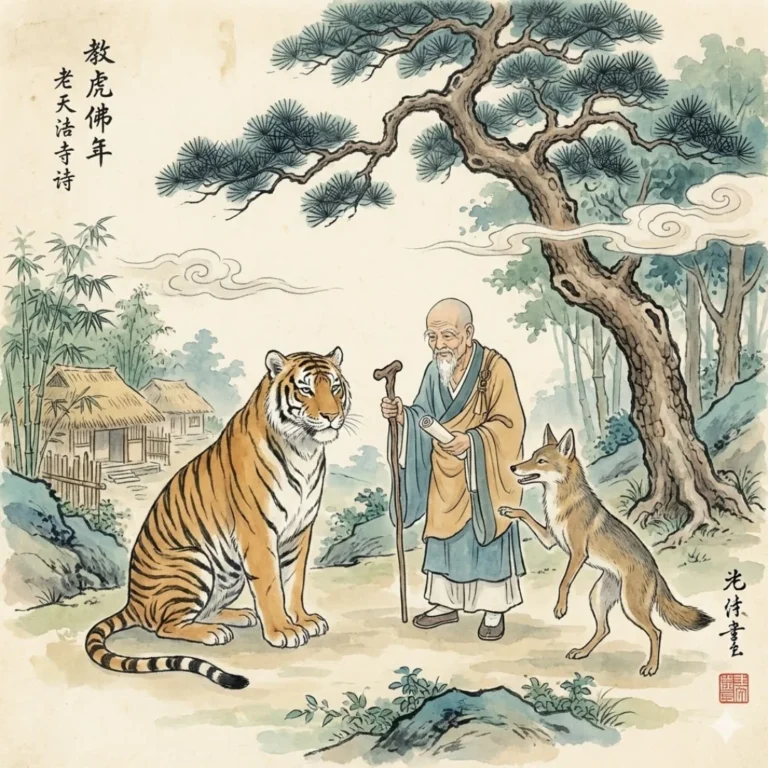
In a village at the edge of the great mountains of Korea, where the seasons painted the landscape in ever-changing colors and the streams sang their way down from the peaks, there was a garden unlike any other. It belonged to Master Sung, an old gardener whose skill with growing things was so renowned that people traveled from distant provinces just to see what bloomed in his care.
In this village also lived a girl named Ji-Woo, who was clever and quick and very, very impatient. She was eleven years old, and she wanted everything to happen right now, immediately, without delay. When she planted seeds, she would dig them up the next day to see if they had sprouted. When she studied calligraphy, she would rush through her characters, making them sloppy and uneven. When her mother made kimchi, Ji-Woo would open the jar after only a day, unable to wait for the proper fermentation.
‘Patience, Ji-Woo,’ her mother would sigh. ‘Good things take time.’
But Ji-Woo didn’t believe it. Waiting felt like wasting time, and she was always in a hurry to get to the result.
One spring morning, Master Sung came to Ji-Woo’s house with an unusual offer.
‘I am growing old,’ he told Ji-Woo’s parents, ‘and I need an apprentice to learn the ways of the garden. I have observed your daughter. She is intelligent and full of energy. If she is willing to learn, I will teach her.’
Ji-Woo was thrilled. Master Sung’s garden was magical! Surely he would teach her his secrets, and soon she would be able to grow amazing flowers and fruits too!
‘When do we start?’ she asked eagerly. ‘Can I learn everything today?’
Master Sung smiled, his face creasing like the bark of an old tree. ‘Ah,’ he said. ‘I see we have much to teach each other. Come tomorrow at dawn, and bring patience with you.’
‘I don’t need patience,’ Ji-Woo thought to herself. ‘I need knowledge. Once I know the secrets, I can make things grow quickly!’
The next morning, Ji-Woo arrived at Master Sung’s garden just as the sun was painting the eastern sky pink and gold. The garden was beautiful – cherry trees heavy with blossoms, beds of flowers in every color, vegetable plots arranged with perfect precision. But what caught Ji-Woo’s attention was a small section of bare earth, carefully prepared but empty.
‘Today,’ Master Sung said, handing Ji-Woo a small cloth bag, ‘you will plant seeds.’
Ji-Woo took the bag eagerly. Finally! She would plant something and watch it grow!
But when she opened the bag, she found only three seeds. They were dark and wrinkled, no bigger than apple seeds, and they didn’t look like much at all.
‘What will they grow into?’ Ji-Woo asked.
‘That,’ Master Sung said, ‘is for you to discover. Plant them with care, tend them with attention, and above all, wait with patience. These are very special seeds, but they require time to reveal their nature.’
Ji-Woo planted the three seeds in the prepared earth, spacing them carefully as Master Sung instructed. She watered them gently and marked each spot with a small stone.
‘When will they sprout?’ she asked.
‘When they are ready,’ Master Sung replied.
‘But when will that be? Tomorrow? Next week?’
‘When they are ready,’ Master Sung repeated with infuriating calm.
That night, Ji-Woo could barely sleep. She kept thinking about the seeds, wondering what they would become. The next morning, she rushed to the garden before dawn, certain she would see sprouts pushing through the soil.
But the earth was bare. Nothing had changed.
Days passed. Then a week. Then two weeks. Ji-Woo checked the seeds every morning and every evening. She watered them carefully, made sure they had enough sun, protected them from birds. But nothing happened. The earth remained stubbornly, disappointingly bare.
Meanwhile, Master Sung taught her other things. He showed her how to prune the fruit trees, how to prepare soil for different plants, how to read the signs of weather in the clouds and wind. He taught her the names of every plant in the garden and their particular needs and seasons.
But Ji-Woo’s mind was always on those three mysterious seeds. Why weren’t they growing? Were they dead? Had she done something wrong?
‘Master Sung,’ she said one evening, trying to keep the frustration from her voice, ‘I think my seeds might be bad. Nothing is happening.’
‘Nothing that you can see,’ Master Sung corrected gently. ‘But beneath the soil, much is happening. The seed must first swell with water, then break its shell, then send down roots before it can send up shoots. All of this takes time and happens in darkness, invisible to impatient eyes.’
‘How long will it take?’ Ji-Woo asked.
‘As long as it takes,’ Master Sung said. ‘Some seeds sprout in days. Some take weeks. Some take months or even years. The gardener’s task is not to hurry the seed, but to provide the right conditions and then wait with patience and trust.’
Ji-Woo tried to be patient. She really did. But it was so hard! Spring turned to summer, and still nothing grew where she had planted her seeds. She watched other plants in the garden grow and bloom and fruit, and her little patch remained bare.
She began to lose hope.
Then, one morning in late summer, Ji-Woo arrived at the garden and stopped in her tracks. There, in the place where she had planted the first seed, a tiny green shoot had pushed through the soil. It was no bigger than her fingernail, but it was there, alive, real.
Ji-Woo’s heart soared like a bird. She had waited for so long, and finally, finally something was happening!
Over the next weeks, she watched with wonder as the shoot grew into a small plant with delicate leaves. But it grew slowly, so slowly, adding only a bit of height each day. Ji-Woo still had to practice patience, resisting the urge to pull on the stem to make it grow faster.
Autumn came, painting the mountains in reds and golds. The first plant was now as tall as Ji-Woo’s knee, with beautiful silver-green leaves. And then, amazingly, the second seed finally sprouted. Ji-Woo had almost forgotten about it, but there it was, pushing determinedly through the earth.
‘Each seed has its own time,’ Master Sung observed. ‘Some are quick, some are slow. The gardener must respect each one’s natural rhythm.’
Winter arrived with its cold winds and snow. The first plant went dormant, its leaves falling, and Ji-Woo worried it had died. But Master Sung assured her it was merely resting, gathering strength for spring.
The second plant grew through the winter, protected by a small shelter Master Sung helped Ji-Woo build. It was different from the first plant, with broader leaves and a sturdier stem.
And the third seed? It still hadn’t sprouted. Ji-Woo checked it faithfully, but the earth remained bare. She had been caring for these seeds for nearly a year now, and the third showed no sign of life.
‘Maybe it’s dead,’ Ji-Woo said sadly one winter day.
‘Maybe,’ Master Sung agreed. ‘Or maybe it simply needs more time. Some seeds have very long dormancies. They wait for exactly the right conditions before they emerge. We must continue to care for it and trust in the timing.’
When spring returned, something miraculous happened. The first plant, which had seemed dead all winter, burst back to life with new growth. And one morning, it produced a single flower – a bloom so exquisitely beautiful that Ji-Woo gasped when she saw it. It was a rare mountain lily, with petals like white silk blushed with pink, and a fragrance that made her think of all the good things in the world.
‘This plant,’ Master Sung said, ‘blooms only once every few years, and only after it has grown strong enough. You have waited patiently, and now you are rewarded with something precious.’
The second plant, meanwhile, had grown sturdy and strong through the winter, and in the spring it produced leaves that Master Sung showed her how to prepare as a medicinal tea.
‘This plant provides healing,’ he said. ‘It too needed its own time to develop its properties. Had it grown quickly, it would not have the same strength.’
Ji-Woo had learned so much in the year of waiting. She had learned to observe carefully, to notice small changes, to trust in processes she couldn’t see. She had learned that her impatience didn’t make things happen faster – it only made the waiting harder. She had learned that some of the most beautiful and valuable things required the most patience.
But the third seed still hadn’t sprouted.
Another summer came. Ji-Woo was now twelve, and she had been tending the garden for more than a year. She still checked the third seed’s spot every day, still watered it, still hoped. But she no longer felt the frantic impatience of before. She had learned to wait with peace in her heart.
And then, on a morning in late summer, almost exactly one year after the first seed had sprouted, Ji-Woo saw something that made her laugh with delight. The third seed had finally, finally pushed a shoot through the soil.
But this shoot was different. It was thick and strong, and it grew faster than either of the others once it started. Within weeks, it was taller than Ji-Woo. By autumn, it was a young tree with a trunk as thick as her wrist.
‘Do you know what this is?’ Master Sung asked, smiling.
Ji-Woo shook her head, wonderment in her eyes.
‘This is a ginkgo tree,’ Master Sung said. ‘One of the oldest species of trees in the world. They can live for thousands of years. But their seeds often wait a long time before sprouting – sometimes years – because they will only emerge when conditions are exactly right. Once they start growing, they become strong and enduring. Your ginkgo waited for nearly a year and a half to sprout, but now it will grow and become a tree that might live to see your great-great-grandchildren.’
Ji-Woo looked at the young tree, at the rare lily now setting its seeds for future blooms, at the medicinal plant providing its healing leaves. She thought about all the waiting she had done, all the patience she had learned.
‘Master Sung,’ she said slowly, ‘when I started as your apprentice, I wanted to learn everything immediately. I thought patience was just wasting time. But now I understand. Good things come to those who wait – not because waiting is magic, but because good things need time to develop properly. The lily needed time to grow strong enough to bloom. The medicine plant needed time to develop its healing properties. The ginkgo needed time to sense that conditions were right. And I needed time to learn patience itself.’
Master Sung’s eyes crinkled with pride. ‘You have learned the most important lesson of the garden, Ji-Woo. Everything has its own perfect timing. We cannot rush a seed to sprout, a bud to bloom, or a fruit to ripen. We can only provide good conditions and then wait with patient care. This is true not only for gardens but for all of life. Skills take time to develop. Understanding takes time to deepen. Friendships take time to grow strong. The best things in life cannot be rushed.’
Ji-Woo became Master Sung’s dedicated apprentice, and in time, a renowned gardener herself. She grew famous not for making things grow quickly, but for her patience and her understanding of natural timing. She taught others what the three seeds had taught her: that patience is not passive waiting, but active caring while trusting in the right timing.
Years later, when the ginkgo tree was tall and strong, spreading its fan-shaped leaves over a wide area, Ji-Woo would sit beneath it with her own students. She would tell them the story of the three seeds and show them the descendants of the rare lily and the medicinal plants that now filled several beds.
‘Good things come to those who wait,’ she would say. ‘Not because waiting is easy, but because the best things need time to become what they are meant to be. Be patient with your plants, patient with your learning, and patient with yourselves. Trust in the right timing, and you will be rewarded with things more valuable than anything rushed could ever be.’
And there, in the garden that Master Sung had built and Ji-Woo had learned to tend, the seasons continued their ancient dance, and the plants grew in their own perfect time, teaching patience to all who had the wisdom to learn.
Frequently Asked Questions
What is the moral lesson of The Gardener’s Apprentice and the Waiting Seed – A Korean Patience Story for Kids?
What age is this story appropriate for?
How long does it take to read The Gardener’s Apprentice and the Waiting Seed – A Korean Patience Story for Kids?
What culture does this story come from?
Can I use this story for teaching?
Frequently Asked Questions
What is The Gardener’s Apprentice and the Waiting Seed about?
The Gardener’s Apprentice and the Waiting Seed is a Korean children’s story about Ji-Woo, an impatient eleven-year-old girl who becomes apprenticed to Master Sung, a legendary gardener. Through caring for seeds and plants, she learns that patience and trusting the process are essential life skills that can’t be rushed.
What moral lesson does The Gardener’s Apprentice and the Waiting Seed teach kids?
The story teaches children that patience leads to better results. Ji-Woo’s habit of rushing — digging up seeds too early, sloppily practicing calligraphy, opening kimchi too soon — shows how impatience can ruin outcomes. The gardening apprenticeship helps her understand that good things genuinely take time and effort to grow.
Is this story appropriate for young children?
Yes, this story is well-suited for children aged six to twelve. The main character Ji-Woo is eleven, making her relatable to middle-grade readers. The themes of patience and learning are presented through simple, engaging storytelling set against a rich Korean cultural backdrop that children can easily connect with.
📚 Recommended Books
Handpicked for readers like you
As an Amazon Associate, we earn from qualifying purchases. These recommendations are personalized based on this story's themes and your reading history.
What Korean cultural elements are featured in this story?
The story includes several Korean cultural details, such as calligraphy practice, kimchi fermentation, and a mountain village setting that reflects traditional Korean rural life. These authentic touches make The Gardener’s Apprentice and the Waiting Seed both an entertaining tale and a gentle introduction to Korean customs and traditions.
How can parents use this story to talk to kids about patience?
After reading, ask your child if they’ve ever rushed something and regretted it, just like Ji-Woo. You can connect the waiting seed metaphor to real-life examples like baking, growing a plant together, or practising a skill. The story makes a natural conversation starter about why slowing down often leads to better, more meaningful results.