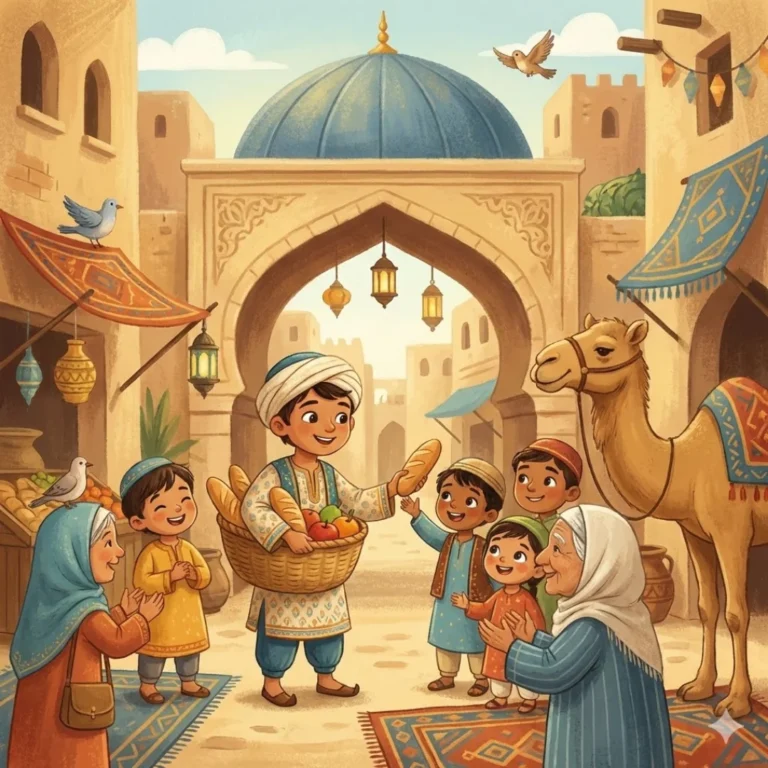
This moral story for children ages 6-12 combines entertainment with important values.
Mahmoud the Generous
In the golden age of Baghdad, when the city’s towers reached toward the heavens and its markets overflowed with treasures from distant lands, there lived a wealthy merchant named Mahmoud. His ships sailed across vast oceans carrying precious silks that felt like water between your fingers. His caravans crossed endless deserts loaded with aromatic spices that filled the air with the scent of cinnamon, cardamom, and saffron.
But if you asked anyone in Baghdad about Mahmoud, they would not tell you about his wealth. Instead, they would tell you about his generous heart.
Every Friday, as the sun climbed high in the sky and the call to prayer echoed across the city’s minarets, Mahmoud would stand outside his largest shop distributing fresh bread, sweet dates, and coins to those in need. He remembered the words he had learned as a child: “The best of people are those who are most beneficial to others.”
One scorching afternoon, as Mahmoud arranged bolts of colorful silk in his shop, a frail old woman shuffled through the door. Her clothes were torn and faded, her face was thin with hunger, and her hands trembled with weakness.
“Please, sir,” she said softly, her voice barely above a whisper. “My husband died last month, and I have no family left to care for me. I haven’t eaten in two days. Can you spare anything to help me?”
Mahmoud’s heart swelled with compassion. He quickly filled a large bag with rice, added a basket of fresh dates, dried figs, and several gold coins. “Please, take these,” he said gently. “And come to my shop every week. I promise I will always help you.”
Tears of gratitude rolled down the old woman’s weathered cheeks. “May Allah bless you abundantly, kind sir. May your generosity return to you a thousand times over.” With the precious food clutched to her chest, she left, her steps a little lighter despite her burden.
That night, Mahmoud had a remarkable dream. He found himself standing in a vast, starlit space before two enormous golden scales that gleamed in celestial light. On one side of the scales appeared all his business achievements – ships full of silk, caravans of spices, shops overflowing with goods, and mountains of gold coins. The scale creaked under the weight.
Then, on the other side, a single thing appeared: the old woman’s prayer of gratitude. Just one simple, heartfelt prayer.
Mahmoud watched in amazement as the scale with the prayer slowly sank down, outweighing all his worldly wealth.
He woke with a start, his heart pounding. In that moment, he understood a truth that would change his life forever: wealth comes and goes like the desert wind, but kindness and mercy are treasures that last for eternity.
From that day forward, Mahmoud doubled his charitable work. He built a house where orphaned children could live safely and learn trades. He opened a kitchen that served free meals to anyone who was hungry. He helped widows, supported students, and aided travelers who had lost their way.
Years passed peacefully. Mahmoud’s beard turned gray, then white. But then, as if testing his faith, misfortune struck like a sudden sandstorm.
One of his ships sank in a terrible storm, taking his most valuable silks to the bottom of the sea. His caravan was ambushed by bandits who stole everything. A fire swept through the market quarter, reducing his shops to ashes. Within months, Mahmoud had lost everything.
His wealthy friends, who had once laughed at his parties and praised his generosity, now crossed the street to avoid him. His business partners, who had once competed for his attention, suddenly forgot his name. Mahmoud had to sell his grand house and move to a tiny dwelling in the poorest quarter of Baghdad.
But something remarkable happened. Even in poverty, Mahmoud felt peace in his heart. He remembered his dream and knew that his true wealth had always been with Allah, not in his storehouses.
One evening, as Mahmoud sat in his small home with an empty stomach and no money for food, he heard a gentle knock at his door. When he opened it, there stood the old woman he had helped years ago, now looking healthier and stronger.
“Mahmoud,” she said warmly, “I heard that you have fallen on difficult times. You helped me when I had nothing, and you were wealthy. Now I will help you.”
She brought him warm bread and a pot of lentil stew. The next day, she returned with more food. And the day after that, something wonderful began to happen.
One by one, other people started arriving at Mahmoud’s door. The orphans he had sheltered, now grown into skilled craftsmen and merchants. The students he had sponsored, now successful scholars and traders. The widows he had helped, now running their own shops. The travelers he had aided, now prosperous in their own cities.
They all remembered Mahmoud’s kindness, and they all wanted to help.
“You gave us hope when we had none,” they said. “You invested in our futures when no one else would. Now let us invest in yours.”
Together, they pooled their resources. They helped Mahmoud purchase a small shop, then another. They partnered with him in trade ventures, always dealing honestly and fairly. Within one year, through their combined efforts and Allah’s blessing, Mahmoud was once again a wealthy man.
But this time, everything was different. Mahmoud gathered all those who had helped him in his great hall and spoke from his heart:
“My dear friends, when I was young and rich, I believed my wealth came from my own cleverness in business. But when I lost everything and became poor, I learned the greatest lesson of my life. Wealth is not ours to keep – it is a trust from Allah. And true richness is not measured in gold or silk, but in the hearts of people who remember your kindness.”
From that day until the end of his long life, Mahmoud was known throughout all of Baghdad as “Mahmoud the Generous.” His story was told in marketplaces and homes, in mosques and schools, as a shining example of faith, charity, and the truth that what we give in kindness returns to us multiplied many times over.
Frequently Asked Questions
What is the moral lesson of Mahmoud the Generous?
What age is this story appropriate for?
How long does it take to read Mahmoud the Generous?
What culture does this story come from?
Can I use this story for teaching?
Frequently Asked Questions
What is the story of Mahmoud the Generous about?
Mahmoud the Generous is a moral story set in the golden age of Baghdad. It follows a wealthy merchant named Mahmoud who is known not for his riches but for his kind and giving heart. The story teaches children the value of generosity and helping others in need.
What age group is Mahmoud the Generous suitable for?
Mahmoud the Generous is written for children ages 6 to 12. It combines entertaining storytelling with important moral values, making it a great read-aloud choice for parents, teachers, and caregivers looking for meaningful children’s stories.
What moral lesson does Mahmoud the Generous teach kids?
The story teaches children that true greatness comes from generosity and helping others, not from wealth or possessions. Mahmoud’s guiding belief that ‘the best of people are those most beneficial to others’ is the heart of the lesson throughout the tale.
📚 Recommended Books
Handpicked for readers like you
As an Amazon Associate, we earn from qualifying purchases. These recommendations are personalized based on this story's themes and your reading history.
Where is the story of Mahmoud the Generous set?
Mahmoud the Generous is set in Baghdad during its golden age, a time when the city was a thriving center of trade and culture. The vivid historical setting, with its markets, caravans, and minarets, adds richness and adventure to this moral story for kids.
Is Mahmoud the Generous a good bedtime story for children?
Yes, Mahmoud the Generous makes an excellent bedtime story for children ages 6 to 12. It is engaging, values-driven, and written in warm, descriptive language. Its short, meaningful narrative leaves kids with a positive lesson about kindness and generosity to reflect on before sleep.