

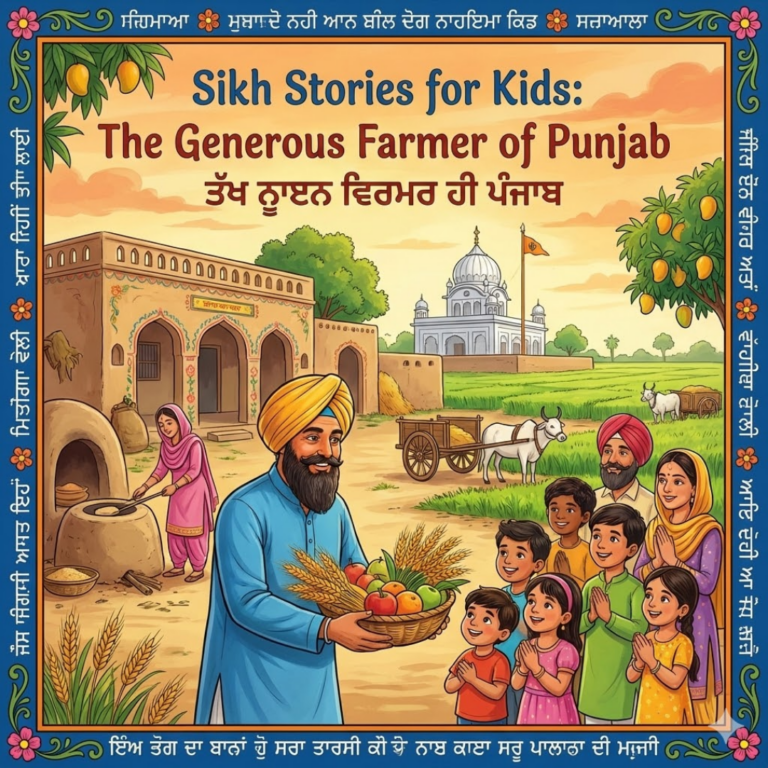
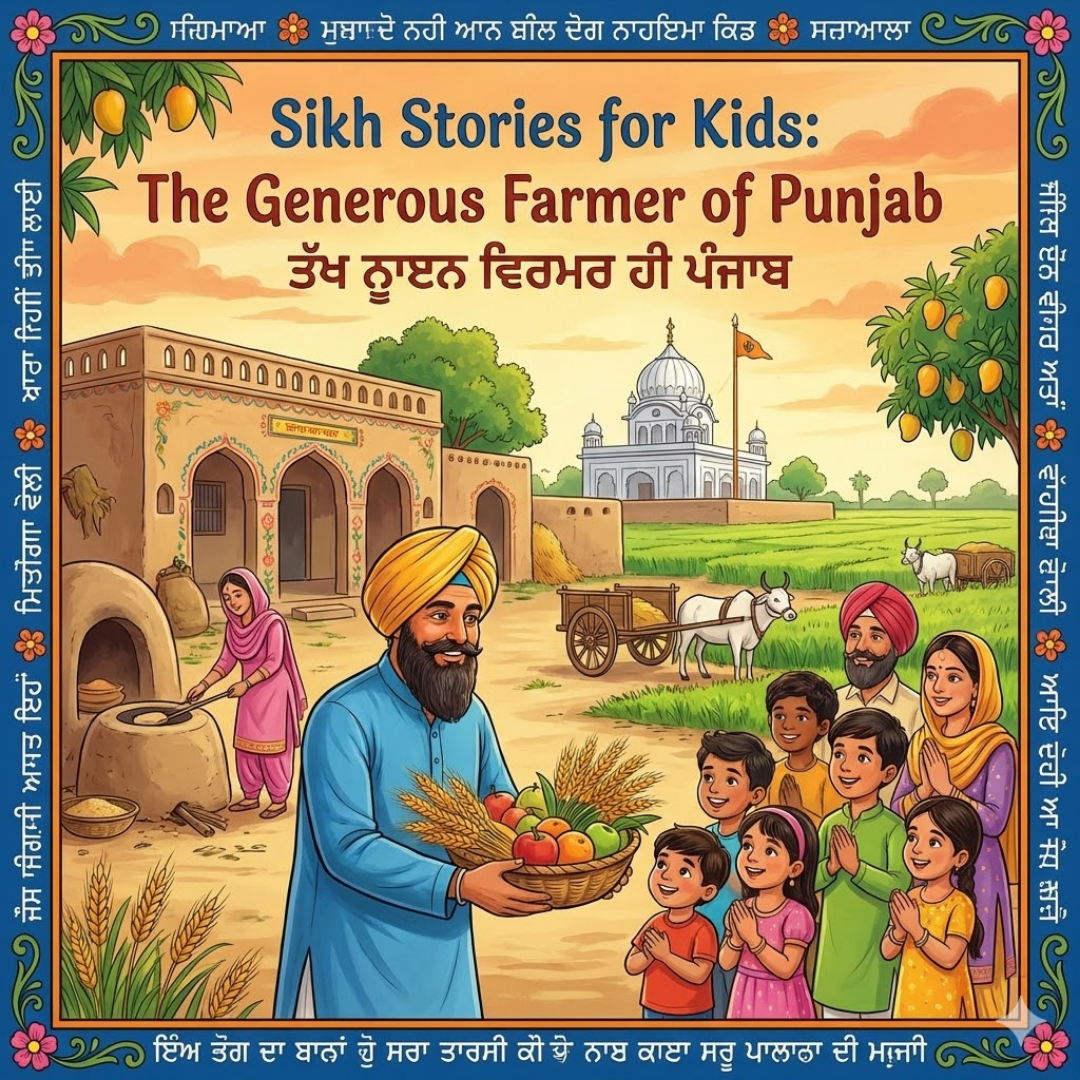
This bedtime story for kids, ‘The Generous Farmer of Punjab’, teaches children ages 6-12 about important moral values.
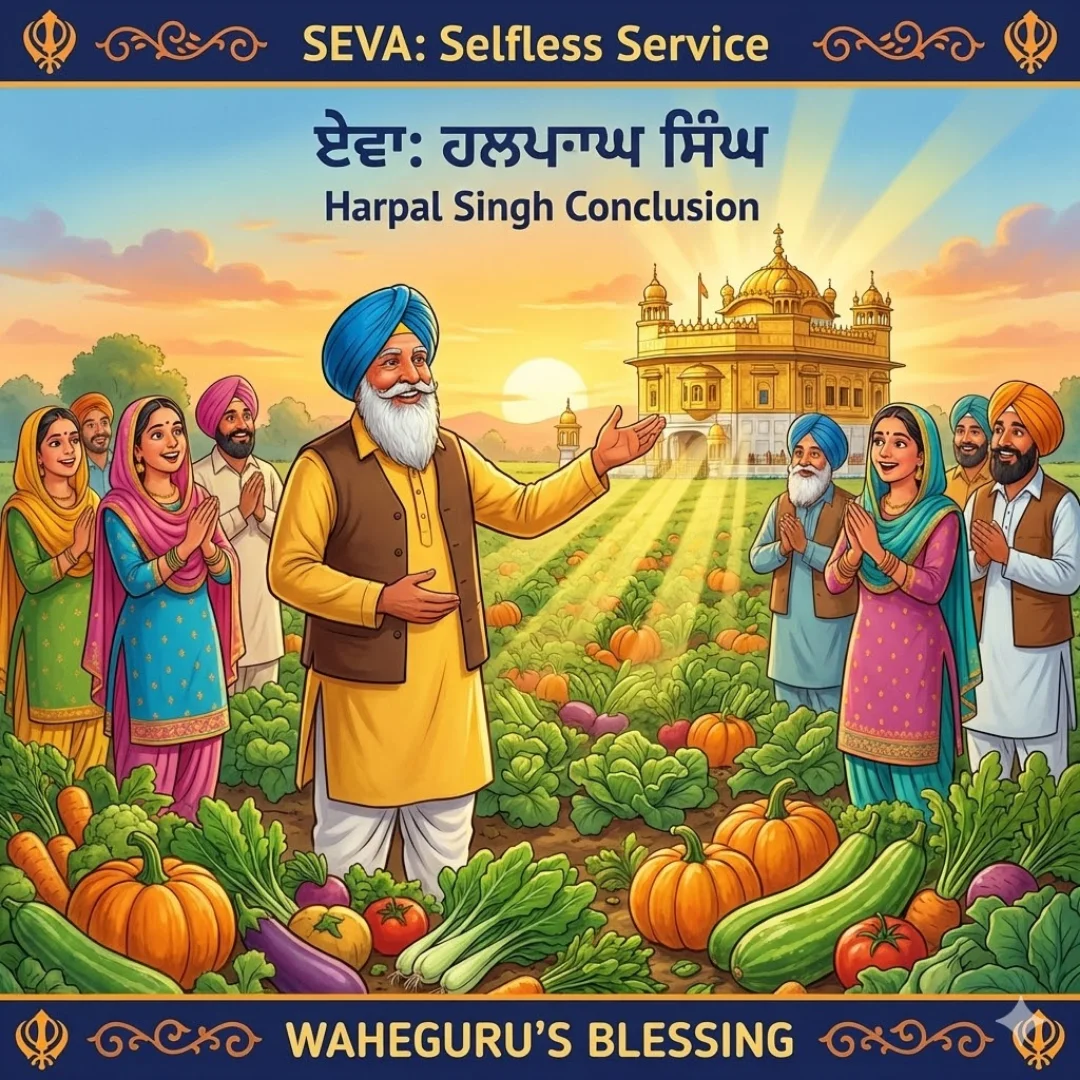
In the fertile lands of Punjab, where rivers run like veins of life through golden fields, there lived a farmer named Harpal Singh.
His land was not the largest in the village. His house was not the finest. But his heart—ah, his heart was vast as the sky.
Every morning, before the sun painted the horizon pink, Harpal Singh would rise from his simple cot. He would wash, dress in clean clothes, and walk to the village Gurdwara—the Sikh house of worship.
There, beneath the golden dome, he would bow before the Guru Granth Sahib, the holy scripture, and recite his prayers:
“Nanak naam chardi kala, tere bhane sarbat da bhala.”
In the name of the One, may there be happiness for all, under Your will.
Then, with peace in his heart, he would walk to his fields to begin the day’s work.
* * *
Harpal Singh’s neighbors often wondered about him.
“Why does he give so much away?” they whispered. “Every harvest, he sets aside a third of his grain for those who have none. Doesn’t he have his own family to feed?”
It was true. While other farmers calculated their profits down to the last rupee, Harpal would fill sacks with wheat and distribute them to widows, orphans, the elderly, anyone who struggled.
“Bhai Harpal,” his neighbor Jaswinder once asked, “don’t you worry about your own future? What if hard times come?”
Harpal smiled, his beard—tied neatly in the Sikh tradition—catching the sunlight.
“My friend,” he said gently, “the Gurus taught us that all we have comes from Waheguru—the Wonderful Lord. We are merely caretakers of these blessings. The true harvest is not what we keep in our granaries, but what we plant in the hearts of others through seva—selfless service.”
He placed his hand on Jaswinder’s shoulder.
“Guru Nanak Dev Ji himself said: ‘Those who have a surplus should share with those who are in need.’ This is not charity, brother. This is dharma—our sacred duty.”
Jaswinder shook his head, not understanding, but respecting Harpal’s conviction nonetheless.
* * *
Then came the year of the great drought.
The monsoon rains, which normally drenched the earth and turned it soft and fertile, did not come.
June passed. July passed. The sky remained a hard, merciless blue.
The sun beat down like a hammer on an anvil, and the earth cracked open, showing wounds of thirst.
Farmers watched helplessly as their crops withered. The wheat that should have stood tall and golden turned brown and brittle. Leaves curled and died. Wells ran dry.
By August, panic had set in.
“What will we eat?” mothers asked, looking at their children with worried eyes.
“How will we survive?” fathers wondered, calculating how long their stored grain would last.
The village that had once been prosperous now faced the specter of famine.
* * *
Harpal Singh’s fields, like everyone else’s, suffered from the drought.
His wheat crop, which normally yielded abundant grain, produced only a fraction of what it should have. Where he usually harvested thirty sacks, this year he harvested only ten.
His wife, Kulwant Kaur, looked at the meager harvest and felt fear grip her heart.
“Husband,” she said quietly that evening, “this is all we have. We must keep it for ourselves and our children. Surely the Gurus would understand.”
Harpal was silent for a long moment, stroking his beard thoughtfully.
Then he said, “Do you remember the story of Guru Nanak and the Sacha Sauda—the True Bargain?”
Kulwant nodded. Of course she knew it. Every Sikh child learned it.
“When Guru Nanak was young,” Harpal continued, “his father gave him money to do business, to make a profit. But on the way to the market, Guru ji met holy men who were starving. He spent all the money feeding them.”
“Yes,” Kulwant said, “and when his father was angry, Guru Nanak said he had made the truest bargain of all—investing in humanity rather than in goods.”
“Exactly,” Harpal said softly. “My dear wife, we face a choice. We can keep these ten sacks and watch our neighbors starve, preserving our own lives at the cost of others. Or we can trust in Waheguru’s will and share what we have, making the ‘sacha sauda’—the true bargain.”
He took her hands in his.
“The Gurus taught us: ‘The highest religion is to rise to universal brotherhood; to consider all creatures as your own self.’ If we abandon this teaching when times are hard, what value does our faith have?”
Kulwant Kaur’s eyes filled with tears—not of sadness, but of pride in her husband’s unwavering faith.
“You are right,” she said. “We will share. Waheguru will provide.”
* * *
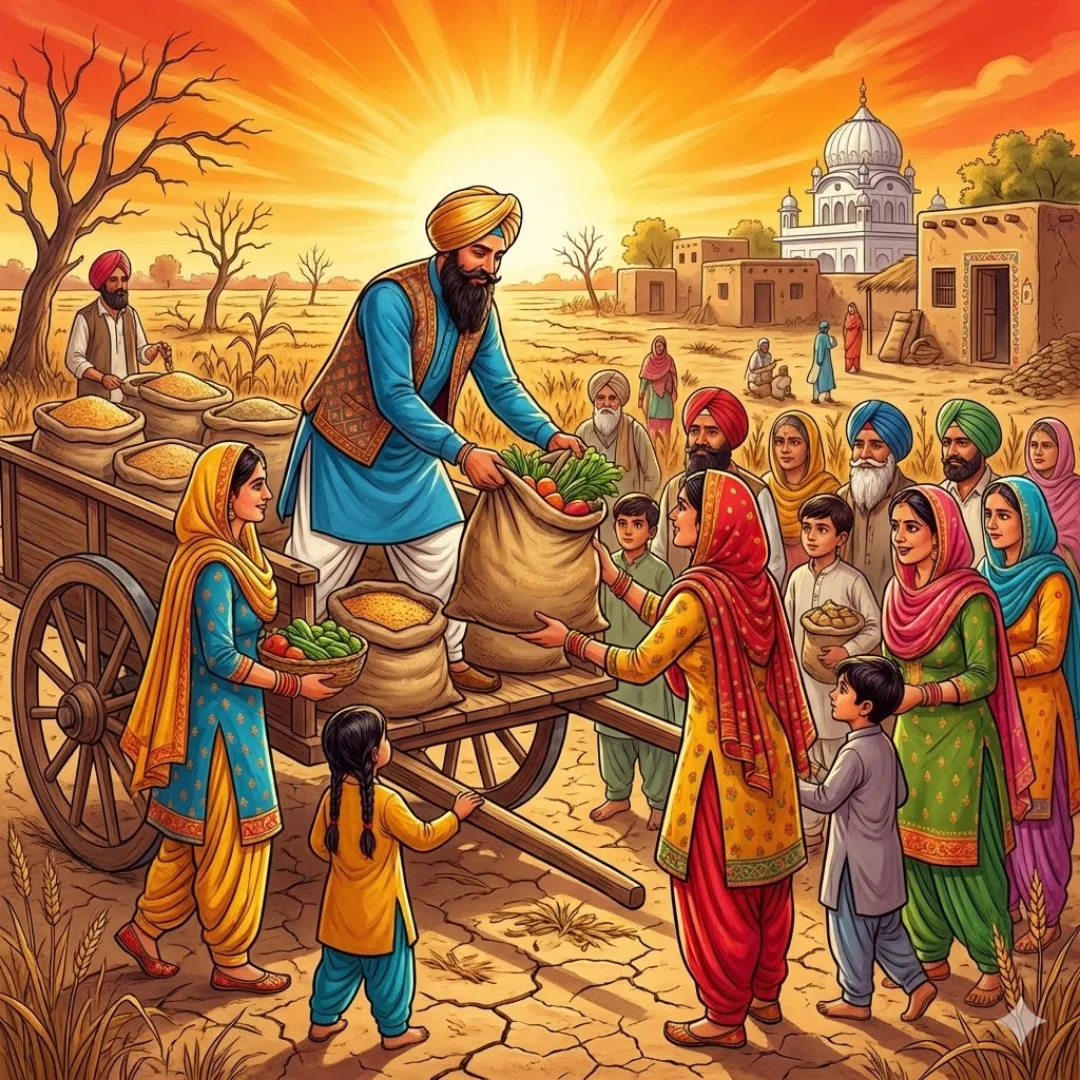
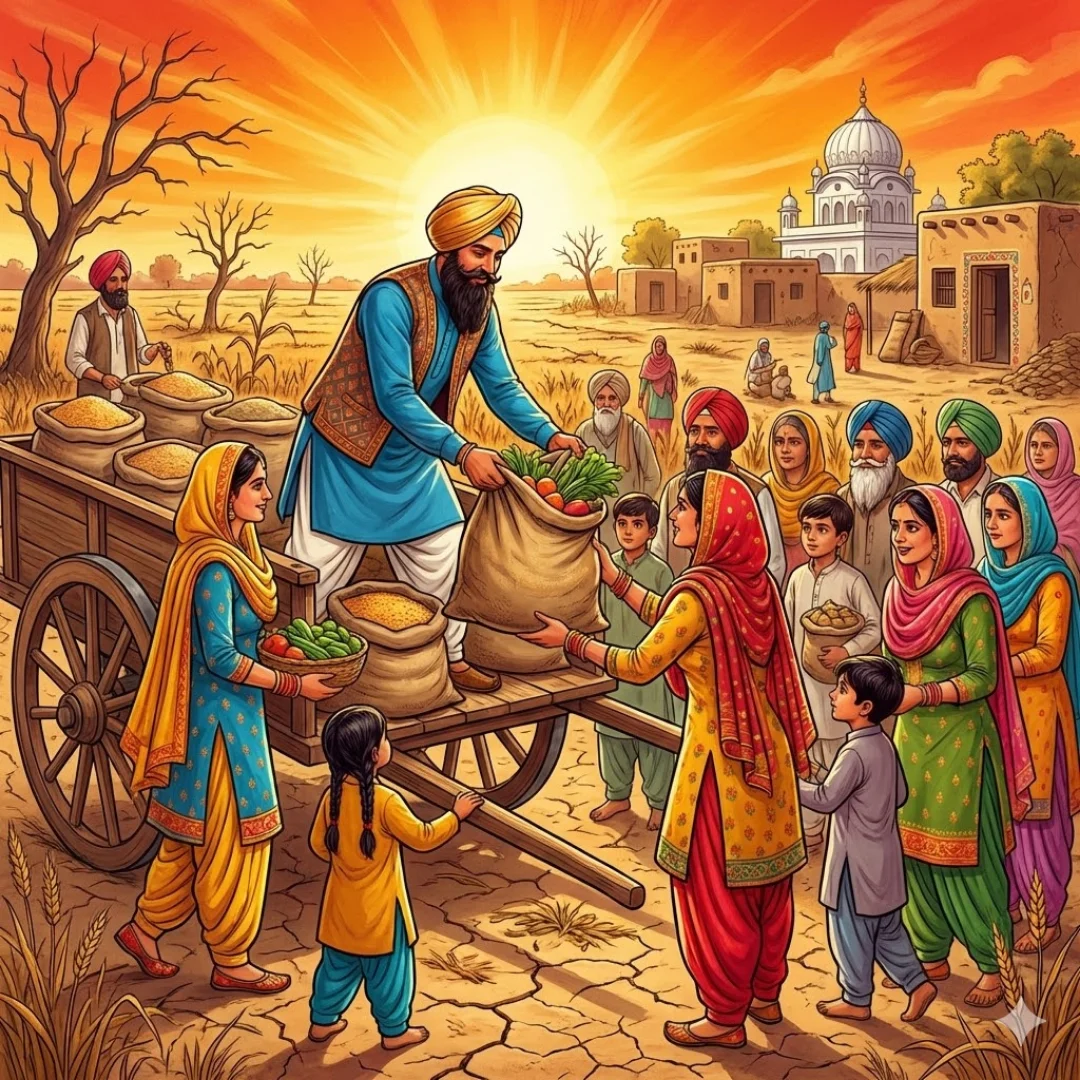
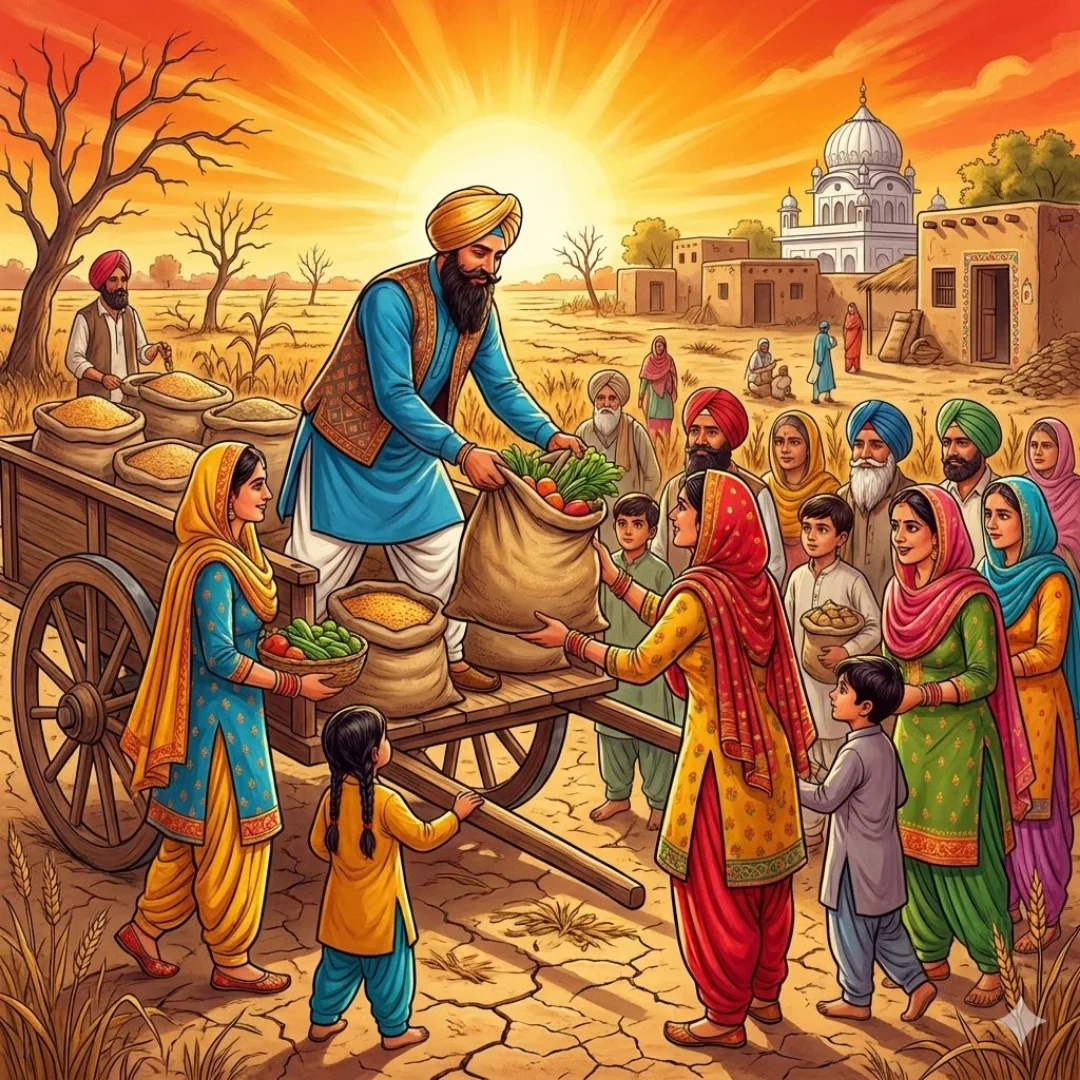
The next morning, to everyone’s astonishment, Harpal Singh began distributing his grain.
He went to the widow Sardarni’s house, whose sons had moved to the city, leaving her alone. He left two sacks at her door.
He went to old Mohan Singh, who was too frail to farm anymore. He left one sack there.
He went to the family of Ram Lal, a laborer with six children. He left two sacks with them.
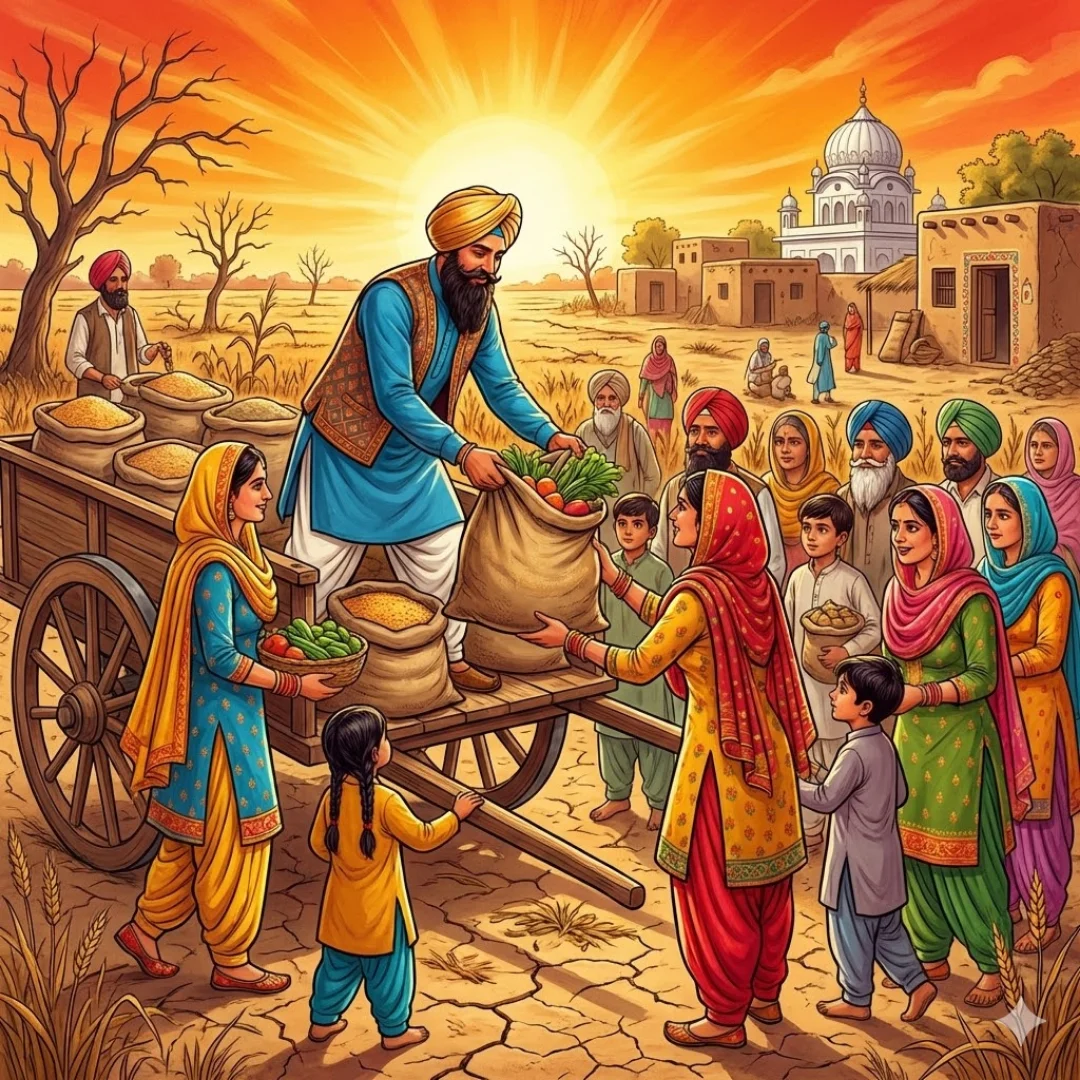
By the time he returned home, he had given away seven of his ten sacks.
The village was stunned.
“Has Harpal Singh gone mad?” people whispered. “He has barely anything, and he gives most of it away?”
But some—those who received the grain—wept with gratitude. They had been facing starvation. Harpal’s gift meant life itself.
* * *
News of Harpal’s generosity spread beyond the village.
It reached the ears of a wealthy Sikh merchant from Amritsar named Gurpreet Singh, who had been traveling through the region assessing the drought’s damage.
Gurpreet Singh had made his fortune in textiles, but he was also a devout Sikh who believed deeply in seva. When he heard about a farmer who had shared his meager harvest during a drought, he was moved.
“I must meet this man,” Gurpreet Singh said.
He arrived at Harpal’s modest farm one evening, dressed simply despite his wealth.
“Sat Sri Akaal, brother,” he greeted Harpal with the traditional Sikh salutation.
“Sat Sri Akaal,” Harpal replied, welcoming the stranger into his home.
Over tea, Gurpreet Singh said, “I have heard about your generosity. In a time when most men hoard what little they have, you share freely. Why?”
Harpal smiled. “I am only following the path shown by our Gurus. They taught us that a Sikh must embody three principles: Naam Japna—remembering God’s name; Kirat Karni—earning an honest living; and Vand Chakna—sharing with others. How can I call myself a Sikh if I abandon Vand Chakna precisely when it is needed most?”
Gurpreet Singh’s eyes glistened with emotion.
“Brother,” he said, “I too try to follow the Guru’s path. I have been blessed with wealth, and I use it to serve others. Your story has shown me the true meaning of seva—it is not about how much you give, but about giving all you can, even when you have little.”
He paused, then continued, “I have connections with traders who have grain stored from last year. I want to help your village. But more than that, I want to help you restore your fields for the next season.”
* * *
What happened next seemed like a miracle, though Harpal knew it was simply the working of Waheguru’s will.
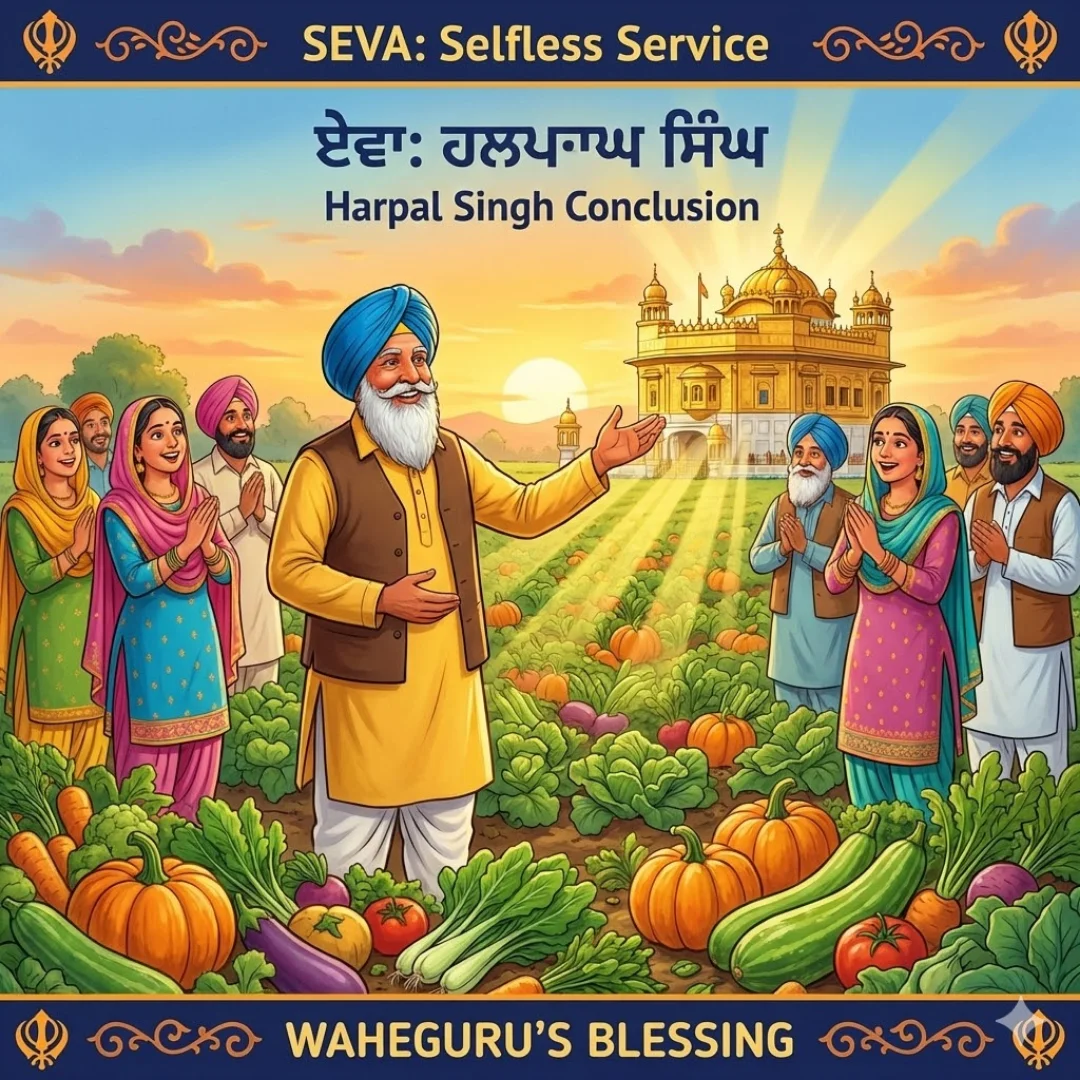
Gurpreet Singh arranged for grain to be transported to the village—enough to feed every family through the drought.
He also provided Harpal with high-quality seeds and resources to prepare for the next planting season.
But he did more than that. He was so inspired by Harpal’s example that he established a permanent langar—a community kitchen—in the village, where anyone could come and eat for free, regardless of their religion or caste, embodying the Sikh principle of equality.
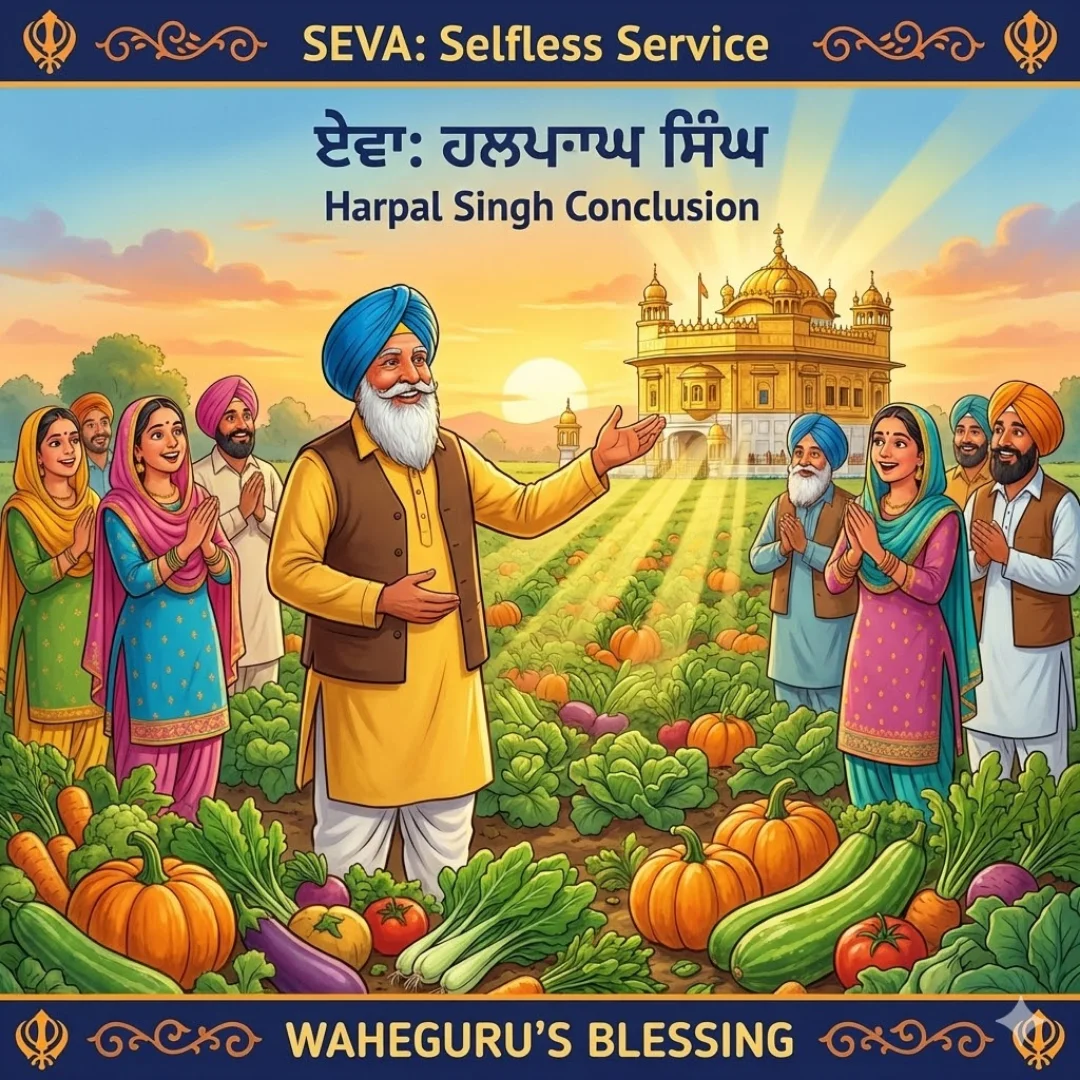
The drought eventually ended. The rains returned. And when they did, Harpal’s fields, enriched by the new seeds and proper preparation, produced the most abundant harvest the village had ever seen.
* * *
Years later, when people spoke of the drought, they remembered two things:
First, they remembered the suffering—the cracked earth, the hunger, the fear.
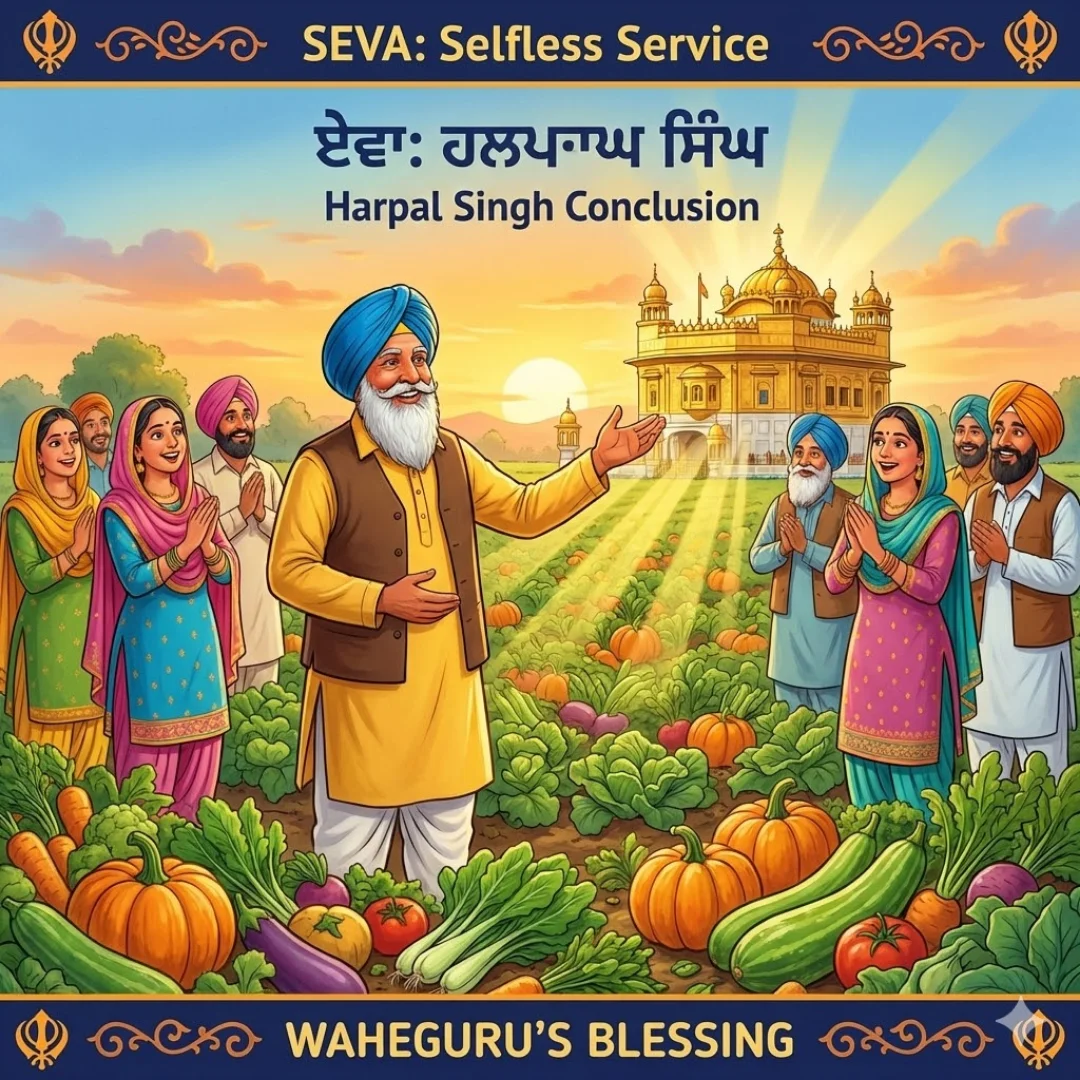
But second, and more importantly, they remembered Harpal Singh’s generosity, and how it had inspired a wealthy merchant to help an entire community.
The langar that Gurpreet Singh established became a gathering place for the village. Rich and poor, Hindu and Sikh, young and old—all sat together on the floor, eating the same simple meal, embodying the principle of equality that Guru Nanak had established centuries before.
And whenever someone new came to the langar and asked about its origins, the villagers would tell them the story of Harpal Singh, the farmer who understood the true harvest.
* * *
Harpal himself remained humble until the end of his days.
When people praised him, he would shake his head.
“I did nothing special,” he would insist. “I only followed the Guru’s teaching. Any Sikh would have done the same.”
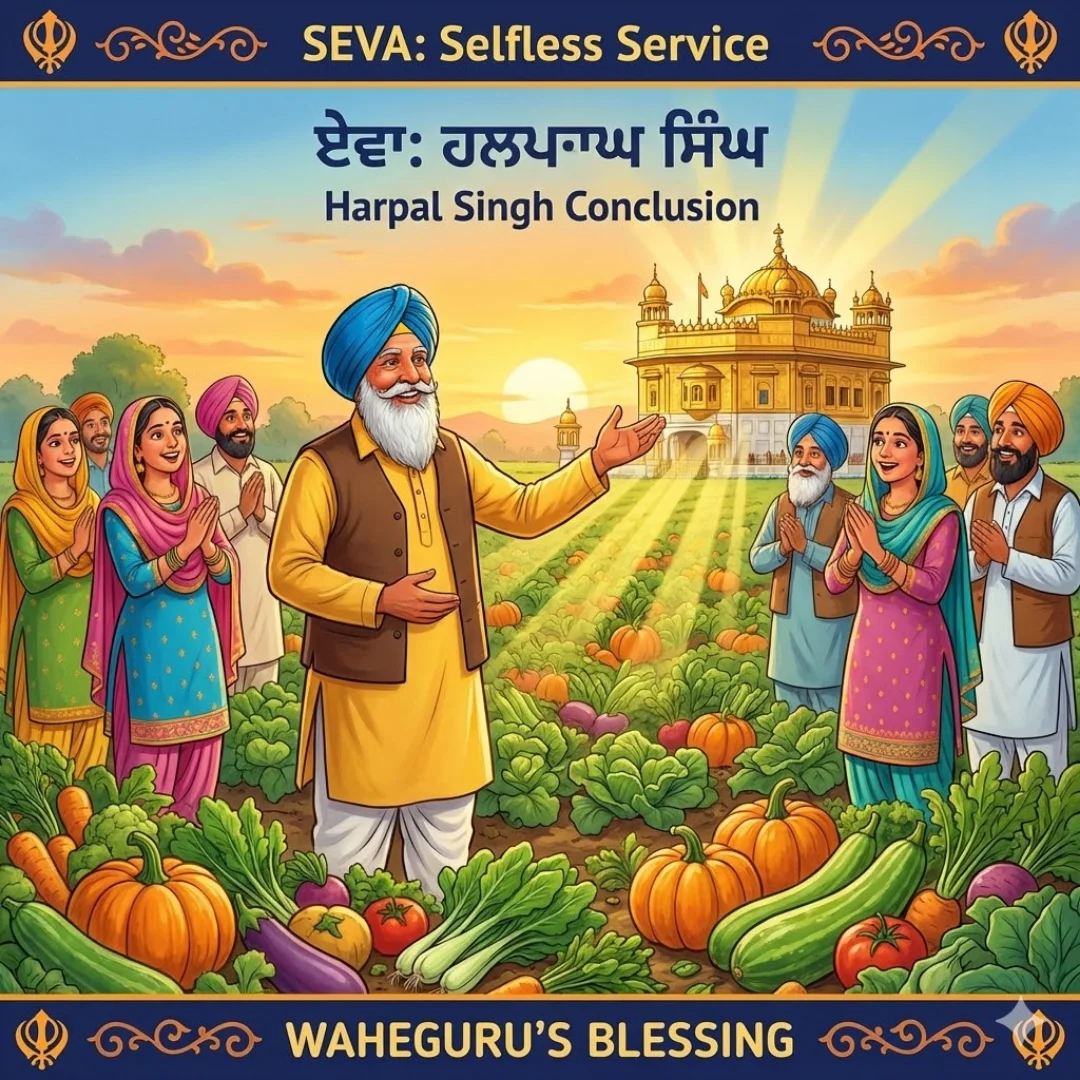
But in his heart, he remembered that moment of choice—when he had ten sacks of grain and a drought-stricken land, and he chose to share rather than hoard.
That choice had not made him poorer. It had made him richer in ways he could never have imagined—richer in community, in purpose, in faith.
The Gurus were right: the true bargain, the Sacha Sauda, was never about accumulating wealth for oneself.
It was about investing in humanity.
It was about recognizing that we are all connected, all part of the same divine creation.
It was about understanding that our highest duty is not self-preservation, but service to others.
This is the path of the Sikh.
This is the meaning of seva.
And this is the lesson that Harpal Singh lived every day of his life:
That the seeds we plant in the hearts of others through kindness and generosity will yield a harvest far greater than any field could produce.
A harvest measured not in sacks of grain, but in love, community, and the knowledge that we have honored the Guru’s teachings.
This is the truest wealth.
This is the eternal harvest.
And this is the path to Waheguru.
MORAL LESSONS:
– True wealth is not what we keep but what we share with others
– Faith is tested most in times of hardship
– Selfless service (seva) to others is a sacred duty
– Generosity inspires generosity in others
– Trust in the divine even when circumstances seem dire
– Community thrives when individuals put others before themselves
– The act of giving enriches the giver as much as the receiver
SIKH PRINCIPLES PRESERVED:
– Seva (selfless service) – core Sikh value
– Vand Chakna (sharing with others) – one of three pillars
– Naam Japna (remembering God’s name) – daily spiritual practice
– Kirat Karni (honest labor) – Harpal works his own farm
– Dasvandh (giving one-tenth, here one-third) – sharing wealth
– Sacha Sauda (True Bargain) – Guru Nanak’s teaching
– Langar (community kitchen) – equality and sharing
– Pangat (sitting together on floor) – breaking caste barriers
– Waheguru (Wonderful Lord) – Sikh name for God
– Guru Granth Sahib – Sikh holy scripture
– Gurdwara – Sikh place of worship
– Sat Sri Akaal – traditional Sikh greeting
CULTURAL ELEMENTS:
– Punjab setting – fertile agricultural land
– Monsoon rains critical for crops
– Traditional Sikh practices (prayers, tied beard, Gurdwara visits)
– Community interconnectedness in village life
– Merchant class supporting religious communities
– Traditional gender roles but showing partnership (Kulwant Kaur’s wisdom)
ENGAGEMENT ENHANCEMENTS:
+ Vivid sensory details (pink horizon, golden dome, cracked earth)
+ Dialogue reveals character and teaches principles naturally
+ Internal conflict (Kulwant’s fear vs faith)
+ Scene breaks for pacing
+ Emotional arc (prosperity → drought → sacrifice → blessing)
+ Show don’t tell (Harpal’s faith shown through actions)
+ Relatable human concerns (fear for family)
+ Satisfying resolution that feels earned, not miraculous
+ Connection to historical Guru Nanak story
SOURCES:
– [Langar – SikhiWiki](https://www.sikhiwiki.org/index.php/Langar)
– [Traditions of giving in Sikhism](https://www.alliancemagazine.org/analysis/traditions-of-giving-in-sikhism/)
– [Seva (Selfless Service) in Sikhism](https://www.sikhmissionarysociety.org/sms/smssikhism/institutions/seva/)
– [Guru Ka Langar: The Sikh Ethos of Sharing Hospitality](https://parliamentofreligions.org/articles/guru-ka-langar-the-sikh-ethos-of-sharing-hospitality/)
– Guru Nanak’s “Sacha Sauda” (True Bargain) teaching
Test Your Understanding
1. What Sikh practice did Harpal Singh follow with his harvest?
Frequently Asked Questions
What is the moral lesson of The Generous Farmer of Punjab?
What age is this story appropriate for?
How long does it take to read The Generous Farmer of Punjab?
What culture does this story come from?
Can I use this story for teaching?
Frequently Asked Questions
What age group is this bedtime story for kids appropriate for?
This moral story about the generous farmer is designed for children ages 6-12. The content is gentle and age-appropriate, focusing on positive values like generosity and kindness without any scary or complex themes that might upset younger children.
What moral lesson does The Generous Farmer of Punjab teach children?
This story teaches kids about the importance of generosity and sharing with others, even when you don’t have much yourself. Through Harpal Singh’s example, children learn that true wealth comes from having a generous heart and helping your community.
Is this a true story or a fictional tale about Punjab?
This is a fictional moral story inspired by traditional Sikh values and Punjab’s agricultural culture. While Harpal Singh is not a real person, the story authentically reflects the generous spirit and community values found in Punjabi and Sikh traditions.
📚 Recommended Books
Handpicked for readers like you
As an Amazon Associate, we earn from qualifying purchases. These recommendations are personalized based on this story's themes and your reading history.
What can kids learn about Sikh culture from this bedtime story?
Children discover important Sikh practices like visiting the Gurdwara (place of worship), reciting prayers from the Guru Granth Sahib, and the core principle of ‘sarbat da bhala’ – working for everyone’s well-being. It introduces kids to Sikh values in an engaging way.
How long does it take to read this story to children?
This bedtime story typically takes 8-10 minutes to read aloud at a comfortable pace for children. It’s the perfect length for a calming bedtime routine that leaves kids with positive thoughts about kindness and generosity before sleep.
