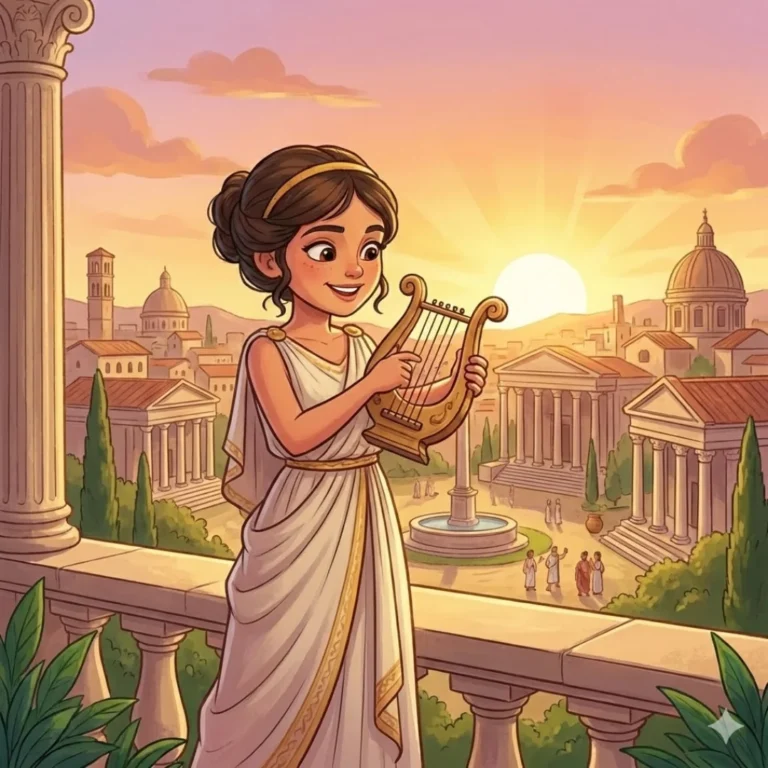
In the heart of ancient Greece, where olive groves climbed sun-warmed hillsides and marble temples gleamed white against the endless blue sky, there lived a king named Midas. His palace rose proud upon a hill, its columns carved from the finest stone, its gardens fragrant with roses and honeysuckle. Yet for all his wealth and power, King Midas wanted more.
The king spent his days in his treasure chamber, a cool underground room where golden coins cascaded through his fingers like water. He would lift a golden cup, turn it in the lamplight, and sigh with pleasure at its weight and shine. His young daughter Marigold often stood in the doorway, watching with concerned eyes.
“Father, won’t you come play with me in the garden?” she asked one bright morning. Her voice was like birdsong, light and hopeful. “The roses are blooming, and I’ve made a crown of daisies for you!”
Midas barely glanced up from counting his coins. “Not now, my dear. Can’t you see how important this is? These golden drachmas must be sorted and counted. Besides,” he added, running his hands through a pile of coins, “nothing is more beautiful than gold.”
Marigold’s smile faltered like a flower in shadow. She held up the daisy crown she’d woven with such care, but her father had already turned back to his treasure. The little princess walked slowly from the chamber, leaving the crown on a marble bench.
That evening, as purple twilight settled over the palace like a velvet cloak, a stranger appeared in Midas’s treasure chamber. He materialized from nothing, as if the very shadows had taken form. The figure glowed with a strange inner light, and when he moved, his robes rippled like liquid gold.
“King Midas,” the stranger said, his voice carrying the weight of distant thunder. “I am a messenger of the gods. Your devotion to gold has been noticed on Mount Olympus.”
Midas dropped to one knee, his heart hammering. He recognized this being Dionysus, god of wine and celebration, who sometimes walked among mortals. “Great Dionysus! I am honored beyond measure!”
The god’s eyes, dark as wine and twice as deep, studied the king. “You once showed kindness to my companion Silenus when he lost his way. For this service, I shall grant you one wish. Choose carefully, King of Phrygia.”
Midas did not hesitate. The words tumbled from his lips like coins from an overturned chest. “I wish that everything I touch would turn to gold!”
Dionysus raised an eyebrow. “Everything, mortal? Are you certain? Think of what ‘everything’ means.”
But Midas’s eyes gleamed with greedy light. “Everything! Just imagine the wealth! I would be the richest man who ever lived!”
The god sighed, a sound like wind through dying leaves. “Very well. At sunrise tomorrow, your wish shall be granted. May you find what you seek, King Midas.” With those words, Dionysus vanished, leaving only the faint scent of grapes and something sharper worry, perhaps, or warning.
Midas could barely sleep that night. He tossed and turned in his royal bed, imagining all the wonders he would create. Golden furniture! Golden walls! A golden kingdom that would shine like a second sun!
When dawn’s rosy fingers painted the eastern sky, Midas leaped from his bed. His hand brushed the bedpost, and wonder of wonders it transformed instantly into pure, gleaming gold! The king laughed aloud, a sound of pure triumph that echoed through the palace halls.
He rushed about his chambers like a child on a festival day, touching everything. The wooden chair became gold. The earthen water jug became gold. His royal robes, the window curtains, even the flowers in the vase all transformed at his touch into precious metal.
“I’m the richest man alive!” Midas cried, dancing with joy. “The whole world shall envy King Midas!”
He hurried down to his garden, touching tree after tree. The ancient olive tree that had shaded three generations became a golden sculpture, its leaves frozen in metal. The roses along the path turned to gold beneath his fingers, their soft petals now hard and cold, unable to release their perfume.
But Midas noticed none of this. He saw only gold, gold, and more gold.
By mid-morning, hunger gnawed at the king’s stomach. He called for breakfast, and servants brought a magnificent feast grapes purple as twilight, fresh bread golden-brown and steaming, cheese white as mountain snow, honey that glowed amber in the sunlight.
Midas reached for a grape. The moment his fingers touched it, the fruit hardened into a golden orb. He tried the bread same result. The cheese, the honey, even the wine in his cup all turned to gold the instant he touched them.
The king’s laughter died in his throat. He tried again and again, but every morsel became inedible metal. For the first time, a cold finger of fear traced down his spine.
“Perhaps I need to be more careful,” he muttered, though his voice trembled. “I’ll use a fork, I’ll”
But the fork turned to gold in his hand. The plate beneath his food became gold. Everything, everything he touched transformed.
“Father! Father!”
Midas turned at the sound of his daughter’s voice. Marigold ran toward him across the garden, her arms outstretched, her face lit with the joy of seeing him outside in the sunshine at last.
“Don’t come closer!” Midas shouted, backing away. But in her excitement, Marigold didn’t hear or didn’t understand. She rushed forward and threw her arms around her father’s waist.
The transformation happened in a heartbeat.
Marigold’s warm skin turned cold and hard. Her joyful laugh cut off mid-breath. Her dancing eyes became fixed and still. In Midas’s horrified arms stood not his beloved daughter, but a golden statue, frozen forever in an embrace of love.
“No,” Midas whispered. Then louder, “No! NO!” His anguished cry rose to the heavens, a sound of such pure grief that birds fell silent and the wind itself seemed to pause.
The king fell to his knees, tears streaming down his face. He wanted to hold his daughter, to somehow bring her back, but he dared not touch the golden statue. Everything he had wished for, everything he had thought he wanted, meant nothing compared to the precious child he had lost.
“Dionysus!” Midas cried out, his voice raw with desperation. “Please! I was a fool! I beg you, take back this cursed gift! I would live in poverty, I would lose everything I own, if only I could have my daughter back!”
The air shimmered, and once again the god appeared. But this time his expression was not stern it was sad, like a teacher watching a student learn a painful lesson.
“Do you understand now, King Midas?” Dionysus asked gently. “Do you see what you have learned?”
“Gold is worthless,” Midas sobbed. “I cannot eat it, I cannot hold what I love, I cannot enjoy the world’s beauty. I was richer before, when I had simple food and my daughter’s laughter. Please, I beg you help me!”
Dionysus nodded slowly. “You have learned wisdom, though the price was high. Go to the River Pactolus, where it springs from the mountain. Wash yourself in its waters at sunrise, and your golden touch will flow away into the river. Then gather water and sprinkle it on all you wish to restore.”
“Thank you!” Midas scrambled to his feet. “Thank you, merciful Dionysus!”
The god raised a warning hand. “Remember this lesson, Midas. True wealth cannot be held in your hands. It lives in laughter and love, in the taste of fresh bread and the scent of roses, in the warmth of an embrace and the beauty of a world that is alive, not frozen in metal.”
Before dawn the next day, Midas stood knee-deep in the River Pactolus, watching the eastern sky pale from black to gray to rose-gold. When the first ray of sunlight touched the water, he plunged himself beneath the surface.
The cold water rushed over him, and with it flowed away the terrible curse. He felt it leave him like a fever breaking, like a heavy weight lifting from his shoulders. When he emerged, gasping and shivering, his hands were merely hands again human, mortal, blessedly ordinary.
(Legend says that from that day forward, the River Pactolus carried gold dust in its waters, and people panned it for centuries afterward, finding tiny flakes of gold a reminder of King Midas and his terrible wish.)
With trembling hands, Midas filled a clay pitcher with river water and ran back to his palace. He sprinkled water on the golden statue of Marigold, praying to every god he knew.
The gold shimmered, faded, and suddenly Marigold gasped and stumbled forward, alive and warm and confused.
“Father? What happened? I feel so strange, like I was having a very odd dream…”
Midas caught her in his arms, weeping openly now, but with tears of joy. He held her close, feeling her heartbeat, her warmth, her precious life.
“I’m sorry,” he whispered into her hair. “I’m so sorry, my dearest treasure. I almost lost you because I was too blind to see that I had already found the greatest wealth in the world.”
From that day forward, King Midas was a changed man. He gave away much of his gold to help the poor. He spent his days with Marigold, playing in the garden, watching roses bloom and fade, enjoying simple meals of bread and fruit. He would sometimes stop and touch a flower just to feel its softness, or hold a cup of water to his lips and marvel at the miracle of being able to drink.
And whenever Marigold made him a crown of daisies, he would wear it all day long, proclaiming it more valuable than any golden crown ever forged.
For Midas had learned what so many must learn: that the greatest treasures in life cannot be bought or made or touched with golden hands. They must be lived, and felt, and cherished while they are here with us, warm and alive and infinitely more precious than all the gold in all the world.
Moral of the Story
True wealth is found not in gold or possessions, but in the love of family, the beauty of nature, and the simple joys of being alive. Greed blinds us to the treasures we already have, and what we can touch with our hands is far less valuable than what we can hold in our hearts.
Learn These Words
- drachmas
- ancient Greek silver coins that were used as money throughout Greece
- Dionysus
- the Greek god of wine, celebration, and theater, known for granting wishes and bringing joy
- Phrygia
- an ancient kingdom in what is now Turkey, where King Midas ruled
- Mount Olympus
- the highest mountain in Greece, believed to be home of the gods in Greek mythology
- mortal
- a human being who can die, as opposed to immortal gods who live forever
- Pactolus
- a river in ancient Greece famous for having gold in its waters, connected to the Midas legend
Test Your Understanding
1What was King Midas’s greatest desire at the beginning of the story?
2Who granted King Midas his wish?
3What happened FIRST after Midas got his golden touch?
4What is the main lesson this story teaches?
5How did Midas break the curse of the golden touch?
Frequently Asked Questions
What is the moral lesson of The Golden Touch of King Midas?
What age is this story appropriate for?
How long does it take to read The Golden Touch of King Midas?
What culture does this story come from?
Can I use this story for teaching?
Frequently Asked Questions
What is the story of King Midas and his golden touch?
King Midas is a tale from ancient Greece about a king who loved gold above all else. He is granted a wish that everything he touches turns to gold. While this sounds wonderful at first, the gift quickly becomes a curse when it affects the people and things he loves most, teaching him a powerful lesson about greed and what truly matters in life.
What is the moral lesson of the King Midas story?
The King Midas story teaches children that greed and the obsessive love of wealth can lead to unhappiness and loss. True happiness comes not from material riches but from love, family, and the simple joys of life. Midas learns this the hard way when his golden touch threatens what he cherishes most.
Who is Marigold in the King Midas story?
Marigold is King Midas’s young daughter. She represents love, innocence, and joy in the story. While her father obsesses over gold in his treasure chamber, Marigold tries to connect with him by playing in the garden and making daisy crowns. She plays a central role in helping Midas understand what is truly precious.
📚 Recommended Books
Handpicked for readers like you
As an Amazon Associate, we earn from qualifying purchases. These recommendations are personalized based on this story's themes and your reading history.
Is the King Midas story suitable for kids?
Yes, the King Midas story is a classic tale perfectly suited for children. It uses vivid imagery, relatable characters, and a clear moral message to engage young readers. The story gently teaches kids about the dangers of greed and the importance of valuing people over possessions, making it ideal for bedtime reading or classroom use.
Where does the King Midas myth originally come from?
The King Midas myth originates from ancient Greece and is one of the most well-known stories in Greek mythology. It has been retold for thousands of years across different cultures. The tale is often associated with the god Dionysus, who grants Midas his famous wish. It remains a popular moral story for children and adults alike.