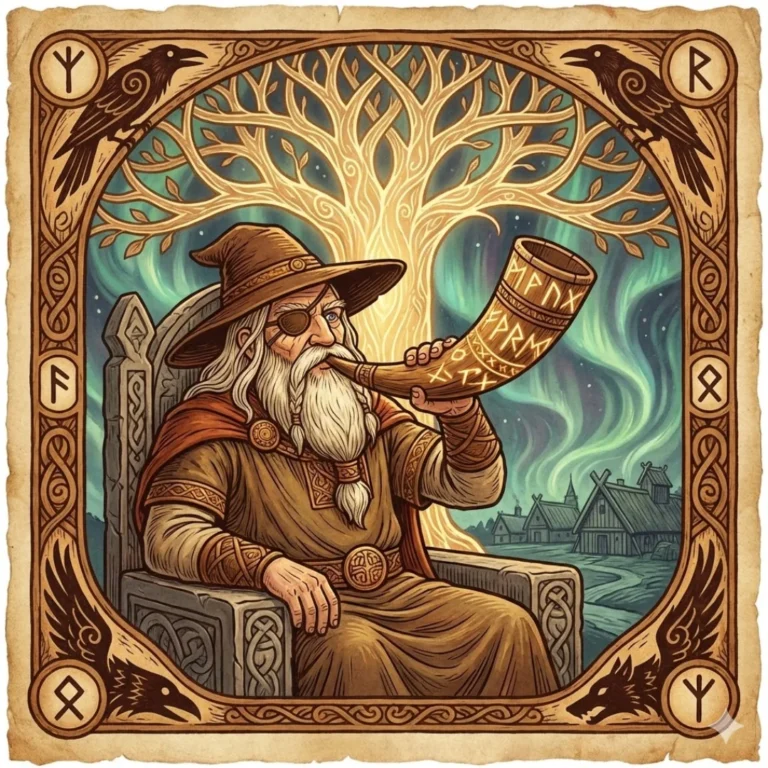
When the wisest being, Kvasir, is killed by greedy dwarves who turn his blood into a magical mead, Odin risks everything to retrieve it. Through cleverness and sacrifice, he brings the Mead of Poetry to the gods, teaching that true wisdom must be shared, not hoarded.
In the time before time had a name, when gods still walked the earth and mountains were young, there lived a being called Kvasir. He was born from peace itself from the mingled spit of two warring tribes of gods who finally made peace.
Kvasir was the wisest creature who ever lived. Every question found an answer in his mind. Every riddle unfolded like a flower at dawn. He traveled the nine worlds freely, sharing his knowledge with anyone who asked, from the smallest farmer to the mightiest king.
“Tell me, wise Kvasir,” a young shepherd once asked as they sat beside a mountain stream, “why does the water always flow downward?”
Kvasir smiled, his eyes reflecting the dancing water. “Because the earth calls to it, just as knowledge flows naturally to those who seek it with open hearts.”
The shepherd nodded slowly, understanding more than just the answer. This was Kvasir’s gift he didn’t just share facts, he taught people how to think.
But not everyone wanted knowledge for noble reasons.
Two dwarf brothers, Fjalar and Galar, lived in a dark cave beneath the mountains. They were clever with their hands, crafting beautiful things from metal and stone. But their hearts were twisted with envy. When they heard of Kvasir’s wisdom, they didn’t feel wonder. They felt greed.
“Why should he give knowledge away freely?” Fjalar muttered, hammering at his forge. The sparks flew like angry fireflies. “Knowledge is power. Power should be kept, not shared.”
“We could take his wisdom for ourselves,” Galar whispered, his eyes gleaming in the forge-light. “Make it ours alone.”
So they invited Kvasir to their cave, pretending they had questions only he could answer. Trusting as sunlight, Kvasir came. And there, in the darkness beneath the earth, the wicked brothers killed him.
They caught his blood in three vessels: two jars called Son and Bodn, and a great cauldron named Odrerir. Then they did something strange and terrible. They mixed the blood with honey from the mountain bees, creating a golden mead that bubbled and glowed with inner light.
Whoever drank this Mead of Poetry would become a great poet and scholar, filled with wisdom and eloquence. But the dwarves kept it hidden, gloating over their prize like dragons over gold.
“Now wisdom belongs to us,” they whispered in the darkness.
But wickedness has a way of calling to more wickedness.
The giant Suttungr had lost his parents to the dwarves’ cruelty. When he discovered what they had done, rage filled him like a winter storm. He carried the dwarf brothers to a reef that would be covered when the tide came in.
“The sea will judge you as you judged others,” Suttungr growled, his voice like grinding stones.
As the cold water rose around their ankles, then their knees, then their chests, the dwarves cried out in fear.
“Mercy! Mercy, great Suttungr! We will give you anything!”
“What could you possibly have that I would want?” the giant asked.
“The Mead of Poetry! The wisdom of Kvasir himself! It’s yours, only spare us!”
Suttungr’s eyes narrowed. Wisdom was valuable, perhaps valuable enough to trade for these wretched lives. He took the mead and let the dwarves scurry away like wet rats.
But Suttungr was no better than the dwarves. He hid the mead deep inside a mountain, with his daughter Gunnlod as its guardian. “Let no one drink even a drop,” he commanded. “This treasure is ours alone.”
Gunnlod was different from her father. She was lonely in the mountain, with only the glowing vessels for company. Sometimes she would open the jars just to smell the sweet mead, and she would feel Kvasir’s wisdom brush against her mind like a gentle bird.
Far away in Asgard, Odin the All-Father heard whispers of the mead. Odin was already wise he had traded one of his eyes for wisdom, hung himself from the World Tree for nine days and nights to learn the runes. But he knew that wisdom was not something you earned once and kept forever. Wisdom was a journey without end, a hunger that grew stronger the more you fed it.
“This mead should not be locked away,” Odin said to the ravens on his shoulders, Huginn and Muninn. “Kvasir shared his wisdom freely. This mead should do the same.”
“But how will you get it?” asked Huginn, Thought.
“Suttungr will never give it willingly,” added Muninn, Memory.
Odin smiled, and there was something of the trickster in that smile. “Then I must be clever.”
He disguised himself as a wanderer named Bolverk, which means “worker of evil” or “troublemaker.” Sometimes you must walk through shadows to bring back light.
Bolverk traveled to the lands near Suttungr’s mountain, where he found nine farmhands trying to sharpen their scythes. They were having a terrible time of it, arguing and complaining.
“Let me help,” Bolverk said, pulling out a whetstone from his pack. The stone was magical, sharpening any blade to perfection with just one stroke.
The farmhands marveled at their newly sharp scythes. They all wanted the whetstone at once, grabbing and pulling and fighting over it. In the chaos, they accidentally hurt each other so badly that none could continue working.
Bolverk went to Baugi, the farm’s owner and Suttungr’s brother. “I heard you lost your workers,” he said sympathetically. “I can do the work of nine men. One summer of labor, and all I ask in return is a single sip of your brother’s famous mead.”
Baugi frowned. “My brother guards that mead jealously. But if you truly can do the work of nine men, I’ll try to help you.”
All summer, Bolverk labored in the fields. He was as good as his word, working with the strength of nine. The crops were harvested perfectly, the animals tended, the barns repaired. When autumn painted the leaves gold and red, Baugi had to admit he owed Bolverk his payment.
But when they went to Suttungr, the giant roared with anger. “Not one drop! That mead is mine! Brother or no brother, I will share with no one!”
Baugi shrugged helplessly. “I tried, wanderer. I cannot give you what my brother refuses.”
“Then help me take what was promised,” Bolverk said quietly. “Or break your word and lose your honor.”
Baugi thought about this. He was not a good man, but he was not as bad as his brother. A promise made should be a promise kept. “What would you have me do?”
“Drill a hole into the mountain. That’s all.”
So Baugi took his auger and drilled into the stone, boring deep into the mountain’s heart. When he said the hole was finished, Bolverk didn’t trust him. He blew into it, and dust came back in his face. Baugi had tried to trick him.
“Deeper,” Bolverk said firmly.
Shamefaced, Baugi drilled deeper. This time, when Bolverk blew, the air flowed through. The hole was complete.
In an instant, Bolverk transformed into a snake and slithered through the hole before Baugi could stop him. Down through stone and darkness he went, until he emerged in a great chamber lit by the golden glow of three vessels.
Gunnlod sat beside them, and when she saw the serpent transform into a man, she gasped but did not scream. She had been alone so long, and this stranger had kind eyes, even if one was missing.
“Who are you?” she asked.
“A seeker,” Odin said, letting his disguise fall away. “I am Odin, and I seek the wisdom that should belong to all, not be hidden in darkness.”
Gunnlod looked at the vessels, then back at Odin. “My father commanded me to let no one drink.”
“And do you think that is right?” Odin asked gently. “I can feel Kvasir’s spirit in this mead. He shared his wisdom freely, traveling wherever he was needed. Would he want his knowledge locked away?”
For three days and three nights, Odin stayed with Gunnlod. He told her stories of the nine worlds, of brave heroes and tragic loves, of the great World Tree and the well of memory. He taught her poems and songs, shared riddles and wisdom.
Gunnlod’s loneliness melted like snow in spring. This was what the mead was supposed to do bring people together, teach and inspire, create beauty through words.
On the third night, she made her decision. “Kvasir would want his gift shared,” she said. “Take three drinks, Odin All-Father. Three drinks for three nights of wisdom shared.”
Odin thanked her gravely. He lifted the first vessel and drank but his drinks were not dainty sips. With the first drink, he drained the entire cauldron Odrerir. With the second, he emptied Son. With the third, he finished Bodn. All the mead was gone, held now in Odin’s belly.
Gunnlod’s eyes widened. “You tricked me.”
“No,” Odin said softly. “You chose freely to share what should never have been hoarded. Thank you for your courage.”
Then he transformed into an eagle and shot up through the hole, just as Suttungr burst into the chamber. The giant roared and became an eagle too, chasing after the thief who had stolen his treasure.
Across the sky they raced, two eagles dark against the clouds. Odin was faster, driven by purpose, but Suttungr was close behind, driven by rage. In his haste, Odin spilled some of the mead from his beak. It fell to earth, and wherever it landed, people found they could make poetry badly, awkwardly, without skill.
This is the gift of bad poetry that anyone can write, but few can master.
But the true Mead of Poetry, the wisdom of Kvasir refined by honey and time, Odin brought safely to Asgard. He landed in the hall of the gods and spat the mead into great vessels.
“From this day forward,” Odin declared, “this mead shall be shared with the worthy. Not hoarded by the greedy, not locked away by the selfish, but given to poets and scholars, storytellers and teachers those who will use it to enlighten others, as Kvasir did.”
And so it was. From that day, whenever a mortal spoke with great eloquence, whenever a poet crafted verses that made people weep or laugh, whenever a storyteller held an audience spellbound, people would say, “They must have tasted Odin’s mead.”
But the story teaches us something deeper. Odin already had wisdom he had sacrificed much to gain it. Yet he risked everything for this mead. Why? Because he understood that wisdom grows when it is shared, that knowledge locked away becomes stagnant, that truth hidden in darkness serves no one.
The dwarves wanted wisdom for power. Suttungr wanted it for possession. Only Gunnlod and Odin understood that wisdom is not something you own, but something you must pass on, like a torch lighting other torches, so the world grows brighter and brighter.
And perhaps that is the greatest wisdom of all: that what we freely give away is never truly lost, but instead multiplies and grows, enriching everyone it touches, forever.
Test Your Understanding
1Who was Kvasir and what made him special?
2Why did the dwarf brothers Fjalar and Galar kill Kvasir?
3What did Odin disguise himself as to get near Suttungr’s mountain?
4How did Odin finally reach the mead inside the mountain?
5What is the main lesson of this story?
Frequently Asked Questions
What is the moral lesson of The Mead of Poetry: How Odin Gained Wisdom?
What age is this story appropriate for?
How long does it take to read The Mead of Poetry: How Odin Gained Wisdom?
What culture does this story come from?
Can I use this story for teaching?
Frequently Asked Questions
What is the Mead of Poetry in Norse mythology?
The Mead of Poetry is a magical drink made from the blood of Kvasir, the wisest being in Norse mythology, mixed with honey by the dwarves who killed him. Anyone who drank it gained the gift of wisdom, poetry, and knowledge. Odin risked everything to retrieve it and share it with the gods.
How did Odin gain wisdom through the Mead of Poetry?
Odin used cleverness, disguise, and personal sacrifice to steal the Mead of Poetry from the giants who had taken it from the dwarves. By bringing it back to the gods rather than keeping it for himself, Odin demonstrated that true wisdom grows when it is shared, not hoarded.
Who was Kvasir and why was he so important?
Kvasir was a being born from the combined saliva of two warring tribes of gods when they made peace. He was considered the wisest creature alive, freely traveling the nine worlds and answering any question asked of him. His murder by greedy dwarves set the events of the Mead of Poetry story in motion.
📚 Recommended Books
Handpicked for readers like you
As an Amazon Associate, we earn from qualifying purchases. These recommendations are personalized based on this story's themes and your reading history.
What is the moral lesson of the Mead of Poetry story?
The central lesson is that wisdom should be shared freely, not hoarded for personal gain. Kvasir freely shared his knowledge with everyone he met, while the greedy dwarves and giants tried to keep the mead for themselves. Odin’s choice to return it to the gods reinforces that knowledge benefits everyone when it circulates openly.
Is the Mead of Poetry story suitable for kids?
The story contains some dark elements, like Kvasir’s murder, but is generally told in a way that is accessible and meaningful for older children. Its themes of wisdom, generosity, and courage make it a valuable teaching tale. Parents may want to read it alongside younger children to discuss its deeper messages.