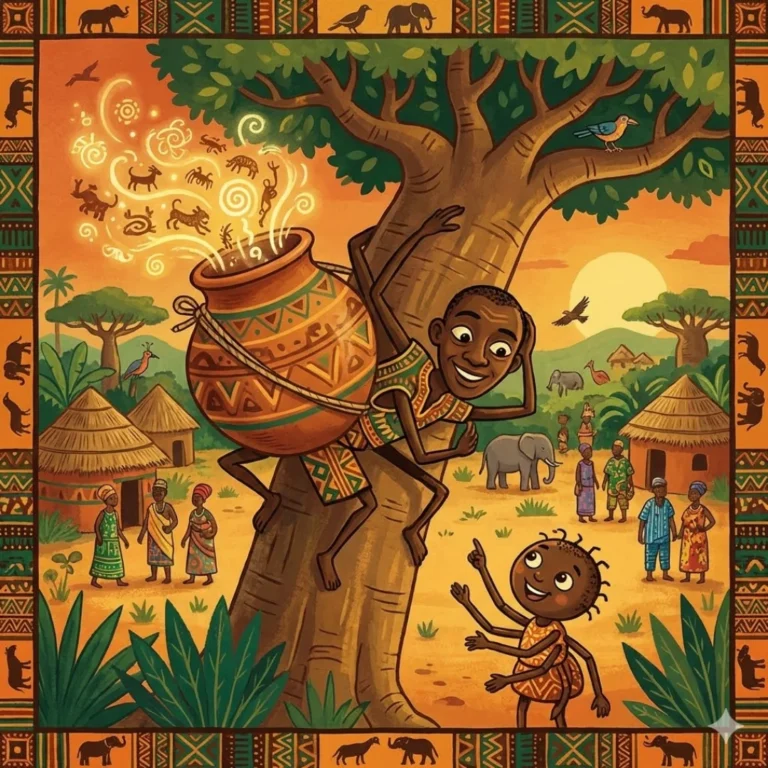
‘Anansi and the Pot of Wisdom’ is an educational moral story perfect for bedtime reading with children ages 6-12.
Anansi’s eight legs tapped impatiently on the clouds as Nyame, the Sky God, handed him a heavy clay pot. The pot’s surface felt smooth and cool beneath Anansi’s touch, decorated with swirling golden patterns that shimmered like sunlight on water.
“This pot contains all the wisdom in the world,” Nyame said, his voice rumbling like distant thunder. “Take it down to Earth, Anansi, and share it with the people. They stumble in darkness without wisdom to guide them.”
Anansi bowed low, his black body nearly touching the soft cloudfloor. “I will do exactly as you command, great Nyame,” he promised.
But as Anansi descended from the heavens, climbing down the silver sky-ladder with the pot tucked under one leg, a sly thought crept into his mind like a spider creeping into a dark corner.
If I share this wisdom with everyone, he thought, then I won’t be special anymore. Every person will be as wise as me. But if I keep it all for myself, I’ll be the most powerful creature in the world. Everyone will have to come to me for answers.
By the time Anansi’s eight feet touched the red earth of his village, his selfish plan was set.
Anansi scurried through the forest, eyes darting for the perfect hiding spot. Warm sunlight filtered through leaves, creating dancing shadows. The air smelled of damp earth and sweet wild flowers. Birds called—tweet-tweet-whistle—their songs filling the green canopy.
Then Anansi saw it. The tallest silk-cotton tree in the forest, its trunk wider than ten men, its top disappearing into the clouds. His eight eyes gleamed with greedy satisfaction.
“Perfect!” he whispered to himself, rubbing his front legs together with a soft scritch-scratch sound. “No one will ever think to look way up there.”
Anansi found a length of strong vine, rough and brown like twisted rope. He wound it carefully around the pot, then tied the vine around his round belly with the pot hanging right in front of him. He approached the massive tree, placed his front legs on the rough, scratchy bark, and began to climb.
THUNK.
The pot smacked against the tree trunk. Anansi winced and tried again, pulling himself higher.
THUNK. THUNK.
The pot kept getting in his way, knocking into his spindly legs and banging against the bark with each movement. Anansi climbed two feet up and slid back down one foot. His legs tangled in the vine. The pot swung wildly, pulling him off balance like a heavy stone tied to his middle.
“Arrgh!” Anansi grunted, his frustration growing hot like a fire in his chest. Sweat beaded on his spider brow and dripped down his face. He tried climbing sideways. He tried climbing backward. He even tried hopping up the trunk. No matter what he did, the heavy pot blocked his path and threw him off balance.
“This stupid pot!” he muttered. “This ridiculous vine!”
From below, a small voice called out, bright and clear as a bell: “Father!”
Anansi looked down to see his son, Ntikuma, a young spider barely bigger than a coconut. The little one’s eyes were wide with concern and curiosity.
“What do you want, Ntikuma?” Anansi snapped, wiping sweat from his brow. “Can’t you see I’m busy doing something very important?”
Ntikuma tilted his small head to one side, thinking. “Father, I can see you’re having trouble. But… why don’t you tie the pot to your back instead of your front? Then it won’t bump into the tree, and you can climb easily. That’s what I would do.”
Anansi froze halfway up the trunk, clinging to the bark. His eight eyes blinked in astonishment. His mouth fell open.
It was such a simple solution—so obvious, so perfectly clever.
Why hadn’t he thought of it himself?
“Hmph,” Anansi grumbled, climbing back down the tree. His cheeks burned with embarrassment, though he tried to hide it. “I was just about to try that.”
But inside, Anansi felt amazed. His young son had solved the problem in mere seconds, while he—the cleverest creature in the forest—had struggled and failed.
Anansi untied the pot from his belly and retied it firmly to his back, pulling the vine snug and secure. Then he turned to the tree again and began to climb.
This time, his legs moved in perfect rhythm—tap-tap-tap-tap—like a drum. The pot stayed snug against his back. Up and up Anansi climbed past bird nests, hanging vines, and glossy green leaves.
The wind grew stronger, whistling past his ears. Higher and higher he climbed, until the village below looked like tiny pebbles and the people like crawling ants.
Finally, Anansi reached the very top of the silk-cotton tree. He perched on the highest branch, catching his breath, his heart pounding from the long climb. The pot still sat strapped to his back, heavy and full of all the world’s wisdom.
But instead of feeling triumphant and clever, Anansi felt… troubled. A heavy weight settled in his chest—heavier even than the pot itself.
I have all the wisdom in the world right here in this pot, Anansi thought, staring up at the clouds. Yet my young son—who has none of this wisdom, who never touched this pot—just solved my problem. He was wiser than me in that moment.
The truth struck Anansi like lightning striking a tree.
If a child can be wise without this pot, then what good is it to keep all the wisdom locked up for myself?
If wisdom already exists in my son, then it must exist in other people too.
Maybe… maybe wisdom grows when it’s shared, not when it’s hidden away.
Shame burned in Anansi’s chest, hot as the midday sun. He had been greedy. He had been selfish. He had been—the word stuck in his throat—foolish. The very thing he had tried to hoard, wisdom itself, had taught him that hoarding it was the most unwise thing he could do.
Anger at his own selfishness bubbled up inside Anansi like water boiling in a pot. With a cry that was part frustration, part regret, and part hope, Anansi untied the vine and hurled the pot down toward the ground far below.
The pot tumbled through the air, spinning end over end, falling and falling and falling. Then—SMAAAAAASH!—it struck a large rock at the base of the tree and shattered into a thousand glittering pieces, the sound echoing through the forest like thunder.
From the broken pot, wisdom exploded outward in a shimmering cloud—golden and bright, swirling and dancing on the wind. It looked like a million tiny fireflies, each one carrying a piece of knowledge, a fragment of understanding.
The wisdom scattered everywhere. Some floated into the village, settling on the elders beneath the baobab tree. Some drifted into fields, where farmers understood the seasons. Some blew into homes, where parents learned patience and kindness. Some drifted into the forest, where children breathed it in.
The wisdom spread across the whole world—into mountains and valleys, across rivers and plains. It didn’t belong to just one creature anymore. Now it belonged to everyone.
Anansi climbed slowly down from the silk-cotton tree, his legs moving carefully, his heart both heavy with shame and light with relief. When he reached the ground, his son Ntikuma ran to him, his small legs pattering across the forest floor.
“Father, are you alright?” the young spider asked, his voice full of worry. “I heard a terrible crash. What happened?”
Anansi looked at his son with new eyes—eyes that truly saw the wisdom and goodness in this small creature who had taught him such a valuable lesson.
“I am better than alright, my son,” Anansi said softly, placing one gentle leg on Ntikuma’s back. “Today you taught me something more valuable than all the wisdom in that pot. You taught me that wisdom cannot be owned by just one person. It must be shared with everyone, like sunlight or rain. And you taught me that even a father—even someone who thinks he’s very clever—can learn from his own child.”
Ntikuma’s eyes shone with happiness. “Really, Father?”
“Really and truly,” Anansi said, and for the first time that day, he smiled a genuine smile.
From that day forward, wisdom was scattered throughout the world. Some people received much, some less. Some had wisdom about farming, others about healing or teaching. No one knew everything—not even Anansi, who now understood he didn’t have all the answers.
And that, the old storytellers say, is why we must always be ready to learn from others, no matter how young or old. Wisdom lives in unexpected places. The person you think has the least to teach might hold the lesson you need most.
Anansi never forgot that day beneath the silk-cotton tree. Whenever he saw his son or heard someone younger speak, he remembered: true wisdom begins with knowing you don’t know everything—and being humble enough to learn.
Frequently Asked Questions
What is the moral lesson of Anansi and the Pot of Wisdom?
What age is this story appropriate for?
How long does it take to read Anansi and the Pot of Wisdom?
What culture does this story come from?
Can I use this story for teaching?
Frequently Asked Questions
What is the story of Anansi and the Pot of Wisdom about?
Anansi and the Pot of Wisdom is an African folktale about the spider trickster Anansi, who is given a pot containing all the world’s wisdom by the Sky God Nyame and tasked with sharing it with humanity. The story explores themes of greed, humility, and what happens when we try to hoard knowledge instead of sharing it.
What age group is Anansi and the Pot of Wisdom suitable for?
This story is ideal for children aged 6 to 12 years old. It works great as a bedtime story and is educational, making it a good choice for parents and teachers looking for engaging moral tales that spark conversations about sharing and wisdom.
What moral lesson does Anansi and the Pot of Wisdom teach?
The story teaches that wisdom grows when it is shared, not hoarded. Anansi learns that trying to keep all the world’s wisdom for himself ultimately backfires, showing children that generosity and sharing knowledge make everyone — including yourself — richer and stronger.
📚 Recommended Books
Handpicked for readers like you
As an Amazon Associate, we earn from qualifying purchases. These recommendations are personalized based on this story's themes and your reading history.
Who is Anansi in African folklore?
Anansi is a beloved trickster spider character from West African, particularly Ghanaian Akan folklore. Known for his cleverness and cunning, he often outsmarts gods and humans alike. He appears in many traditional stories as both a hero and a flawed character who learns important life lessons.
Who is Nyame in the Anansi wisdom story?
Nyame is the Sky God in Akan mythology from West Africa. In Anansi stories, Nyame is a powerful divine figure who often gives Anansi important tasks or challenges. In this story, Nyame entrusts Anansi with the pot of wisdom and asks him to share it with the people of Earth.