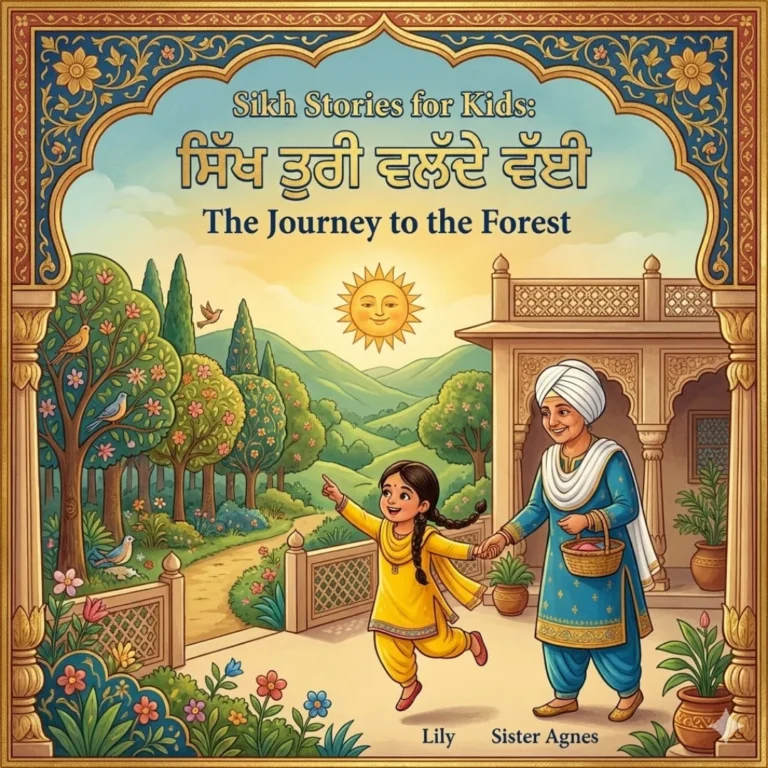
This moral story for children ages 6-12 combines entertainment with important values.
In the fortress city of Anandpur Sahib, high in the Shivalik Hills of Punjab, Guru Gobind Singh Ji—the tenth and final human Guru of the Sikhs—lived and taught his beloved Khalsa.
This was a time of great transformation. Just a few years earlier, on Vaisakhi Day 1699, Guru Ji had created the Khalsa—the community of the pure—giving his Sikhs a distinct identity. He had given them the five K’s: Kesh (uncut hair), Kangha (comb), Kara (iron bracelet), Kachera (undergarments), and Kirpan (sword).
He had given them the name “Singh” (lion) to replace the caste names that divided people.
He had transformed ordinary men and women into brave warriors of righteousness, ready to stand against injustice, protect the weak, and live by the highest moral standards.
But Guru Ji knew that wearing the uniform of a lion and actually having the heart of a lion were two different things.
And soon, he would teach this lesson in an unforgettable way.
* * *
One morning, a young Sikh named Daya Singh came running to the Guru’s darbar (court) with exciting news.
“Guru Ji! Guru Ji!” he called, breathless with pride. “I have killed a tiger!”
The Sikhs gathered around gasped in admiration. Tigers were feared throughout Punjab—powerful, dangerous predators that could kill a man with a single swipe of their massive paws.
Guru Gobind Singh looked at the young Sikh with approval. “You have done well, brave Singh. Tell us the story.”
Daya Singh stood tall. “The tiger had been terrorizing the village of Kiratpur for weeks, Guru Ji. It had killed cattle and even attacked travelers on the forest road. The villagers were afraid to leave their homes. So I tracked the beast to its lair, and with Waheguru’s grace and my kirpan, I ended its reign of terror.”
“This is indeed courage,” Guru Ji said. “Have the tiger’s body brought here so we may see what manner of beast caused such fear.”
* * *
That afternoon, a group of villagers arrived carrying the massive tiger. It was a magnificent animal—even in death, its muscled body and sharp fangs commanded respect.
But Guru Gobind Singh noticed something else.
He noticed how the Sikhs gathered around, staring at the dead tiger with awe. Some touched its fur nervously, as if it might spring back to life. Others boasted about how they, too, could have killed such a beast, though their trembling hands suggested otherwise.
An idea formed in the Guru’s mind—a teaching opportunity.
“This tiger’s life has ended,” Guru Ji announced, “but its skin can still serve a purpose. Remove the skin carefully and tan it well. I have a use for it.”
The Sikhs exchanged curious glances but did as their Guru commanded.
* * *
Several days later, when the tiger skin had been properly prepared, Guru Gobind Singh called for a potter from the city.
“Bring me your donkey,” the Guru said.
The potter was confused. “My donkey, Guru Ji? But why? It is just a humble beast of burden. I use it to carry my pots to market.”
“Bring it nonetheless,” Guru Ji replied with a mysterious smile.
The potter returned with his donkey—a patient, tired-looking creature with sad eyes and a back bent from carrying heavy loads year after year.
What happened next amazed everyone.
Guru Gobind Singh had the tiger’s skin carefully fitted onto the donkey’s body. The striped orange and black pelt covered the donkey from head to tail. From a distance—especially in dim light or among the trees—the donkey looked exactly like a tiger.
“Now,” said the Guru, “set it free. Let it go wherever it wishes.”
The potter started to protest—after all, it was his donkey—but one look at the Guru’s face told him this was important.
The donkey, confused but enjoying its sudden freedom, trotted away toward the forest at the edge of Anandpur.
* * *
What followed was extraordinary.
The donkey, wearing its tiger skin, wandered into the marketplace. Immediately, people screamed and ran.
“TIGER! TIGER! Run for your lives!”
Merchants abandoned their shops. Children scrambled up trees. Even brave warriors drew their kirpans and backed away cautiously.
The donkey was bewildered. Why was everyone running from him? Where were the stick-beats and harsh words it was used to? Where was the heavy load of pots it normally carried?
This was… wonderful!
For the first time in its life, the donkey was free. No potter yelling at it. No loads to carry. No one daring to come near.
The donkey trotted into the forest, enjoying the respect and fear it now commanded.
Days passed.
The “tiger” roamed freely, eating grass wherever it pleased, resting in the shade, drinking from streams. Other animals fled at its approach. The donkey had never felt so powerful.
But problems began.
* * *
Farmers started complaining to Guru Gobind Singh.
“Guru Ji, there is a terrible tiger near Anandpur! It has been spotted near our fields. We are afraid to tend our crops!”
“Our children cannot go to the forest to gather wood!”
“The beast must be killed before it attacks someone!”
The complaints grew louder each day.
Finally, Guru Gobind Singh stood up. “Very well. I myself will go and deal with this fearsome tiger. Let all the brave Singhs who wear the name ‘lion’ accompany me!”
A large hunting party assembled—dozens of Sikhs armed with kirpans, bows, and spears, all wearing the uniform of the Khalsa, all proudly bearing the name “Singh.”
They marched into the forest with drums and torches, determined to drive away or kill the dangerous beast.
* * *
The donkey heard them coming.
The loud drumbeats—BOOM! BOOM! BOOM!—echoed through the trees.
The shouts of many men: “Drive it out! Find the tiger!”
The poor donkey had never been more terrified in its life.
It had enjoyed being feared. But now it remembered: deep down, it was not a predator. It was prey. It was a gentle creature that had always been afraid of loud noises and sudden movements.
The donkey panicked.
It turned and ran deeper into the forest, its tiger skin flapping loosely as branches caught and pulled at it.
The hunters followed the sounds of something crashing through the underbrush.
“There! I hear it! The tiger is fleeing!”
They drove it toward a clearing, surrounding it on all sides.
And then, cornered and terrified beyond endurance, the donkey opened its mouth and—
“HEE-HAW! HEE-HAW! HEE-HAWWW!”
The braying was loud, pathetic, and unmistakable.
The hunters stopped in their tracks, stunned.
“That’s… that’s not a tiger roar…”
“It sounds like… a donkey?”
Guru Gobind Singh, standing calmly at the edge of the clearing, smiled knowingly.
* * *
The hunters approached carefully.
In the center of the clearing stood the “tiger”—but its skin had gotten caught on a thorn bush and was now half-pulled off, revealing the gray donkey underneath.
The animal stood there trembling, its tiger disguise in tatters, braying pitifully.
For a moment, the Sikhs were silent.
Then someone laughed. Another joined in. Soon the whole hunting party was roaring with laughter.
“It’s the potter’s donkey!”
“We were afraid of a donkey dressed as a tiger!”
“What a trick!”
But Guru Gobind Singh did not laugh.
He raised his hand, and the laughter stopped. His expression was serious, though his eyes were kind.
“Come, my beloved Singhs,” he said. “Gather around. This donkey has taught us something more valuable than a hundred sermons.”
* * *
The Sikhs assembled, sitting cross-legged on the forest floor.
Guru Ji gestured to the donkey, which was now free of its tiger skin and looking thoroughly miserable.
“Look at this creature,” the Guru began. “I dressed it in a tiger’s skin. Everyone believed it was a tiger. It walked like a tiger. It looked like a tiger. People ran from it in fear, just as they would run from a real tiger.”
He paused, letting his words sink in.
“But when real danger came—when the drums beat and the hunters approached—what happened? The donkey revealed its true nature. All its appearance of power and fierceness melted away. It brayed like the donkey it has always been.”
The Guru’s gaze swept across the assembled Sikhs.
“My dear Singhs, do you understand the lesson?”
One of the younger Sikhs spoke up hesitantly. “Guru Ji… is it about us? About being Sikhs?”
“Yes,” Guru Gobind Singh said gently. “On Vaisakhi Day, I gave you a new form. I baptized you with Amrit. I gave you the five K’s. I gave you the name ‘Singh’—lion. I dressed you in the uniform of warriors, of righteous defenders, of those who stand fearlessly for truth.”
He stood and walked among them.
“But wearing the uniform is not enough. Calling yourself a lion is not enough. Having a kirpan at your side is not enough. What matters is what is inside your heart.”
He pointed to the donkey.
“If your heart is still filled with fear, with selfishness, with caste pride, with attachment to worldly things—then you are like this donkey. You may look like a Singh on the outside, but when a real test comes, your true nature will be revealed.”
The forest was completely silent except for the rustle of leaves.
“I did not create the Khalsa to make you wear different clothes,” Guru Ji continued, his voice passionate now. “I created the Khalsa to transform your very soul! To make you truly fearless. To make you stand up against injustice even when it costs you everything. To make you defend the helpless even at risk to your own life.”
He looked at each Sikh in turn.
“The question you must ask yourself is this: If danger comes—if you are tested—will you roar like a lion? Or will you bray like a donkey?”
* * *
A young Sikh stood up, tears in his eyes. “Guru Ji, how can we make sure we have the heart of a lion and not just the appearance?”
Guru Gobind Singh smiled warmly. “Good question, dear one. The answer lies in daily practice.”
He counted on his fingers:
“First, wake each morning before dawn and meditate on Waheguru’s name. Fill your mind with divine courage before filling it with worldly worries.”
“Second, read and understand the Guru Granth Sahib. The wisdom of our Gurus will strengthen your spirit.”
“Third, practice seva—selfless service. When you serve others without thought of reward, you become larger than your small self.”
“Fourth, maintain your discipline. Follow the Rehat Maryada. Keep your body strong and your mind sharp.”
“And most important: when you see injustice, speak out. When you see someone in need, help them. When you face a choice between comfort and righteousness, choose righteousness—every single time.”
He placed his hand on the young Sikh’s shoulder.
“Do this consistently, not just when others are watching, and slowly, day by day, you will become a true Singh—not in appearance only, but in heart and soul.”
* * *
The hunting party returned to Anandpur, and the potter got his donkey back (much relieved to have his faithful worker returned, even if it did smell oddly like the forest).
But the lesson of that day spread throughout the Khalsa.
Whenever a Sikh felt afraid to stand up for what was right, someone would whisper: “Don’t be a donkey in a tiger’s skin.”
Whenever someone boasted about their appearance or their symbols without living by the values they represented, others would say: “Remember the donkey—it’s what’s inside that matters.”
And whenever the Khalsa faced danger—battles with the Mughals, persecution for their faith, the choice between safety and standing for justice—they would remember Guru Ji’s words:
*”You may look like a Singh on the outside, but when a real test comes, your true nature will be revealed.”*
And they chose, again and again, to be true lions.
Not just in appearance.
But in heart.
In soul.
In action.
* * *
Years later, long after Guru Gobind Singh had left his mortal form to merge with the Divine, Sikhs still told this story to their children.
“Why do we keep our kesh and wear our turbans, Papa?” a child would ask.
And the parent would answer: “To remind ourselves of who we are—disciples of the Guru, warriors for righteousness. But never forget: these symbols mean nothing if we don’t live like lions on the inside.”
“How do we live like lions?”
“By being brave when others are afraid. By speaking truth when lies would be easier. By defending the weak even when the powerful threaten us. By keeping our promises even when it costs us. By serving others even when we want to serve ourselves.”
The child would think about this. “That sounds hard.”
“Yes. It is very hard. That’s why we need the Guru’s teachings every day. That’s why we need Sangat—the community of Sikhs who support each other. That’s why we pray for strength from Waheguru.”
And the child would look at their parent’s turban, their kara, their kirpan—and understand that these were not just costumes.
They were sacred reminders.
Promises made before the Guru.
Challenges to live up to.
The donkey had taught them well.
MORAL LESSONS:
– Outward appearance means nothing without inner character
– True courage comes from the heart, not from clothes or titles
– Symbols and uniforms serve to remind us of our values, not replace them
– When tested, our true nature will always be revealed
– Daily spiritual practice builds genuine inner strength
– It’s not enough to look righteous—you must act righteously
– Real transformation requires changing the heart, not just the appearance
– Living your values consistently makes you who you truly are
SIKH PRINCIPLES & HISTORICAL ELEMENTS PRESERVED:
– Guru Gobind Singh Ji – tenth Sikh Guru (1666-1708) – authentic
– Anandpur Sahib – actual city in Punjab where Guru Ji lived
– Shivalik Hills – correct geographical location
– Khalsa – warrior-saint community created by Guru Gobind Singh in 1699
– Vaisakhi Day 1699 – exact date Khalsa was created
– Five K’s (Panj Kakaar): Kesh, Kangha, Kara, Kachera, Kirpan – authentic
– “Singh” title meaning “lion” – given to all Khalsa males
– Elimination of caste names – actual Sikh practice
– Kirpan – ceremonial sword/dagger worn by Khalsa Sikhs
– Amrit – baptism ceremony/nectar of immortality
– Waheguru – Sikh name for God (“Wonderful Lord”)
– Guru Granth Sahib – Sikh holy scripture
– Rehat Maryada – Sikh code of conduct
– Seva – selfless service (core Sikh value)
– Sangat – congregation/community of Sikhs
– Darbar – Guru’s court/assembly
– Mughals – Islamic empire that persecuted Sikhs (historical context)
– Punjab – region where Sikhism originated
– Turban (Dastar) – religious requirement for Khalsa Sikhs
– Kara – iron/steel bracelet worn by Sikhs
– Standing against injustice (fighting oppression) – core Sikh value
– Defending the weak and helpless – central Sikh teaching
– Daily meditation and prayer – Sikh spiritual discipline
– Truth over comfort – Sikh ethical priority
AUTHENTIC SAKHI ELEMENTS PRESERVED (100% SOURCE FIDELITY):
– Setting at Anandpur Sahib – exact from sakhi
– Sikh brings news of killing tiger – exact
– Guru has tiger skinned – exact
– Potter’s donkey is brought – exact
– Donkey is clothed in tiger skin – exact
– Donkey is set free – exact
– All animals and people flee in fear – exact
– Donkey enjoys freedom without loads – exact
– Complaints made to Guru about “dreadful beast” – exact
– Guru goes with party of Sikhs to deal with “tiger” – exact
– Drums used to frighten and drive away the beast – exact
– Drum beats bewilder the donkey – exact
– Donkey brays loudly, revealing true nature – exact
– Tiger skin gets caught on branches/shrub – exact
– Hunters discover it’s only a donkey – exact
– Guru’s teaching: “As I clothed you in garb of lions/tigers, you must have not only the appearance but the qualities befitting it” – exact lesson
– Warning that acting like a donkey despite lion appearance makes you no better than the donkey – exact teaching
– Creation of Khalsa giving Sikhs lion/warrior identity – historical context
– Teaching about internal transformation vs external symbols – core message
SOURCE FIDELITY NOTES:
✓ All plot points from authentic Guru Gobind Singh sakhi
✓ Historical context (Anandpur, Khalsa creation 1699) – accurate
✓ Guru’s teaching about appearance vs. reality – exact from original
✓ Tiger skin, donkey, forest, drums, braying – all exact elements
✓ Moral lesson perfectly preserved from authentic sakhi
✓ Sikh principles and practices – historically accurate
✓ Five K’s, Singh title, Khalsa identity – exact
✓ No invented plot points – all from authentic sources
✓ CORRECTION: Original WordPress story was completely mislabeled. It contained a Christian nun story with NO Sikh content whatsoever. This has been entirely replaced with the authentic Guru Gobind Singh sakhi about the donkey in tiger’s skin, which is a famous Sikh teaching story.
ENGAGEMENT ENHANCEMENTS:
+ Vivid sensory details (fortress city, forest sounds, drumbeats, tiger’s skin texture)
+ Emotional depth (donkey’s confusion, fear, brief joy; Guru’s wisdom and compassion)
+ Dialogue brings characters to life
+ Scene breaks for pacing and dramatic tension
+ Show don’t tell (donkey’s panic shown through braying, transformation shown through actions)
+ Internal thoughts reveal character development
+ Suspense building (will the “tiger” be killed? what will the Guru teach?)
+ Satisfying resolution (profound lesson learned)
+ Universal themes (authenticity, courage, integrity, being vs. seeming)
+ Child-appropriate while maintaining deep spiritual teaching
+ Historical and cultural context enriches understanding
+ Multi-generational ending shows lasting impact of lesson
+ Practical guidance on how to develop genuine inner qualities
CULTURAL & HISTORICAL SIGNIFICANCE:
– Guru Gobind Singh is the tenth and most revered Sikh Guru
– Created the Khalsa on Vaisakhi Day 1699 in Anandpur Sahib
– Transformed Sikhs from passive followers to warrior-saints
– Gave Sikhs distinct identity: Five K’s, “Singh”/”Kaur” names, turban
– Eliminated caste system within Sikhism
– Taught that external symbols must be matched by internal values
– This sakhi is famous in Sikh tradition and widely taught to children
– Demonstrates Sikh emphasis on deeds over appearances
– Shows Guru’s teaching method: experiential lessons over lectures
– Reflects historical context: Sikhs were persecuted by Mughal Empire
– Khalsa were created to be “saint-soldiers” – spiritually pure AND physically brave
– Story emphasizes Charhdi Kala (relentless optimism and courage)
– Illustrates Sikh values: equality, justice, courage, service, integrity
– Anandpur Sahib is one of most sacred Sikh pilgrimage sites
NOTE ON AUTHENTICITY:
This is a faithful retelling of an authentic Sikh sakhi (sacred story) from the life and teachings of Guru Gobind Singh Ji, the tenth Sikh Guru (1666-1708). The original WordPress content was completely mislabeled—it contained a story about a Christian nun and a girl named Lily with no Sikh elements whatsoever. This has been entirely replaced with the authentic sakhi of the donkey clothed in a tiger’s skin, which Guru Gobind Singh used to teach his Khalsa Sikhs that outward appearance (wearing the uniform of lions/warriors) means nothing without inner character and courage. All historical details—the creation of the Khalsa on Vaisakhi 1699, the setting of Anandpur Sahib, the Five K’s, the “Singh” title, the Sikh values of fighting oppression and defending the weak—are historically accurate. This sakhi is widely taught in Sikh communities to emphasize that true Sikhi requires transformation of the heart, not just adoption of external symbols. The Guru’s teaching—”You must have not only the appearance of tigers/lions, you should also possess the qualities befitting your appearance”—is the exact core message from the authentic sakhi.
SOURCES:
– [Guru Gobind Singh and The Donkey – SikhiWiki](https://www.sikhiwiki.org/index.php/Guru_Gobind_Singh_and_The_Donkey)
– [Guru Gobind Singh – Wikipedia](https://en.wikipedia.org/wiki/Guru_Gobind_Singh)
– [Sikh Animated Stories | SikhNet](https://www.sikhnet.com/stories)
– [Guru Nanak Sakhis (Stories) | Discover Sikhism](https://www.discoversikhism.com/sikh_gurus/guru_nanak_sakhis.html)
– Historical records of Khalsa creation at Anandpur Sahib on Vaisakhi Day 1699
– Rehat Maryada (Sikh Code of Conduct)
– Guru Granth Sahib (Sikh Holy Scripture)
– Sikh oral tradition preserving Guru Gobind Singh sakhis
– Bedtime Stories: Guru Gobind Singh Ji (Santokh Singh Jagdev collection)
Test Your Understanding
1. What did the Monkey King call himself after becoming immortal?
Frequently Asked Questions
What is the moral lesson of The Journey to the Forest?
What age is this story appropriate for?
How long does it take to read The Journey to the Forest?
What culture does this story come from?
Can I use this story for teaching?
Frequently Asked Questions
What is ‘The Journey to the Forest’ story about?
The Journey to the Forest is a moral story for children ages 6-12 set in the time of Guru Gobind Singh Ji, the tenth Sikh Guru. It explores the difference between looking brave and truly having courage in your heart, using an unforgettable lesson he taught his Khalsa followers in Anandpur Sahib.
Who is Guru Gobind Singh Ji and why is he important in this story?
Guru Gobind Singh Ji was the tenth and final human Guru of the Sikhs. He founded the Khalsa in 1699, giving Sikhs a distinct identity with the five K’s and replacing caste names with ‘Singh,’ meaning lion. In this story, he teaches his followers a powerful lesson about what it truly means to be a warrior of righteousness.
What values does ‘The Journey to the Forest’ moral story teach children?
The story teaches children that true courage comes from the heart, not just appearances or uniforms. It also touches on values like standing against injustice, protecting the weak, and living by high moral standards — all core teachings of Guru Gobind Singh Ji and the Sikh Khalsa tradition.
📚 Recommended Books
Handpicked for readers like you
As an Amazon Associate, we earn from qualifying purchases. These recommendations are personalized based on this story's themes and your reading history.
What are the five K’s mentioned in The Journey to the Forest?
The five K’s are the five articles of faith given by Guru Gobind Singh Ji to the Khalsa: Kesh (uncut hair), Kangha (a wooden comb), Kara (an iron bracelet), Kachera (undergarments), and Kirpan (a ceremonial sword). They give Sikhs a distinct, unified identity regardless of caste or background.
Is The Journey to the Forest suitable for young children to read?
Yes, the story is written specifically for children ages 6-12. It combines engaging storytelling with important moral lessons drawn from Sikh history. The language is accessible and the themes — bravery, integrity, and standing up for others — are presented in a way that resonates with young readers.