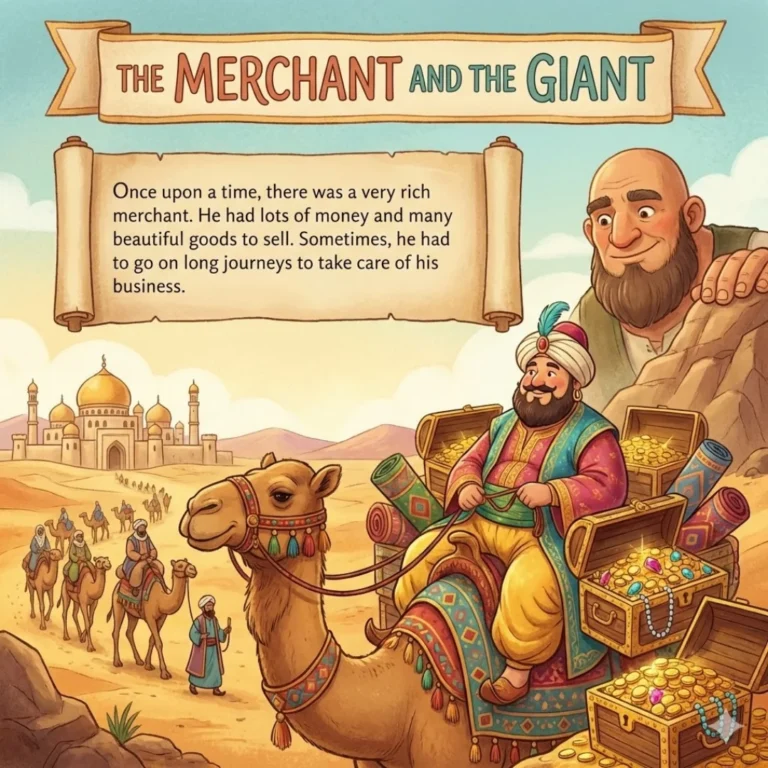
‘The Merchant and the Giant’ is an educational moral story perfect for bedtime reading with children ages 6-12.
In the days when caravans crossed the golden deserts and merchants traveled from Baghdad to distant lands, there lived a wealthy trader named Hassan. His ships sailed the seas, his camels crossed the dunes, and his reputation for honest dealings spread from marketplace to marketplace.
But wealth and reputation cannot protect a man from fate.
* * *
One blazing summer, Hassan had business in a distant city—a journey that would take him across the great desert. He packed his saddlebags with dried dates, flatbread, and a waterskin, mounted his finest horse, and set out at dawn when the air was still cool.
For three days he traveled.
The desert stretched endlessly in all directions—rolling dunes of copper and gold, shimmering in the heat. The sun beat down mercilessly. His horse’s hooves left prints in the sand that the wind erased moments later, as if he had never passed at all.
On the fourth day, after completing his business and beginning the journey home, Hassan was exhausted. The midday sun was at its fiercest, turning the desert into an oven. His lips were cracked. His throat burned with thirst.
Then, like a gift from heaven, he spotted it—a cluster of palm trees rising from the sand, their green fronds waving gently. Shade. Water. Rest.
An oasis.
* * *
Hassan urged his horse forward with renewed energy. As he drew closer, he heard it—the sweet sound of running water, bubbling up from the earth.
A spring!
He dismounted quickly, tying his horse to a palm trunk where it could nibble on the tough grass growing near the water. Then he collapsed in the shade, his back against the rough bark, and breathed deeply.
The air here was different—cooler, fresher, perfumed with the scent of date palms and wild jasmine.
Hassan reached into his saddlebag and pulled out his provisions. He was famished. He ate the flatbread slowly, savoring each bite, and then reached for the dates—plump, sweet, sticky with natural sugar.
One by one, he ate them, spitting the hard pits onto the ground carelessly as he chewed.
When his hunger was satisfied, he washed his hands and face in the cool spring water. It felt like a blessing, that water—clean and pure, washing away the dust of travel.
Hassan closed his eyes for just a moment, feeling peace settle over him.
And then he heard the voice.
“STAND, HUMAN!”
* * *
Hassan’s eyes snapped open.
Before him stood a creature from nightmares.
The demon—for that is what it was—towered three times the height of a man. Its skin was the color of dried blood, its eyes burned like coals, and in its massive hand it gripped a curved scimitar, long and cruel, its blade catching the sunlight and throwing it back like fire.
Hassan scrambled to his feet, his heart hammering in his chest.
“Wh-who are you?” he stammered.
“I am Ifrit ibn Shaitan,” the demon growled, its voice like grinding stones. “And you, merchant, have murdered my son. For this crime, you will die.”
Hassan’s mind reeled. “Murdered? My lord, I have murdered no one! I swear by Allah, I am an honest merchant! I have never harmed—”
“SILENCE!” The demon raised its sword. “Do you deny that you sat in this very spot? Do you deny that you ate dates and threw the pits onto the ground?”
“I—yes, I ate dates, but—”
“Then you killed my son!” The demon’s eyes blazed brighter. “My boy was walking here, invisible to your human eyes, when one of your date pits struck him in the chest. It pierced his heart. He died in my arms, crying out in pain.”
The color drained from Hassan’s face.
A date pit. A simple date pit.
“I didn’t know!” Hassan fell to his knees. “My lord, I didn’t see anyone! It was an accident—a terrible accident! I never meant—”
“Intention means nothing,” the demon said coldly. “You threw the pit. The pit killed my son. Therefore, you killed my son. And so, by the ancient laws, I will kill you.”
The sword rose high, glinting in the desert sun.
“WAIT!” Hassan cried out. “Please! I beg you for mercy! I have a wife—children! They depend on me! At least grant me time to say goodbye to them, to settle my affairs, to provide for their future!”
The demon paused, the sword still raised.
“You ask for mercy,” it said slowly, “when my son received none?”
“I am not asking to escape my fate,” Hassan said, his voice shaking. “I am asking only to be a good man before I die. Let me return home. Let me divide my wealth among my family, settle my debts, say my farewells. I swear by Allah, by all that is holy, that I will return to this spot in exactly one year. On my honor as a merchant, I will return to accept my punishment.”
The demon stared at him with those burning eyes.
For a long moment, there was only silence, broken by the whisper of wind through the palm fronds.
Then the demon lowered its sword.
“Very well,” it said. “I am no monster without honor. You have one year. But know this, merchant: if you do not return, I will hunt you down. I will find you no matter where you hide. I will destroy your family, burn your house, and drag you back here screaming. Do you understand?”
“I understand,” Hassan whispered. “I will return. I swear it.”
“One year from today,” the demon said. “When the sun reaches its highest point in the sky. Be here.”
And with that, the demon vanished like smoke, leaving only the faint smell of sulfur in the air.
* * *
Hassan returned home in a daze.
His wife and children welcomed him joyfully, but he could not return their smiles. That night, he told them everything.
His wife wept. His children clung to him.
“Don’t go back,” his eldest son begged. “That demon will never find you. We’ll leave this city, change our names, hide—”
But Hassan shook his head.
“I gave my word,” he said quietly. “What kind of man would I be if I broke an oath sworn in Allah’s name? What kind of father would you have if I taught you that promises mean nothing?”
And so, Hassan spent the year setting his affairs in order.
He paid every debt he owed. He distributed his wealth among his family, ensuring they would be provided for. He wrote letters to friends and business partners, explaining what had happened. He prayed five times a day, seeking forgiveness for any wrongs he had done in his life.
As the year drew to a close, his family begged him not to go.
But Hassan kissed each of them and said goodbye.
“If I do not return,” he told his wife, “know that I died with honor.”
* * *
On the appointed day, Hassan rode back across the desert.
His heart was heavy, but his conscience was clear. He had kept his word. He had lived honorably. If today was the day he died, at least he would die as a man of integrity.
The oasis appeared on the horizon.
The same palm trees. The same spring. The same shade where he had carelessly thrown date pits a year ago.
Hassan dismounted and sat down under the tree to wait.
The sun climbed higher in the sky.
Hassan performed his prayers, asking Allah for strength.
And then he heard footsteps.
But they were not the demon’s heavy tread.
Three old men were approaching—travelers, by the look of them, each leading an animal. The first led a gazelle on a golden chain. The second led two black dogs. The third led a mule.
“Peace be upon you, brother,” the first old man said. “Why do you sit here alone in the desert, looking so sorrowful?”
Hassan looked up at them with tired eyes.
“Peace be upon you as well,” he said. “Sit, if you wish. I will tell you my story. But I warn you—when you hear it, you may wish you had kept walking.”
The three old men sat down in the shade, curious.
And Hassan told them everything—the journey, the dates, the demon, the oath, the year he had spent preparing for death.
When he finished, the three old men looked at one another.
“This is a remarkable tale,” the first old man said. “A terrible injustice, but you have behaved with honor. If you don’t mind, we will wait with you. A man should not face death alone.”
Hassan’s eyes filled with tears. “Thank you, brothers. Your kindness means more than you know.”
The four men sat together in silence as the sun climbed toward its zenith.
And then the demon appeared.
* * *
It materialized out of the air like a sandstorm taking shape—huge, terrible, its eyes burning with rage and grief.
“You came,” the demon said, and there was surprise in its voice. “You actually came.”
“I gave my word,” Hassan said, rising to his feet. His legs shook, but his voice was steady. “I am ready.”
The demon drew its sword.
But the first old man stepped forward.
“Wait, mighty Ifrit!” he called out. “Before you take this man’s life, will you grant me one request?”
The demon turned its burning gaze on him. “What request, human?”
“I wish to tell you a story,” the old man said. “A story more strange and wonderful than anything you have ever heard. If you agree that my tale is truly remarkable, will you spare one-third of this merchant’s blood-debt?”
The demon considered this.
“Very well,” it said. “Tell your tale. If it is as remarkable as you claim, I will spare one-third of his life.”
And so the first old man began to speak.
* * *
“This gazelle you see,” he said, stroking the animal’s head, “was once my wife.
“I was married to my cousin—a beautiful woman, but her heart was dark. We had no children, so I adopted my nephew and loved him as my own son. I also took in a slave woman and her child, treating them with kindness.
“But my wife grew jealous. She studied the black arts—magic—and one day, while I was away on a journey, she transformed my nephew into a calf and the slave woman’s child into a cow. When I returned, she told me they had run away.
“Years passed. One festival, I asked my steward to buy me a fat cow for sacrifice. He brought me a cow that looked at me with such human, pleading eyes that my heart broke. I could not kill it. ‘Find another,’ I said.
“The steward’s daughter, who knew some magic herself, said, ‘Master, that cow is the slave woman. Your nephew is the calf in the barn. Your wife enchanted them.’
“I was horrified. The steward’s daughter reversed the spells, restoring them to human form. Then, with my permission, she punished my treacherous wife by transforming her into this gazelle you see before you.
“And now she travels with me, so I will never forget the price of jealousy and cruelty.”
When the old man finished, the demon was silent for a long moment.
“That is indeed a remarkable tale,” it said finally. “Very well. I grant you one-third of the merchant’s blood.”
Hassan felt a surge of hope—but he was still two-thirds dead.
Then the second old man stepped forward.
* * *
“Mighty Ifrit,” he said, “I too have a tale—perhaps even more remarkable than my companion’s. These two black dogs were once my brothers.
“When our father died, he left his wealth divided equally among the three of us. I became a merchant and invested wisely. My business flourished. But my brothers’ businesses failed. They came to me, penniless, and begged for help.
“I gave them money and welcomed them into my ventures. We sailed together on a trading voyage. But when we returned, wealthy beyond measure, my brothers grew jealous of my success.
“While I slept on the ship, they threw me overboard and left me to drown, stealing my share of the wealth.
“But I was saved by a marid—a sea jinn—a beautiful spirit who had taken a liking to me. She carried me to safety and gave me treasures from the ocean floor, making me wealthy once more.
“When I returned home, my brothers were shocked to see me alive. They begged forgiveness, claiming they had been driven mad by greed.
“I forgave them. But the marid did not. She appeared to them and said, ‘For your treachery, you will walk on four legs for ten years.’ And she transformed them into these black dogs you see.
“Nine years have passed. I travel with them, feeding them, caring for them, waiting for their curse to end and for them to be human again.”
The demon nodded slowly.
“Another remarkable tale. Very well. I grant you one-third of the merchant’s blood.”
Hassan’s heart leaped. He was now only one-third condemned—but that still meant death.
The third old man opened his mouth to speak—
But the demon raised its hand.
“Stop,” it said.
The old man fell silent.
The demon turned to Hassan, studying him with those burning eyes.
“Merchant,” it said quietly, “you threw a date pit and killed my son. This is true.”
Hassan nodded, tears streaming down his face. “It is true.”
“And yet,” the demon continued, “you returned when you could have fled. You kept your word when breaking it would have cost you nothing. You faced death with honor.”
The demon was quiet for a long moment.
“My son died by accident,” it said finally. “This I now believe. It was fate—qadar—not murder. You are not evil. You are simply a man who made a careless mistake.”
The demon lowered its sword.
“These two men have given their stories in exchange for two-thirds of your life. I will give you the final third myself—not for a story, but for your honor. You are free to go, merchant. Your debt is paid.”
Hassan collapsed to his knees, sobbing with relief.
“Thank you,” he whispered. “Thank you.”
The demon looked down at him with an expression that might have been sorrow.
“Go home to your family,” it said. “Hold your children. Kiss your wife. And remember—every action has consequences, even the small ones. Even a date pit, carelessly thrown, can end a life. Be mindful. Be present. Be careful.”
And with that, the demon vanished.
* * *
Hassan returned home to a joyful reunion. His family wept with happiness. His friends celebrated his survival.
But Hassan was a changed man.
He was more careful now—not just with date pits, but with his words, his actions, his choices. He understood that even small, thoughtless acts could cause great harm.
He never forgot the demon’s words: *Be mindful. Be present. Be careful.*
And for the rest of his long life, Hassan lived by those words.
He taught his children to think before they acted. He trained his apprentices to consider the consequences of their decisions. He gave generously to those in need, knowing that kindness creates ripples that spread far beyond what we can see.
And he never, ever threw a date pit without looking carefully around him first.
* * *
Years later, when Hassan was an old man with grandchildren climbing on his knees, they would ask him, “Grandfather, why are you so careful? Why do you always think before you act?”
And Hassan would smile and say, “Let me tell you a story about a merchant, a demon, and a date pit…”
And the children would listen, wide-eyed, learning the lessons that Hassan had paid so dearly to learn himself.
Because that is how wisdom is passed down—through stories, through experiences, through the memories of those who came before.
And Hassan’s story is still told today, in the lands of the Arabian Nights, wherever people gather to share tales of fate, honor, and the surprising mercy that can be found even in the heart of a demon.
MORAL LESSONS:
– Think before you act—even small, careless actions can have serious consequences
– Keep your promises, even when it costs you greatly
– Honor and integrity matter more than survival
– Mercy and forgiveness are signs of strength, not weakness
– Fate (qadar) plays a role in our lives, but we must still be mindful of our choices
– Stories have power—they can change minds and save lives
– Every person (and being) deserves to be heard and understood
– Accidents happen, but we must still take responsibility for our actions
– Justice should balance punishment with mercy
– Family bonds are precious—cherish them while you can
ARABIAN NIGHTS ELEMENTS PRESERVED:
– “The Merchant and the Demon” is the first tale of One Thousand and One Nights
– Merchant travels across desert and stops at oasis
– Throws date pits carelessly
– Demon appears claiming merchant killed his son
– One date pit struck and killed the invisible demon’s son
– Merchant asks for one year to settle affairs
– Swears oath to return
– Merchant keeps his promise and returns
– Three old men arrive and offer stories in exchange for merchant’s life
– First old man’s story: Wife transformed into gazelle/hind through magic
– Second old man’s story: Brothers transformed into black dogs by a jinn
– Third old man present but demon pardons merchant before third story told
– Demon shows mercy and releases merchant
– Theme of qadar (fate/destiny) central to Islamic storytelling
– Honor and oath-keeping emphasized
– Frame story structure typical of Arabian Nights
– Justice tempered with mercy
SOURCE FIDELITY NOTES:
✓ Based on One Thousand and One Nights (Alf Layla wa-Layla)
✓ First tale told within the frame story of Scheherazade
✓ Merchant stops at oasis—exact
✓ Eats dates and throws pits—exact
✓ Demon appears and accuses him of murder—exact
✓ Date pit killed demon’s invisible son—exact
✓ Merchant asks for one year—exact
✓ Returns on appointed day—exact
✓ Three old men arrive—exact
✓ Each leads an animal (gazelle/hind, two black dogs, mule)—exact
✓ Old men tell stories in exchange for portions of merchant’s life—exact
✓ First old man: Wife turned into hind via magic—exact
✓ Second old man: Brothers turned into dogs by jealous jinn—exact
✓ Demon grants mercy—exact from various translations
✓ Islamic elements (Allah, prayers, qadar) authentic to source culture
✓ Desert setting and caravanserai culture accurate
✓ Honor and oath-keeping central to plot—exact
ENGAGEMENT ENHANCEMENTS:
+ Named the merchant (Hassan) for better connection
+ Vivid sensory details (copper and gold dunes, sulfur smell, cool spring water)
+ Emotional depth (Hassan’s fear, demon’s grief, family’s love)
+ Extended dialogue makes characters come alive
+ Scene breaks create better pacing
+ Internal thoughts reveal motivations
+ Suspense building (will he return? will he survive?)
+ Demon given complexity—not just monster, but grieving father
+ Satisfying resolution with clear lessons
+ Frame device at end (Hassan as grandfather) reinforces oral tradition
+ Child-appropriate language while maintaining cultural richness
+ Show don’t tell (demon’s appearance, desert’s harshness)
CULTURAL SIGNIFICANCE:
– Central tale from One Thousand and One Nights
– Demonstrates Islamic values: honor, promise-keeping, mercy
– Concept of qadar (divine fate) integral to Islamic worldview
– Frame story structure reflects Arabian oral storytelling tradition
– Explores tension between justice and mercy
– Shows importance of intention vs. outcome in Islamic law
– Demonstrates power of stories to change hearts (meta-narrative)
– Jinn/demons are part of Islamic cosmology (mentioned in Quran)
– Oath-keeping sacred in Arab/Islamic culture
– Desert setting reflects historical context of Arabian Peninsula
NOTE ON AUTHENTICITY:
This is a faithful retelling of the first embedded tale in One Thousand and One Nights, known as “The Merchant and the Demon” or “The Merchant and the Jinni.” The core plot—merchant accidentally kills demon’s son with date pit, promises to return in one year, three old men tell stories to save him—is exact from the original. The characterization has been enhanced for modern children while maintaining the cultural elements (Islamic references, desert setting, honor code, concept of fate) authentic to the Arabian/Islamic source material. The moral lessons about mindfulness, honor, and mercy are central to the original tale.
SOURCES:
– [Arabian Nights](https://novaonline.nvcc.edu/eli/eng251/arabstudy.htm)
– [1001 Ways to Save Your Life: Shahrazad and The Arabian Nights | Ronald B. Richardson](https://ronaldbrichardson.com/metafiction/1001-ways-to-save-your-life-shahrazad-and-the-arabian-nights/)
– [The Arabian Nights The Merchant And The Demon Summary | Course Hero](https://www.coursehero.com/lit/The-Arabian-Nights/the-merchant-and-the-demon-summary/)
– [The Arabian Nights Group 2 Summary & Analysis | SparkNotes](https://www.sparknotes.com/lit/arabian-nights/section3/)
– [The Project Gutenberg eBook of The Arabian Nights Entertainments](https://www.gutenberg.org/files/19860/19860-h/19860-h.htm)
– One Thousand and One Nights (Alf Layla wa-Layla) – classical Arabic literature
– Various scholarly translations and analyses of Arabian Nights tales
Test Your Understanding
1. What simple act caused the merchant Hassan to accidentally kill the demon’s son?
Frequently Asked Questions
What is the moral lesson of The Merchant and the Giant?
What age is this story appropriate for?
How long does it take to read The Merchant and the Giant?
What culture does this story come from?
Can I use this story for teaching?
Frequently Asked Questions
What is The Merchant and the Giant about?
The Merchant and the Giant tells the story of Hassan, a wealthy trader who travels across the desert from Baghdad to distant lands. During his journey, he encounters fate and learns important life lessons about wealth, reputation, and what truly matters in life.
Is this story appropriate for young children?
Yes, this educational moral story is specifically designed for children ages 6-12 and is perfect for bedtime reading. The story teaches valuable lessons while being age-appropriate and engaging for young readers.
Where does The Merchant and the Giant take place?
The story is set in the Middle East during historical times when caravans crossed golden deserts. It follows Hassan’s journey from Baghdad across the great desert, featuring marketplaces, ships, camels, and the vast Arabian landscape.
📚 Recommended Books
Handpicked for readers like you
As an Amazon Associate, we earn from qualifying purchases. These recommendations are personalized based on this story's themes and your reading history.
How long does it take to read this story?
This bedtime story is designed to be read comfortably in one sitting with children. Based on the storytelling style and target age group of 6-12 years, it typically takes about 10-15 minutes to read aloud.
What moral lesson does this story teach kids?
While the full lesson unfolds throughout Hassan’s desert journey, the story explores themes about how wealth and reputation cannot protect us from fate, and the importance of character over material possessions in facing life’s challenges.