

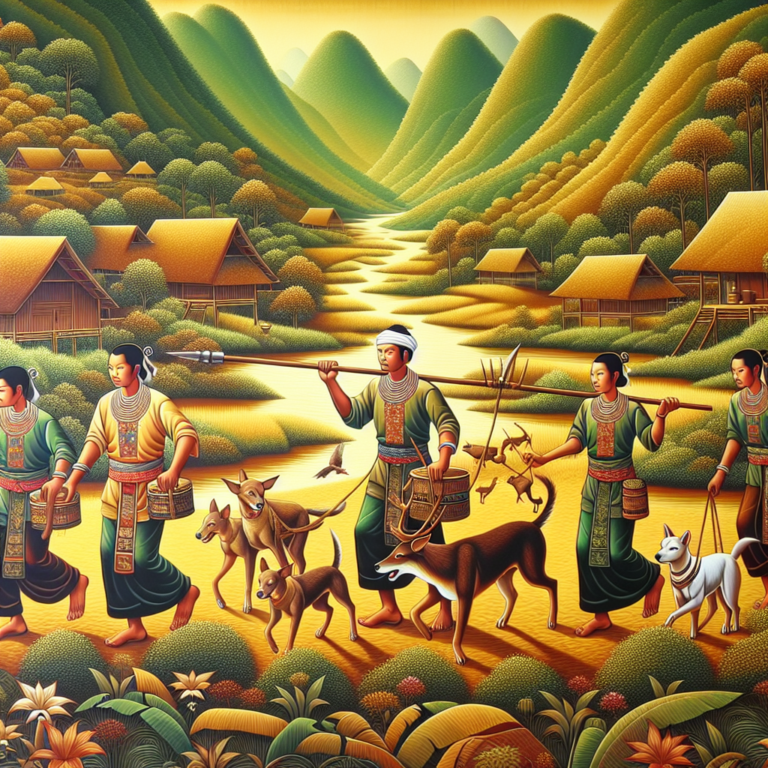
This bedtime story for kids, ‘The Tinguian Tribe’s Adventure: The Enchanted Jar of Patience’, teaches children ages 6-12 about important moral values.
Chapter 1: The Hunt Begins
The morning sun had barely touched the peaks of the Cordillera mountains when Lakay gathered the young hunters of the village. His weathered face bore the marks of a thousand hunts, and his voice carried the authority of experience.
“Today,” he announced, “we seek the great stag that has been seen near the sacred springs. Who will join me?”
Five hands shot up immediately. There was Baldo, the strongest; twins Dako and Maysa, who could track a mouse through a rice paddy; young Nesto, eager to prove himself; and Lakay’s own nephew, Kwan, who had recently come of age.
“Good,” Lakay nodded. “Prepare your spears, your head-axes, and release the hunting dogs. But remember – in these mountains, we hunt only what we need. The spirits watch, and they reward respect with bounty, and greed with nothing.”
The young men gathered their weapons, their hearts racing with anticipation. The hunting dogs – lean, muscular beasts with keen noses – whined with excitement, sensing the adventure ahead.
Kwan checked his spear one more time, running his fingers along the sharp bamboo tip. His mother had blessed it with prayers to Kabunian, the creator god, and tied a small woven talisman near the grip. “For protection,” she had said, “and for wisdom to know what is worth chasing and what is not.”
At the time, Kwan had not understood her words. By the end of this day, he would.
Chapter 2: The Chase
The party ascended into the mountains through dense jungle where giant ferns towered overhead and vines hung like nature’s curtains. Mist clung to the slopes, making everything seem magical and slightly unreal.
“Release the dogs,” Lakay commanded when they reached the hunting grounds.
The dogs bounded into the underbrush, their barks echoing through the valley. The hunters spread out, each taking a different path while keeping within earshot of the others.
Kwan moved carefully, his eyes scanning for movement, his ears straining for the sound of the dogs. The forest was alive with sounds – birdsong, insects, the rustle of unseen creatures. But no deer.
Then – a sharp, urgent bark. And another. The dogs had found something.
“This way!” Dako shouted.
The hunters converged, crashing through the undergrowth toward the sound. Kwan’s heart pounded as he ran, imagining the magnificent stag they would find.
But when they reached the clearing where the dogs circled frantically, there was no deer.
Instead, sitting peacefully on a moss-covered rock, was a jar.
Chapter 3: The Mysterious Jar
Not just any jar – a burnay of remarkable beauty. Its surface gleamed with colors that seemed impossible: deep blue like the ocean, green like new rice shoots, gold like sunrise. Patterns swirled across its surface, patterns that seemed to move when you looked at them directly.
“What is this?” Nesto whispered, reaching out to touch it.
The moment his fingers neared the jar, it slid backward, just out of reach. The movement was smooth, almost playful.
“Did you see that?” Maysa gasped.
“It moved,” Baldo confirmed, his eyes wide. “Jars don’t move.”
Lakay raised his hand for silence. His expression was thoughtful, cautious. “This is not an ordinary jar,” he said slowly. “This is a spirit vessel. I have heard of such things from my grandmother’s stories, but I never thought to see one.”
“What should we do?” Kwan asked.
“Nothing,” Lakay replied. “We should leave it and continue our hunt.”
But Nesto was not so easily deterred. “But uncle, imagine if we brought this back to the village! The spirits must have put it here for us to find. Surely it contains something valuable – gold, perhaps, or magical rice that never runs out!”
Baldo nodded eagerly. “Let’s catch it!”
Before Lakay could object, the young men rushed toward the jar. Again, it slid away – this time farther, toward the edge of the clearing.
“Chase it!” Nesto commanded.
And the chase began.
Chapter 4: Deeper into the Mountains
The jar led them on a wild pursuit through parts of the mountain none of them had ever seen. It would let them get close, almost close enough to touch, then slip away like a fish through water.
At first, the hunters laughed, treating it as a game. “Almost had it!” Dako would shout, lunging and missing. “There it goes!” Maysa would cry, pointing as the jar rolled smoothly down a path.
But as the sun climbed higher and began its descent, the laughter faded. They had wandered far from familiar territory. The trees here were older, stranger. The mist was thicker.
Kwan noticed that his mother’s talisman had grown warm against his chest.
“We should stop,” he said finally. “This isn’t right.”
“What do you mean?” Nesto panted, bent over with exhaustion. “We almost have it!”
“Do we?” Lakay asked quietly. He had followed but not joined the chase, watching with troubled eyes. “Or does it almost have us?”
Kwan looked around. The dogs had disappeared somewhere during the chase – or had they been led away? The path behind them was no longer visible. The forest had swallowed all traces of their passage.
“I think,” Kwan said slowly, “that we are the ones being hunted.”
Chapter 5: The Spirit’s Test
As if responding to his words, the jar stopped moving. It sat in the center of a circular clearing, surrounded by seven ancient trees. The air was perfectly still.
Then a voice spoke – not aloud, but directly into their minds.
“Well done, young one. You begin to understand.”
The hunters froze. From behind the jar, a figure emerged – an old woman, though her face kept shifting, young and old at the same time, beautiful and terrifying. She was dressed in the traditional weave of the Tinguian, but her clothes seemed made of woven light.
“I am the guardian of this mountain,” she said. “And that jar you have been chasing? It is empty.”
“Empty?” Baldo’s voice cracked.
“Completely empty. No gold. No magical rice. No treasure at all.”
“Then why did you make us chase it?” Nesto demanded, his earlier eagerness turning to frustration.
The spirit smiled – a smile that was somehow kind and mocking at the same time. “I did not make you do anything. I placed the jar in your path. You chose to chase it. The question is: why?”
Silence fell over the group. Kwan thought about the hunt – how they had set out to find a deer, food for the village, and had abandoned that purpose the moment something shiny appeared.
“We were greedy,” he admitted. “We saw something pretty and forgot why we came.”
“And more than that,” the spirit continued, “you were impatient. If you had simply sat with the jar, observed it, waited – you would have seen it for what it was: an illusion, a test. But you ran, and ran, and ran, never stopping to think.”
Lakay bowed his head. “You are right, grandmother spirit. We have failed the test.”
“Failed?” The spirit laughed, and the trees seemed to laugh with her. “Who said anything about failing? You learned the lesson, did you not? That is all a test is for.”
Chapter 6: The True Gift
The spirit waved her hand, and the jar’s colors faded. Beneath the illusion was an ordinary burnay, cracked and old.
“This jar,” she said, picking it up, “belonged to a chief’s daughter centuries ago. She too was impatient, always chasing the next thing, never content with what she had. Her people placed her spirit in this jar after she died, hoping she would find peace.”
“And has she?” Kwan asked.
The spirit’s form flickered, and for a moment, Kwan saw a young woman within the old woman’s shape – a girl not much older than himself, with sad eyes.
“Almost,” the spirit whispered. “Every time the jar leads impatient hearts to learn patience, she grows closer to peace. You have given her a great gift today.”
The spirit set down the jar and gestured toward a gap in the trees that had not been there before. “The path home is that way. Your dogs wait at the edge of the sacred grove.”
“Wait,” Kwan said. “Is there anything we can do? To help her find peace completely?”
The spirit studied him for a long moment. “You could tell her story. Not as a warning of what not to do, but as a reminder that all of us struggle with impatience, and that it is never too late to learn. Every time her story is told with kindness, she grows lighter.”
Kwan nodded solemnly. “I will tell it. I promise.”
Chapter 7: The Return
The journey home was swift – unnaturally so, as if the mountain itself was shortening the path. The dogs greeted them with joyful barks, and the familiar slopes of their village appeared before sunset.
Lakay said nothing about the failed hunt. The others, subdued, went to their homes.
But that night, Kwan asked his mother to gather the children of the village. And by firelight, he told the story of the enchanted jar – not as a warning, but as a tale of a restless girl who was learning, even after death, to find peace.
“Patience,” he concluded, “is not just waiting. It is understanding that not everything worth having can be chased. Sometimes, the greatest treasures are found by sitting still and seeing clearly.”
In the mountains far above, something shifted. The old jar, resting in its clearing, cracked one final time – and from within, a soft light rose, ascending through the trees toward the stars.
The spirit of the chief’s daughter had finally found her way home.
And Kwan felt, somehow, that he had done more that day than any hunt could have accomplished. He had helped a soul find peace – and in doing so, had learned something about his own.
Moral Lessons
- Patience and contentment are greater treasures than any prize we might chase; true wisdom lies in knowing when to pursue and when to simply observe.
Test Your Understanding
1Who went on a deer hunt?
Frequently Asked Questions
What is the moral lesson of The Tinguian Tribe’s Adventure: The Enchanted Jar of Patience?
What age is this story appropriate for?
How long does it take to read The Tinguian Tribe’s Adventure: The Enchanted Jar of Patience?
What culture does this story come from?
Can I use this story for teaching?
Frequently Asked Questions
What is The Enchanted Jar of Patience story about?
The Enchanted Jar of Patience is a bedtime story set in the Cordillera mountains, following young hunters from the Tinguian tribe on an adventure. It teaches children ages 6-12 important moral values like patience, respect, and taking only what you need from nature.
What age group is The Tinguian Tribe’s Enchanted Jar of Patience story suitable for?
This story is written for children between 6 and 12 years old. It uses adventure and fantasy elements to deliver meaningful life lessons in a way that’s engaging and easy for kids in that age range to understand and enjoy at bedtime.
What moral lesson does The Enchanted Jar of Patience teach kids?
The story teaches children the value of patience, respect for nature, and avoiding greed. Through the young Tinguian hunters’ journey, kids learn that respecting the world around them brings rewards, while greed leads to nothing — a timeless lesson delivered through exciting storytelling.
📚 Recommended Books
Handpicked for readers like you
As an Amazon Associate, we earn from qualifying purchases. These recommendations are personalized based on this story's themes and your reading history.
Who are the main characters in this Tinguian tribe story?
The main characters include Lakay, a wise and experienced elder hunter, and five young hunters: Baldo, twins Dako and Maysa, eager Nesto, and Kwan — Lakay’s nephew who has recently come of age. Together they hunt a great stag near sacred mountain springs.
Is this a good bedtime story for teaching kids about indigenous culture?
Yes! This story is set among the Tinguian people of the Philippine Cordillera mountains and incorporates authentic cultural elements like traditional hunting practices, spiritual beliefs, and community values. It’s a wonderful way to introduce children to indigenous culture while sharing a meaningful moral lesson.
