

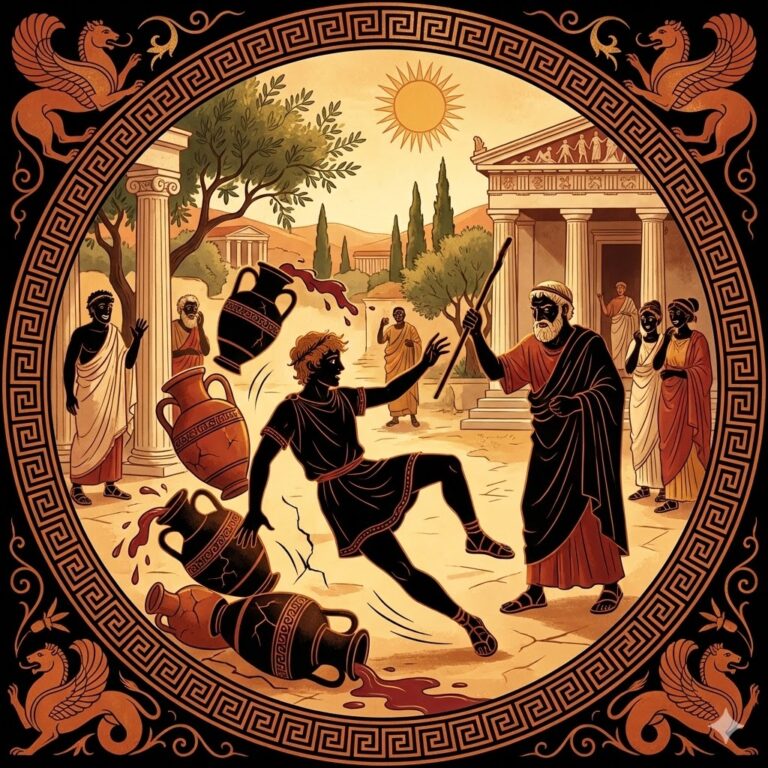
This bedtime story for kids, ‘Perseverance/” title=”More stories about perseverance”>Perseverance leads to success’, teaches children ages 6-12 about important moral values.
Chapter One: The Boy Who Dreamed of Bronze
Long ago, in the ancient city-state of Corinth, where artisans crafted treasures of bronze and clay that were famous throughout the Mediterranean world, there lived a young boy named Theron. His name meant “hunter,” but Theron had set his sights on a different kind of prey: he dreamed of becoming a master metalworker, creating magnificent bronze sculptures that would stand in temples for thousands of years.
There was just one problem. Theron’s hands shook.
Not always, and not terribly, but enough. When he held a hammer, it would tremble slightly. When he tried to etch fine details into soft metal, the lines would waver. The other apprentices at the workshop laughed behind his back, calling him “Theron the Trembler.”
“Perhaps you should consider another trade,” suggested Daedalus, the master craftsman who ran the workshop. Though his words were not unkind, they struck Theron like a blow to the chest. “Metalwork requires a steady hand. You might find more success as a merchant or a farmer.”
Theron returned home that evening with tears streaming down his cheeks. His mother, Calliope, found him sitting beneath the old pomegranate tree in their courtyard, drawing patterns in the dirt with a stick.
“What troubles you, my son?” she asked, settling beside him.
“Master Daedalus says my hands are too unsteady for metalwork. He says I should give up my dream.”
Calliope was quiet for a long moment, watching a spider spinning its web between two branches of the pomegranate tree. “Do you see that spider?” she finally asked.
Chapter Two: The Lesson of the Spider
Theron looked up at the spider, which was attempting to stretch its thread from one branch to another. As they watched, a gust of wind snapped the delicate strand, and the spider tumbled down, dangling by a single thread.
“Watch,” Calliope whispered.
The spider climbed back up and began again. Once more, the wind broke its work. And once more, the spider climbed back up.
Theron and his mother watched as the spider failed seven times. Each time, it would pause for just a moment, as if gathering its strength, and then begin again. On the eighth attempt, the wind was calm, and the spider successfully stretched its thread between the branches.
“That spider does not have steady legs,” Calliope observed. “It cannot control the wind. But it has something more powerful: the determination to try again and again until it succeeds.”
“But Mother,” Theron protested, “my hands will always shake. How can determination change that?”
Calliope smiled and took his trembling hands in her own steady ones. “Perhaps you cannot stop your hands from shaking. But you can learn to work with them, to find new techniques, to practice until your skill overcomes your limitation. The gods do not always bless us with natural gifts, Theron. Sometimes, our greatest achievements come from overcoming the challenges we were given.”
Chapter Three: A New Approach
Inspired by his mother’s words, Theron returned to the workshop the next day. But instead of hiding his shaking hands in shame, he approached Master Daedalus with a proposal.
“Please, Master, give me one more month. I will not ask you to teach me; I know you have other students who need your attention. Just let me work in the corner of the workshop, and at the end of the month, judge my progress.”
Daedalus studied the young man’s face, seeing something in his eyes that hadn’t been there before: a fierce determination that reminded him of his own youth. “Very well,” he agreed. “One month.”
Theron began experimenting. He discovered that if he braced his wrist against a wooden rest he carved himself, he could steady his hammer strokes. He found that by working with thicker metals at first, he could make larger movements that didn’t require perfect precision.
But his most important discovery came by accident. One evening, while watching older craftsmen work, he noticed that Master Daedalus’s most beautiful pieces weren’t made with a single tool but with dozens of specialized implements, each designed for a specific purpose.
“What if,” Theron wondered aloud, “I created tools that work with my trembling rather than against it?”
Chapter Four: The Tools of Perseverance
Over the following weeks, Theron spent every spare moment designing and crafting new tools. He made a special engraving stylus with a wider grip that absorbed some of his hand’s movement. He invented a small frame that held pieces steady while he worked, allowing him to rest his arms against it.
He also developed something no one else in the workshop used: a technique of making many small, quick marks instead of long, continuous lines. Where other craftsmen drew a curved line in one smooth motion, Theron created the same curve with a hundred tiny touches. The result, surprisingly, gave his work a unique texture that was oddly beautiful.
The other apprentices stopped laughing. They began watching Theron with curiosity, then with respect.
“How do you make those patterns?” asked Aristides, the most talented young craftsman in the workshop. “They look like the scales of a fish or the feathers of a bird.”
Theron showed him his technique, and soon other apprentices were trying to imitate it. But none could quite match Theron’s style, because they didn’t have his particular challenge that had forced him to innovate.
Chapter Five: The Test
When the month ended, Master Daedalus called Theron to the center of the workshop. All the other craftsmen and apprentices gathered around to witness the judgment.
“Show me what you have made,” Daedalus commanded.
With trembling hands, Theron unwrapped a cloth bundle and placed his creation on the workbench: a small bronze owl, sacred symbol of Athena, goddess of wisdom and craft. The owl was no larger than a man’s fist, but every detail was exquisite. Its feathers seemed to ripple with life, rendered in Theron’s distinctive textured style. Its eyes were inlaid with silver, gleaming with an almost supernatural intelligence.
Master Daedalus picked up the owl and examined it in silence. The workshop held its breath.
“This texture,” Daedalus murmured, tracing his finger over the feathers. “I have never seen anything like it. It captures light in a way that makes the bronze seem almost soft, almost alive.”
He set the owl down and looked at Theron with new eyes. “This is remarkable work. Not despite your limitations, but because of them. You have discovered something new because you had to.”
Chapter Six: The Master’s Lesson
That evening, Master Daedalus invited Theron to his private workshop, an honor usually reserved for craftsmen who had completed their apprenticeship.
“Let me tell you something I have never shared with the other students,” Daedalus said, pouring two cups of watered wine. “When I was young, I was not the most talented apprentice in my workshop. There was another boy, Nikias, whose hands were so steady he could draw a perfect circle without any guide. Everyone said he would become the greatest metalworker in all of Greece.”
“What happened to him?” Theron asked.
“Because everything came easily to him, Nikias never learned to struggle. When he faced his first real challenge, a commission that required techniques he had never used before, he gave up. He said it was impossible and became a wine merchant instead.” Daedalus shook his head. “He had talent but not perseverance. You have perseverance, Theron. That is the more valuable gift.”
Daedalus raised his cup. “To perseverance, which transforms obstacles into opportunities.”
Chapter Seven: The Temple Commission
Years passed, and Theron’s reputation grew throughout Greece. His distinctive textured style became highly sought after, and other craftsmen tried to learn his techniques. But the tools and methods he had developed were so specifically designed for his own hands that others struggled to replicate his results.
The greatest moment of his career came when the city of Athens commissioned him to create bronze panels for a new temple dedicated to Athena. It was the most prestigious assignment any craftsman could receive.
As Theron worked on the panels, creating scenes of Athena in her many aspects, wise goddess of craft, fierce goddess of strategic warfare, and gentle patron of heroes, he thought often of the spider his mother had shown him so many years ago.
When the panels were installed, citizens came from across Greece to admire them. They marveled at the lifelike quality of the feathers on Athena’s owl, the texture of her robes, the way light seemed to dance across the bronze surfaces.
“How did you achieve this?” they asked.
Theron would smile and show them his hands, still trembling after all these years. “With these,” he would say. “And with patience. And with the determination to try again every time I failed.”
The Athenians were astonished. They had assumed that such beautiful work could only come from the steadiest hands in all of Greece. Instead, it had come from hands that never stopped shaking, guided by a heart that never stopped trying.
Moral Lessons
- True success comes not from natural talent alone, but from the perseverance to keep trying despite obstacles. Our limitations can become our greatest strengths when we refuse to give up.
Test Your Understanding
1Who was Bellerophon?
Frequently Asked Questions
What is the moral lesson of Perseverance leads to success?
What age is this story appropriate for?
How long does it take to read Perseverance leads to success?
What culture does this story come from?
Can I use this story for teaching?
Frequently Asked Questions
What is the moral of the perseverance leads to success story?
The story teaches children that setbacks and self-doubt don’t have to stop you from reaching your dreams. Through Theron’s journey, kids learn that consistent effort, resilience, and belief in yourself — even when others doubt you — are the keys to achieving success.
What age group is this perseverance bedtime story suitable for?
This bedtime story is designed for children aged 6 to 12. The language and themes are engaging enough for older kids while still being accessible to younger readers, making it a great shared reading experience for families with children across that age range.
Who is Theron in the story?
Theron is a young boy in ancient Corinth who dreams of becoming a master metalworker. Despite having trembling hands and being mocked by other apprentices, he refuses to give up on his passion, making him the perfect character to illustrate how perseverance leads to success.
📚 Recommended Books
Handpicked for readers like you
As an Amazon Associate, we earn from qualifying purchases. These recommendations are personalized based on this story's themes and your reading history.
Why do kids need stories about perseverance?
Stories about perseverance help children understand that failure and struggle are a normal part of learning. They build emotional resilience, teach growth mindset, and inspire kids to keep trying even when things get hard — lessons that apply to school, friendships, and everyday challenges.
Is this bedtime story based on real history?
The story is a work of fiction set in the ancient city-state of Corinth, a real historical location famous for its bronze craftsmanship. While the characters are fictional, the historical backdrop adds an educational layer, giving children a glimpse into the ancient Mediterranean world as they enjoy the tale.
