

This bedtime story for kids, ‘The Patient turtle and the Mounta’, teaches children ages 6-12 about important moral values.
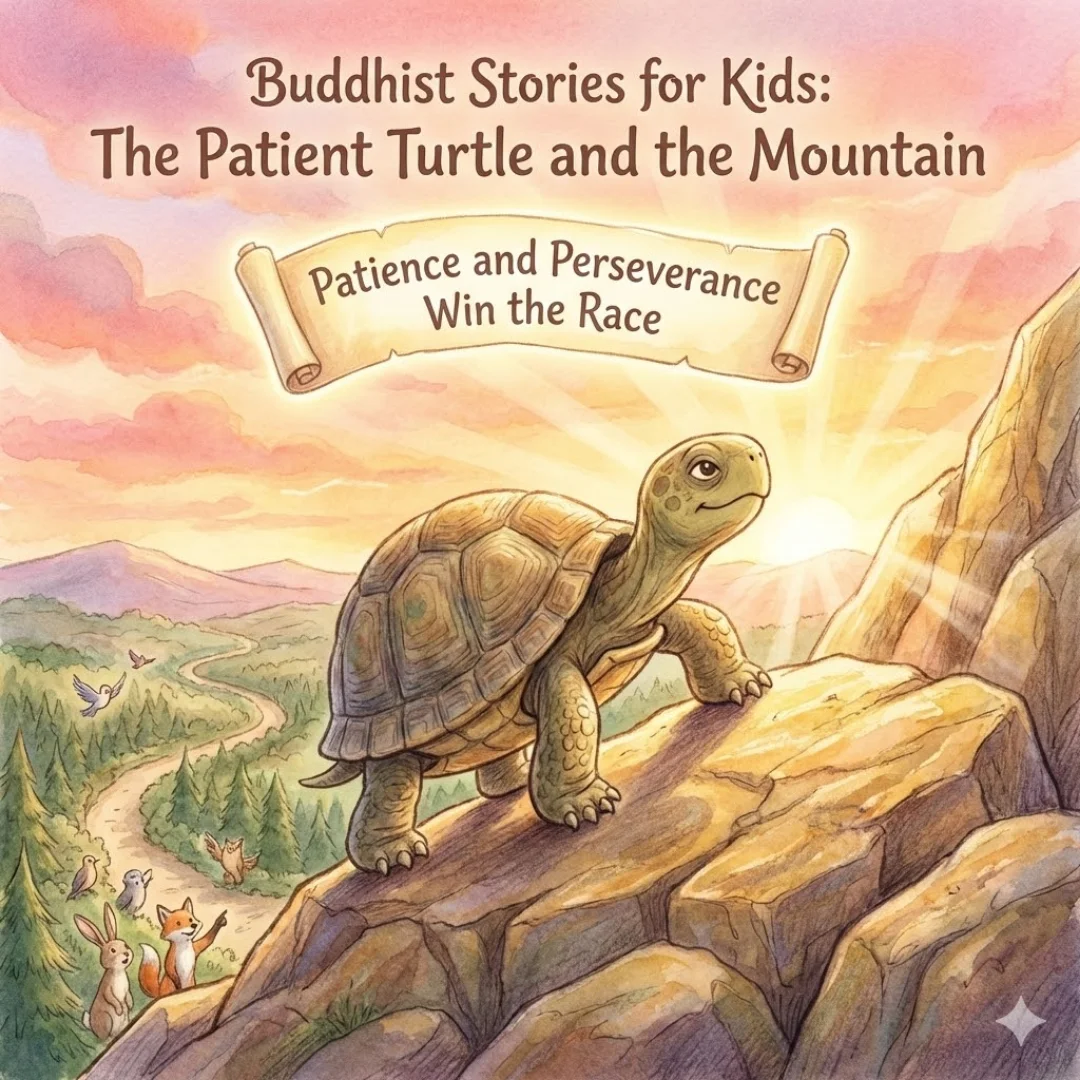
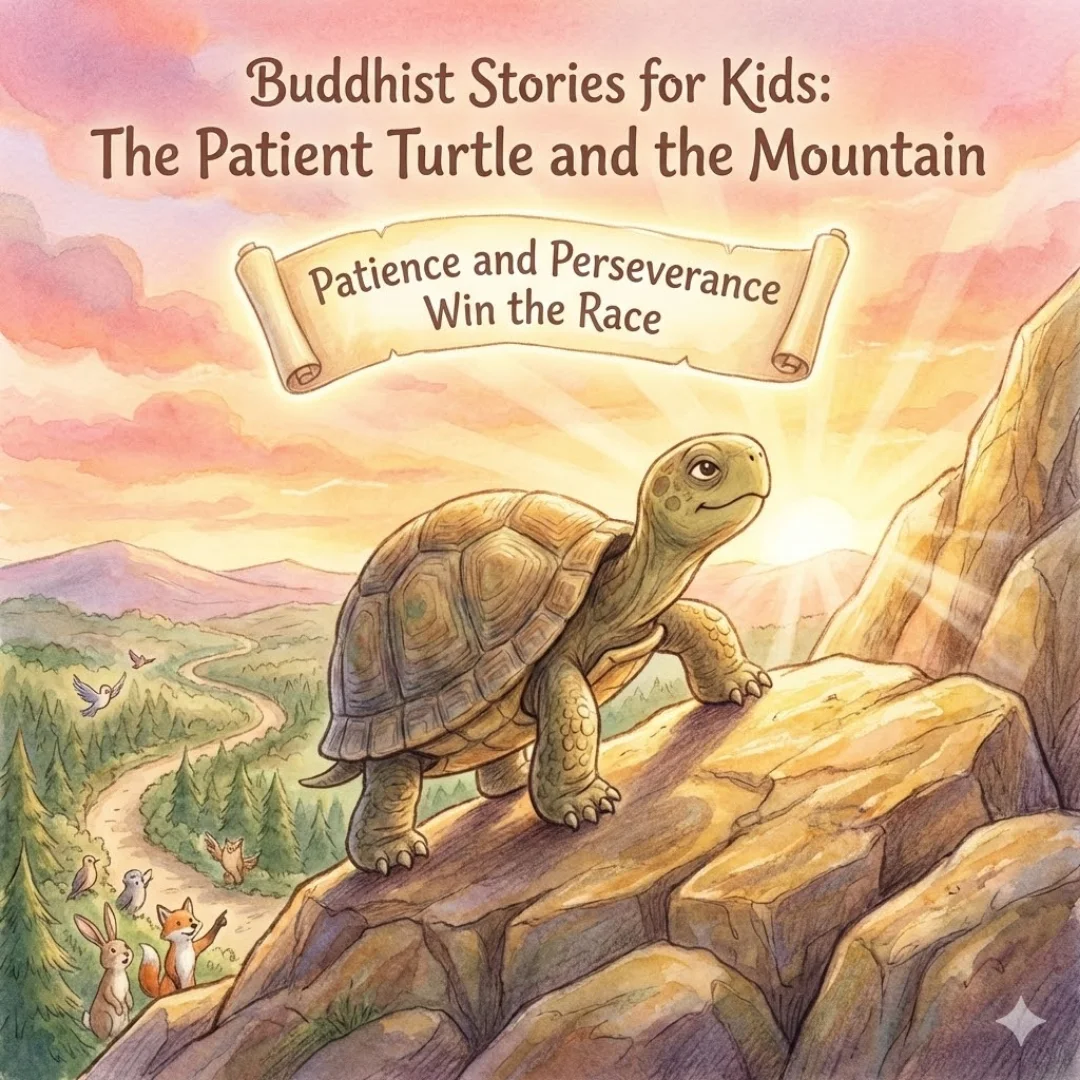
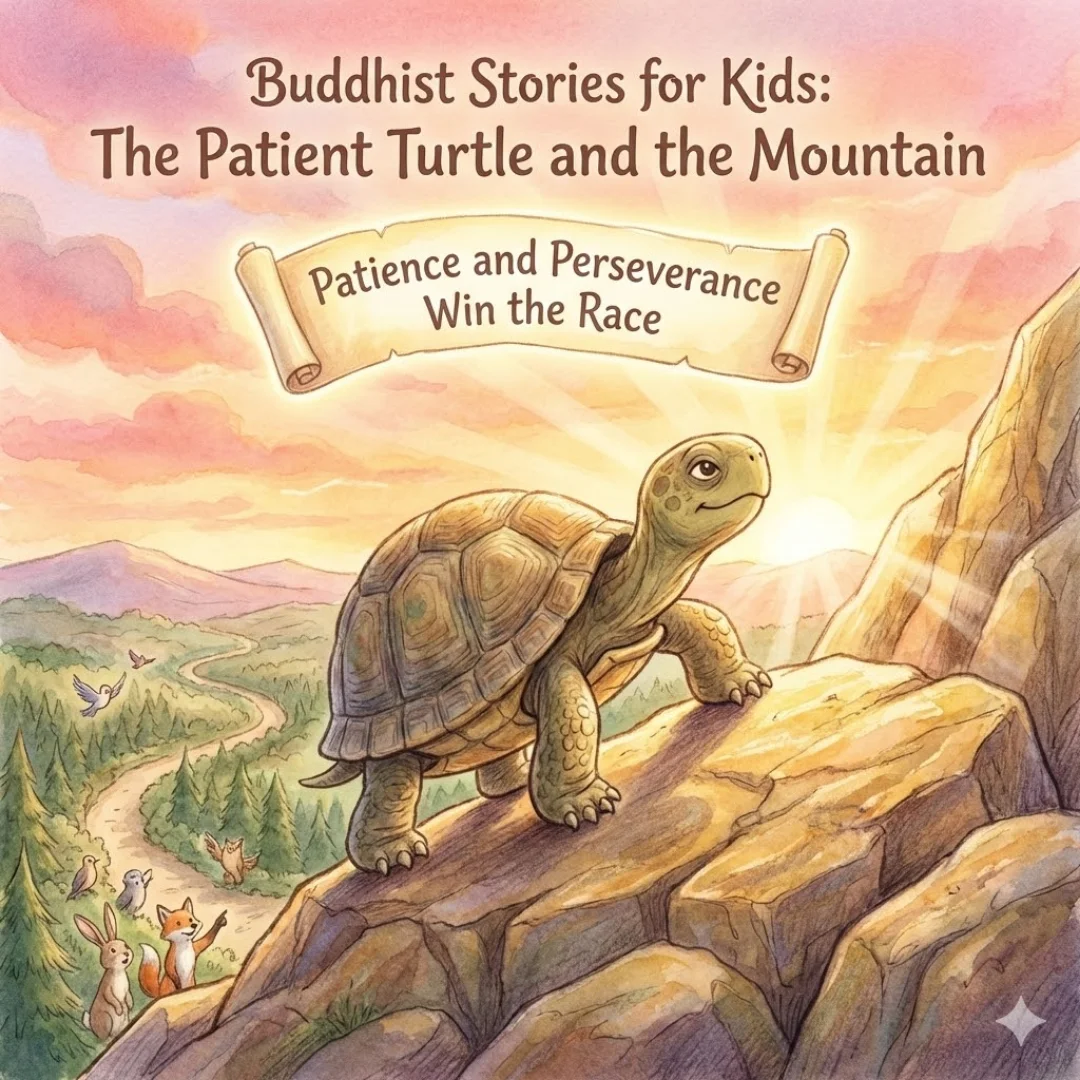
At the edge of a great mountain, where the forest met the rocky slopes, there lived a young turtle named Kavi.
His shell was the color of weathered stone. His legs were short and sturdy. He moved slowly—always slowly—as turtles do.
But inside Kavi’s heart burned a dream that seemed impossible.
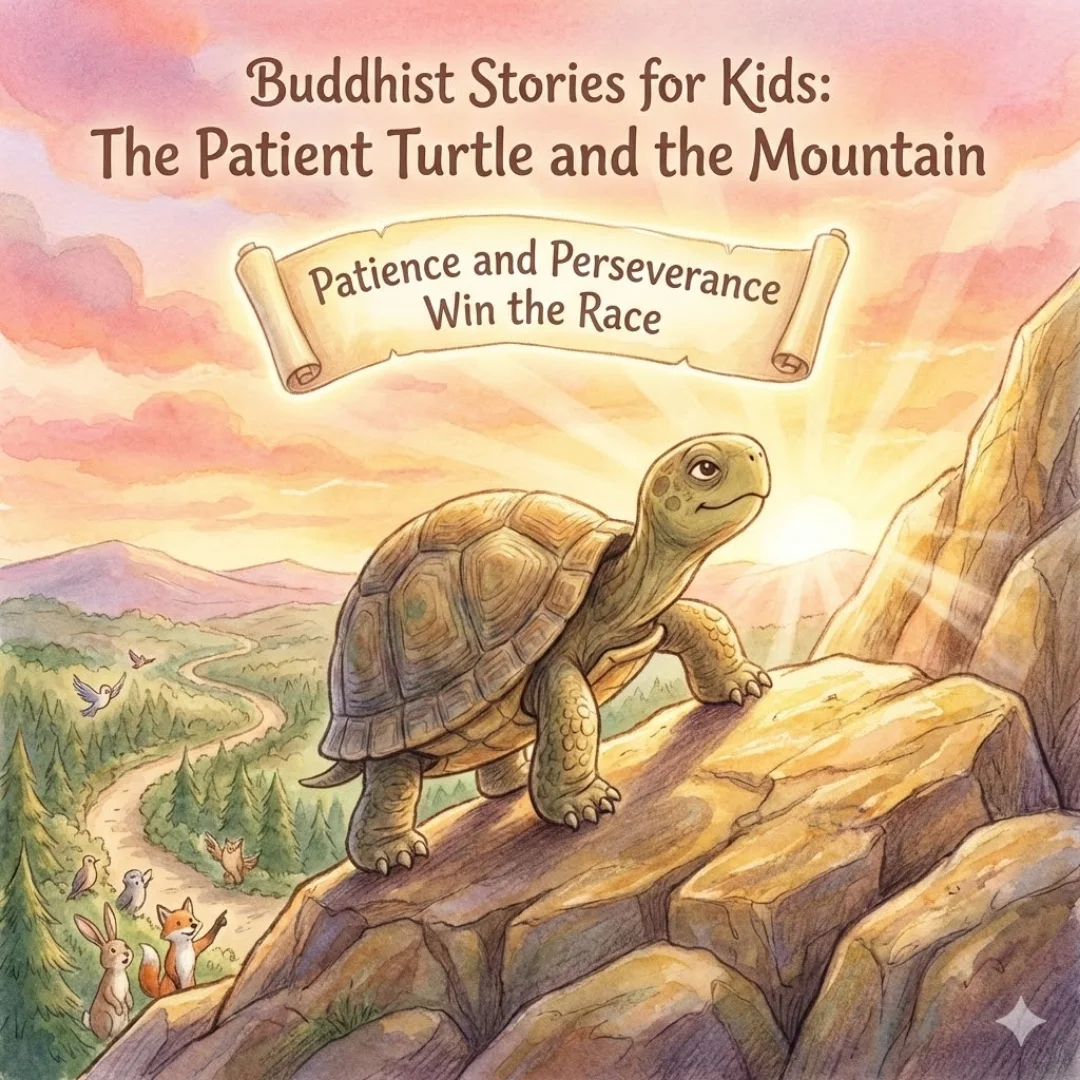
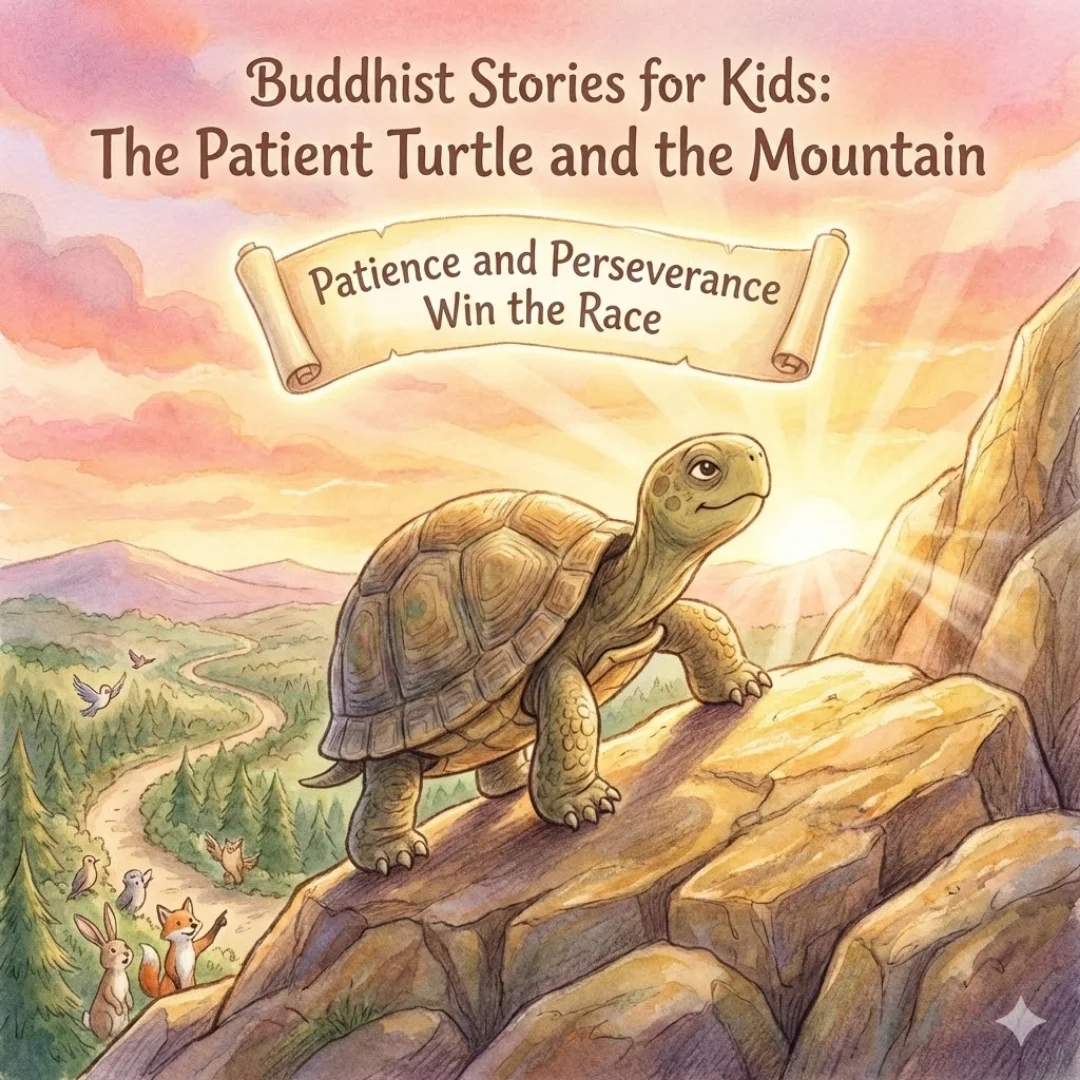
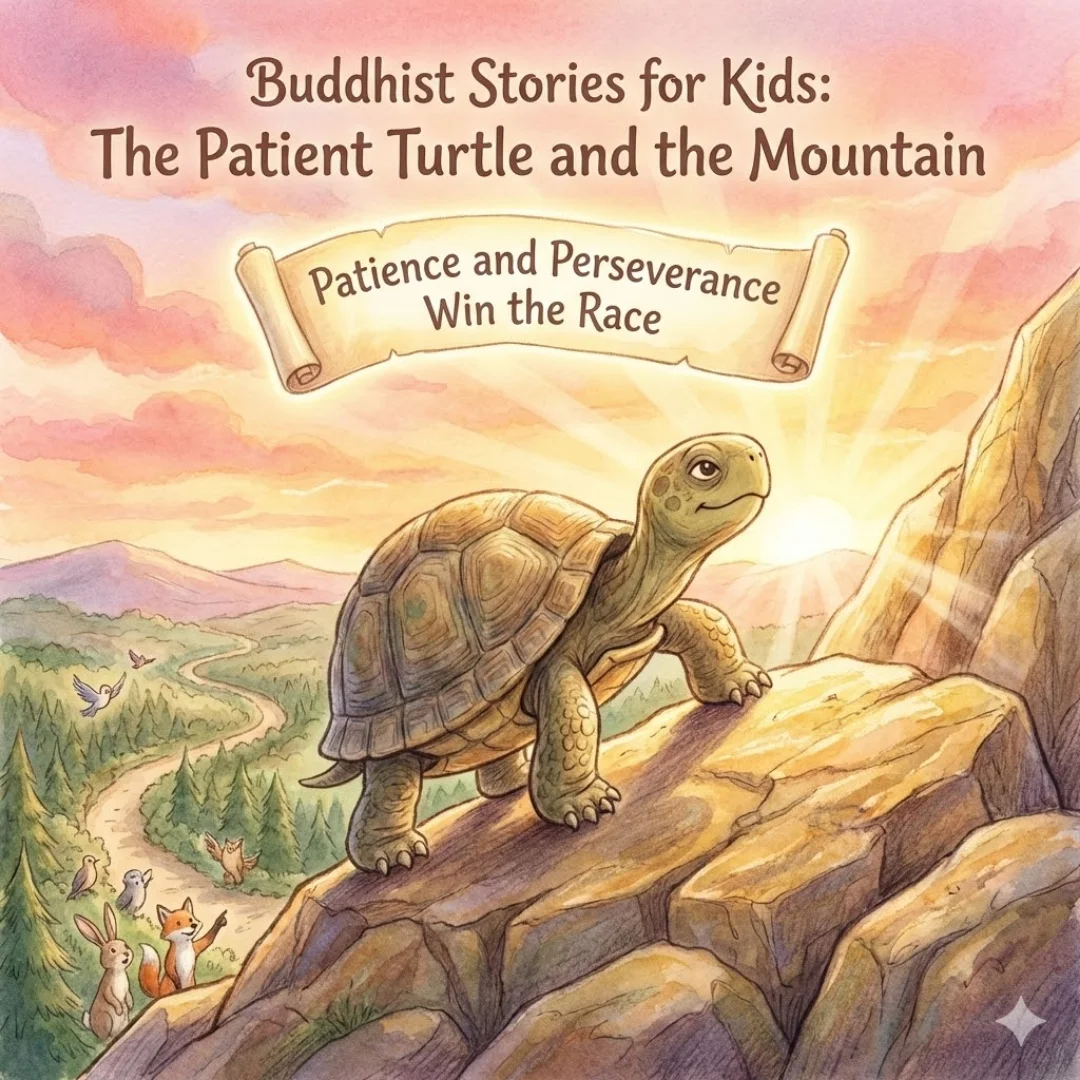
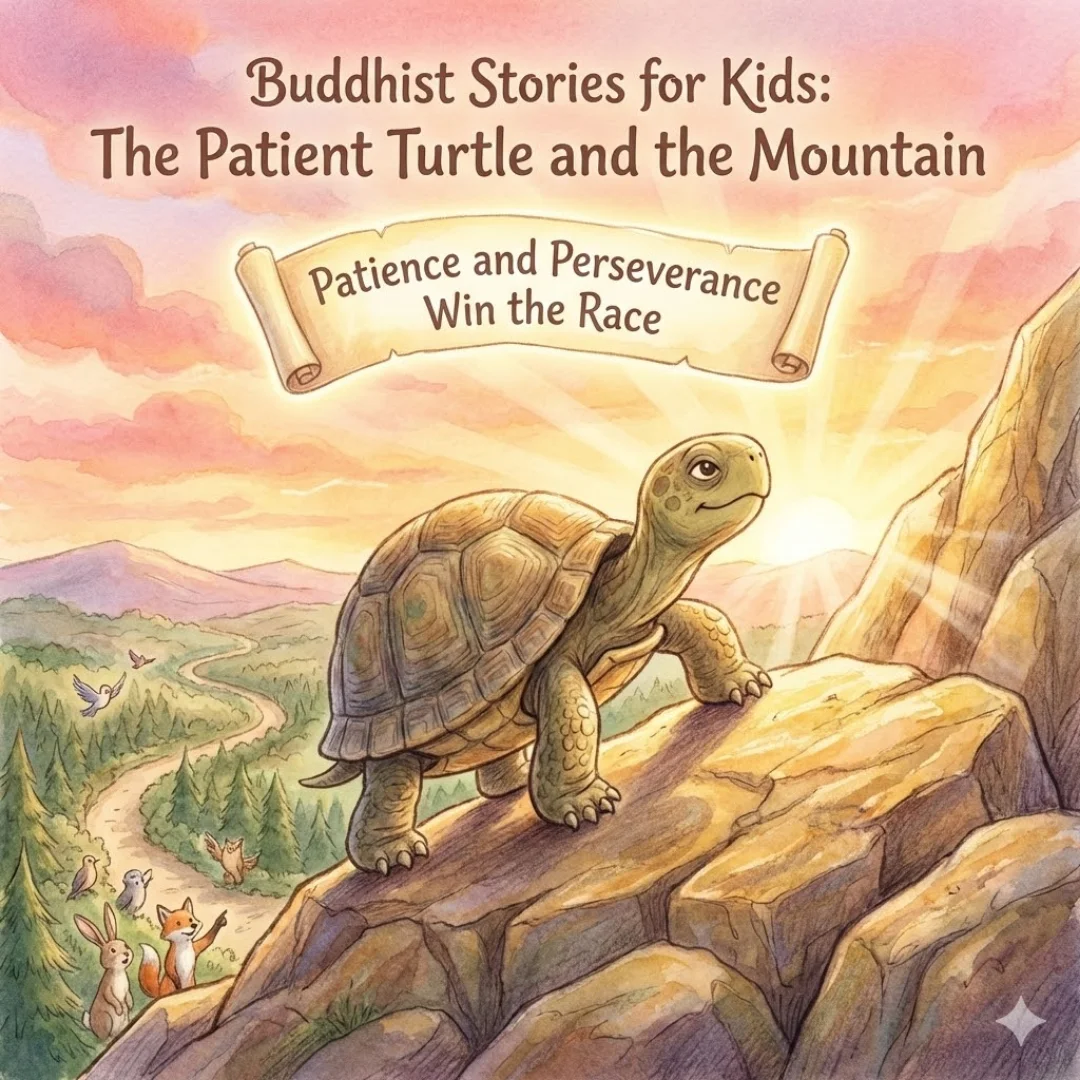
He wanted to climb to the very top of the mountain and watch the sunrise from above the clouds.
* * *
“A turtle? Climb a mountain?”
Riku the rabbit nearly choked on the clover he was chewing when Kavi announced his plan.
“That’s the most ridiculous thing I’ve ever heard!” the rabbit said, his nose twitching with amusement. “I could hop to the summit and back down again before you’d climbed ten steps!”
Pranav the peacock spread his magnificent tail feathers, shimmering in blues and greens like a waterfall of jewels.
“The wind alone would blow you backward,” he said with a dismissive sniff. “Some dreams, my dear turtle, are simply not meant for creatures like you. You should be content pulling your head into your shell and staying where you belong—in the mud by the pond.”
Even Maya the monkey, swinging from a nearby branch, shook her head.
“Kavi, I love you, but this is madness. That mountain is taller than the sky! Its peak is hidden in clouds! Birds take half a day to fly there. How long would it take you? Years? Decades?”
Kavi looked up at the towering mountain. Its slopes seemed to stretch forever. The summit was so high it disappeared into white mist.
He felt small. He felt slow. He felt inadequate.
But then he remembered the words of the wise old elephant, Bodhi, who lived by the lotus pond.
* * *
Bodhi was ancient—so old that his tusks had yellowed to the color of old cream and his eyes held the depth of centuries.
He had traveled to distant lands in his youth and sat at the feet of monks who taught the Buddha’s wisdom. Now he spent his days in meditation beneath the spreading banyan tree, sharing what he had learned with anyone who would listen.
Kavi had often sat beside him, listening to stories and teachings.
“Master Bodhi,” Kavi had asked one evening, “how does one accomplish something that seems impossible?”
The old elephant had opened one eye and regarded the little turtle with infinite gentleness.
“The Buddha taught us,” Bodhi said slowly, “that great things are not accomplished by strength or speed, but by persistent effort. A jug fills drop by drop. A mountain is conquered step by step.”
He touched Kavi’s shell gently with the tip of his trunk.
“Do not concern yourself with the destination,” Bodhi continued. “Concern yourself only with the single step before you. Take that step mindfully, with full attention. Then take the next. And the next. Before you know it, you will look back and see you have traveled far.”
“But what if others mock me?” Kavi had asked. “What if they say I’m too slow, too small, too weak?”
Bodhi’s eyes had twinkled with ancient wisdom.
“The Buddha said: ‘Do not dwell in the past, do not dream of the future, concentrate the mind on the present moment.’ Let others laugh if they must. You cannot control their thoughts. You can only control your own actions. Walk your path with patience and right effort. That is all any creature can do.”
* * *
Now, standing at the mountain’s base with his friends mocking him, Kavi remembered those words.
“I will try anyway,” he said quietly.
And on the first day of spring, when the morning air was cool and fresh, Kavi began his journey.
Left foot. Right foot. Left foot. Right foot.
His pace was slow—agonizingly slow to anyone watching. But it was steady.
The mountain path was steep and rocky. Thorns caught at his legs. Pebbles slid beneath his feet. But Kavi did not rush. He simply moved forward, one careful step at a time.
* * *
By midday, Riku the rabbit’s curiosity got the better of him.
“Fine!” he declared. “I’ll show that foolish turtle how it’s really done!”
With powerful hind legs, Riku bounded up the mountainside. He leaped over boulders. He dashed through meadows of wildflowers. His speed was astonishing.
In just one hour, Riku reached a height that Kavi wouldn’t reach for days.
The rabbit looked back and saw the tiny speck of the turtle, far, far below, barely visible.
“Ha! Just as I thought,” Riku said to himself. “I’m already halfway up, and that turtle has barely left the forest. I have so much time, I could take a nap and still beat him to the top.”
A soft patch of grass beckoned invitingly. The sun was warm. The breeze was gentle.
“Just a short rest,” Riku murmured, settling into the grass. “The turtle is so far behind, there’s absolutely no hurry…”
His eyes closed. His breathing deepened. And Riku fell into a deep, comfortable sleep.
* * *
Meanwhile, Kavi climbed.
He did not know that Riku was sleeping. He did not think about where the rabbit was or how much faster he was moving.
Kavi’s entire world had narrowed to this: the rock before him. The next foothold. The single breath he was taking right now.
This is what the Buddha meant by mindfulness—being fully present in each moment, not scattered by thoughts of the past or worries about the future.
When his legs grew tired, Kavi did not despair. He simply rested briefly, breathing slowly, watching a line of ants march past, marveling at how they too carried burdens much larger than themselves.
Then he continued.
Left foot. Right foot. Left foot. Right foot.
* * *
The next morning, Pranav the peacock decided to show everyone the truly superior way to reach the mountaintop.
He spread his wings—though peacocks are not built for long flights—and launched himself upward.
He flew and flew, his powerful wings beating against the air. For a while, it seemed he would reach the summit easily.
But the mountain was far taller than Pranav had realized. The air grew thin and cold. His wings ached. His breath came in ragged gasps.
Exhausted, the peacock landed on a ledge halfway up, folded his beautiful tail, and admitted defeat.
“The mountain is too high,” he panted. “No bird could reach that summit. I was wise to give up before exhausting myself completely.”
He rested there, watching the clouds drift by, convinced that Kavi must have given up long ago.
He did not see the small turtle, far below, still climbing.
* * *
Days passed. Then weeks.
Kavi’s world became the mountain.
Sometimes the path was smooth and easy. Sometimes it was treacherous, forcing him to find creative routes around obstacles. Sometimes rain made the rocks slippery, and he had to wait for the sun to dry them.
But always—always—he continued.
He met other creatures along the way.
A family of marmots offered him seeds and encouragement. “We’ve lived on this mountain all our lives,” the mother marmot said, “and we’ve never seen a turtle climb before. You have a brave heart, little one.”
A golden eagle, soaring overhead, called down, “The summit is still far, turtle! But you are closer than you were yesterday. That is what matters.”
These kindnesses sustained Kavi when doubt crept into his mind.
* * *
On the forty-seventh day of his journey, as dawn broke, Kavi climbed over the final rocky outcrop…
…and found himself standing on the summit of the mountain.
The world spread out beneath him like a vast painting. The forest where he’d lived his whole life was a green carpet far below. Rivers wound like silver ribbons through valleys. Other mountains marched toward the horizon.
And above him—oh, above him!
The sky was turning from deep purple to rose to brilliant gold. The sun, that glorious sun, rose slowly from behind distant peaks, painting everything with light.
Tears filled Kavi’s eyes. Not tears of sadness, but of overwhelming joy and gratitude.
He had done it.
A slow, small turtle had climbed a mountain that touched the clouds.
* * *
Kavi sat on the summit for a long time, breathing in the thin, pure air, feeling the sun warm his shell.
And in that moment of stillness and achievement, he understood something profound.
The journey itself had been the treasure.
Each step had taught him patience. Each obstacle had taught him problem-solving. Each moment of doubt had taught him to trust in persistent effort.
He had not climbed this mountain to prove the other animals wrong. He had climbed it to prove something to himself: that with patience, persistence, and mindful attention to each present moment, even the impossible becomes possible.
* * *
When Kavi finally descended (which took another forty days), he found Riku the rabbit still sleeping in the meadow—he had meant to rest for an hour but had slept for nearly a month!
He found Pranav the peacock still sitting on his ledge halfway up, convinced the summit was unreachable.
They both stared at Kavi in disbelief when he told them he had reached the top.
“But… but how?” Riku sputtered. “You’re so slow!”
Kavi smiled—a gentle, knowing smile.
“I am slow,” he agreed. “But I never stopped. That is the difference between speed and persistence. Speed without persistence is a flash of lightning—bright but brief. Persistence without speed is a river—slow but unstoppable.”
Pranav ruffled his feathers uncomfortably. “But surely the wind, the cold, the steepness—”
“Were all very real challenges,” Kavi acknowledged. “But the Buddha taught that suffering comes from attachment to desires and aversion to difficulties. I did not desire to reach the summit instantly, so I was not frustrated by my slow progress. I did not resist the challenges, so they did not defeat me. I simply accepted each moment as it came and did what I could.”
* * *
Old Bodhi the elephant, hearing of Kavi’s achievement, smiled his ancient smile.
When Kavi came to visit him by the lotus pond, Bodhi touched the turtle’s shell with his trunk—a blessing and an acknowledgment.
“You have learned well,” the old elephant said. “You have lived the Buddha’s teaching: ‘Drop by drop is the water pot filled. Likewise, the wise one, gathering it little by little, fills oneself with good.’”
“But Master,” Kavi said, “I still feel like the same small, slow turtle I always was.”
“And that,” Bodhi said, “is the greatest wisdom of all. You did not climb that mountain to become something you were not. You climbed it by being exactly what you are—patient, persistent, and present in each moment. This is the path to enlightenment itself. Not by becoming someone else, but by fully becoming your truest self.”
* * *
Kavi lived the rest of his life by the pond, content with his small, slow existence.
But sometimes, when the young animals complained that their goals seemed impossible, he would tell them the story of how a turtle climbed a mountain.
And he would share the wisdom he had learned:
That great things are accomplished not in giant leaps, but in small, persistent steps.
That speed means nothing if you do not persist.
That the journey itself—each mindful step—is just as important as the destination.
And that every creature, no matter how small or slow, carries within them the potential for greatness, if only they have the patience to discover it.
The Buddha taught that the path to awakening is walked one step at a time. Kavi had walked that path—literally—and found its truth.
And sometimes, on clear mornings, Kavi would look up at the mountain summit, glowing in the sunrise, and smile.
For he alone knew what the world looked like from up there.
And he knew, beyond all doubt, that he had the strength to return whenever he wished.
Not because he was fast.
Not because he was powerful.
But because he had learned the greatest truth of all:
That patience and persistence can move mountains.
Or, in Kavi’s case, move a turtle over one.
MORAL LESSONS:
– Great achievements come from persistent effort, not speed or strength
– Focus on the present moment rather than being overwhelmed by the distant goal
– Small, steady steps eventually cover great distances
– Do not let others’ doubts prevent you from pursuing your dreams
– The journey itself teaches wisdom as valuable as reaching the destination
– Being true to your nature is more important than trying to be something you’re not
– Mindfulness and patience are more powerful than rushing
BUDDHIST PRINCIPLES INTEGRATED:
– Right Effort (samma vayama) – persistent, balanced effort
– Mindfulness (sati) – being fully present in each moment
– Non-attachment – not clinging to quick results or being averse to difficulties
– The Gradual Path – enlightenment comes step by step, not all at once
– Buddha’s teaching: “Drop by drop is the water pot filled”
– Acceptance of one’s nature without self-judgment
– The Middle Way – neither giving up nor rushing recklessly
– Compassion and wisdom from Bodhi (bodhi means “awakening” in Sanskrit)
ENGAGEMENT ENHANCEMENTS ADDED:
+ Vivid sensory details (peacock’s shimmering feathers, sun painting with light)
+ Character depth through internal thoughts and doubts
+ Dialogue reveals personalities and relationships
+ Scene breaks for better pacing
+ Emotional arc (doubt → determination → achievement → wisdom)
+ Supporting characters that mirror reader’s own doubts
+ Specific details (47 days climbing, descriptions of summit view)
+ Show don’t tell throughout (Kavi’s persistence shown through actions)
+ Universal themes accessible to all children
+ Satisfying emotional resolution
NOTE ON AUTHENTICITY:
This is not an ancient Jataka tale, but a modern story incorporating authentic Buddhist teachings about patience, persistence, and mindfulness. The wisdom shared is faithful to the Buddha’s teachings even though the narrative is contemporary.
SOURCES:
– [Introduction to the Jātaka Stories](https://ancient-buddhist-texts.net/Reference/Rhys-Davids/Introduction-to-the-Jataka-Stories.htm)
– [Jataka Tales Index](https://sites.pitt.edu/~dash/jataka.html)
– Buddhist teachings on Right Effort and Mindfulness
– “The Tortoise and the Hare” (Aesop’s Fables) – narrative inspiration
Test Your Understanding
1. What was Kavi the turtle’s impossible dream?
Frequently Asked Questions
What is the moral lesson of The Patient Turtle and the Mounta?
What age is this story appropriate for?
How long does it take to read The Patient Turtle and the Mounta?
What culture does this story come from?
Can I use this story for teaching?
Frequently Asked Questions
What is ‘The Patient Turtle and the Mountain’ bedtime story about?
This bedtime story follows Kavi, a young turtle who dreams of climbing to the top of a great mountain to watch the sunrise above the clouds. Despite being mocked by faster animals like Riku the rabbit and Pranav the peacock, Kavi pursues his seemingly impossible dream with determination and patience.
What age group are these bedtime stories for kids designed for?
This moral story is specifically written for children ages 6-12. The language, themes, and storytelling style are crafted to be engaging and age-appropriate for elementary school children, making it perfect for bedtime reading or independent reading practice.
What moral lesson does the patient turtle story teach children?
The story teaches children about patience, perseverance, and not letting others discourage their dreams. It shows kids that being slow or different doesn’t mean you can’t achieve great things, and that steady determination often wins over speed and arrogance.
📚 Recommended Books
Handpicked for readers like you
As an Amazon Associate, we earn from qualifying purchases. These recommendations are personalized based on this story's themes and your reading history.
How long does it take to read this turtle mountain story?
Based on the excerpt shown, this appears to be a longer-form story suitable for a complete bedtime reading session. Most stories of this type take about 5-10 minutes to read aloud, making them perfect for nighttime story time routines.
Is this story based on traditional folklore or is it original?
While the specific characters and plot appear original, the story follows classic moral tale traditions found in many cultures. The theme of the slow but steady turtle achieving success against doubt echoes timeless fables about perseverance and patience.