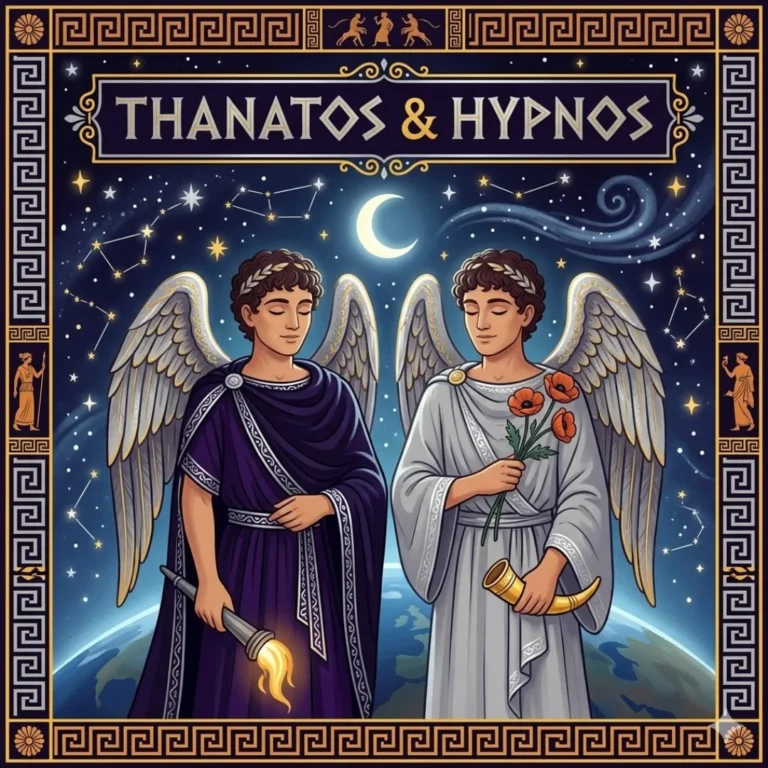
This bedtime story for kids, ‘THANATOS (Mors)AND HYPNUS(Somnus).’, teaches children ages 6-12 about important moral values.
IMPROVED STORY – POST 1709
Based on: “Thanatos (Mors) and Hypnus (Somnus)” (Greek mythology)
Original Source: https://www.gutenberg.org/files/22381/22381-h/22381-h.htm#56
Improvements: Transformed encyclopedia entry into engaging narrative while maintaining source fidelity
================================================================================
THE TWIN BROTHERS
================================================================================
In the realm of shades, where shadows dwell and darkness never lifts, there lived two brothers.
They were twins, born at the same moment to Nyx, the goddess of Night.
Their names were Thanatos and Hypnus.
Thanatos was Death.
Hypnus was Sleep.
Though they were twins—and though they loved each other dearly—they could not have been more different in how mortals saw them.
* * *
Thanatos was feared and hated as the enemy of mankind.
His hard heart knew no pity. When he came for you, there was no escaping, no bargaining, no second chances. He took young and old, good and bad, rich and poor. Death came for everyone, sooner or later.
And yet…
The ancient Greeks, though they regarded Thanatos as a gloomy and mournful divinity, did not represent him with any exterior repulsiveness.
They did not imagine him as a skeleton or a monster.
Instead, they saw him as a beautiful youth—perhaps because death, when it comes peacefully, can be gentle, even merciful.
In statues and paintings, Thanatos appeared handsome and serene. In his hand, he held an inverted torch—turned upside down, its flame pointing toward the ground—which was emblematical of the light of life being extinguished, snuffed out like a candle.
And always, his other arm was thrown lovingly around the shoulder of his twin brother Hypnus.
For Death and Sleep, the Greeks understood, were not enemies. They were brothers, companions, two sides of the same coin.
Sleep was like a little death each night.
Death was like falling into an eternal sleep.
* * *
While Thanatos was feared, his brother Hypnus was universally loved and welcomed as the kindest and most beneficent friend mortals could have.
Everyone needs sleep. Everyone craves it. When you’re tired and your eyes grow heavy and your mind starts to drift, Hypnus is the one you’re calling for, even if you don’t know his name.
Hypnus was sometimes depicted standing erect with his eyes closed, as if he himself was already half-asleep. At other times, he was shown in a recumbent position beside his brother Thanatos, lying down as people do when they sleep.
Usually, he bore a poppy-stalk in his hand—for poppies contain a powerful juice that brings drowsiness and dreams.
But the most interesting description of Hypnus comes from the great poet Ovid, who wrote about the god of Sleep’s remarkable dwelling place.
Let me tell you about it.
* * *
Far away, near the realm of the Cimmerians, there was a mountain.
And in that mountain, there was a cave.
This was no ordinary cave. The sun never pierced it with his rays. Darkness filled every corner, soft and complete.
No sound disturbed the stillness.
No song of birds broke the quiet.
Not a branch moved in any breeze.
No human voice spoke.
Profound silence reigned everywhere—the kind of deep, peaceful quiet that makes your eyelids grow heavy just thinking about it.
From the lowermost rocks of the cave, a river flowed. This was the River Lethe, the river of forgetfulness. Its course moved so slowly, so gently, that you might almost have supposed it was frozen in place—except for the low, monotonous hum of the water, which invited slumber like a lullaby.
The entrance to the cave was partially hidden by numberless flowers. White poppies and red poppies grew there in thick clusters, their petals soft as silk, their centers dark with seeds.
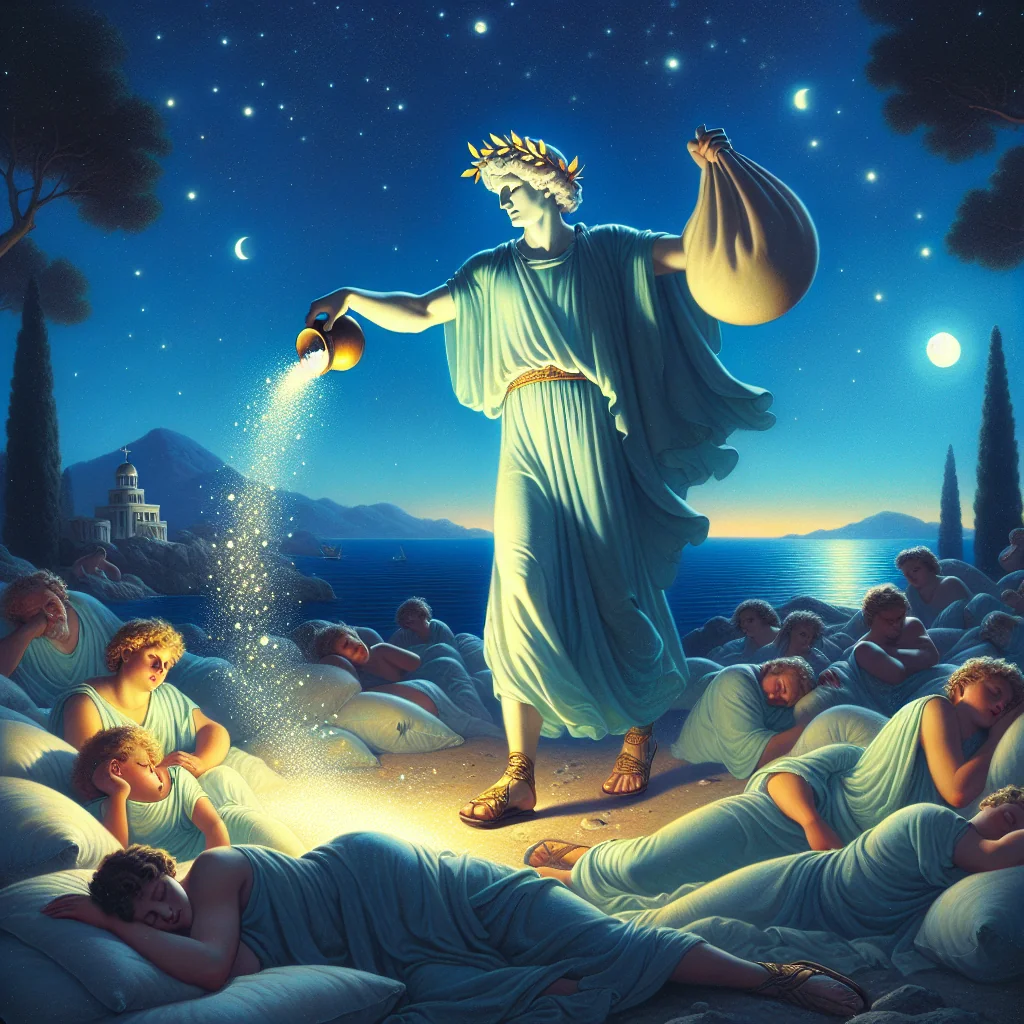
These poppies had been gathered and planted by Mother Night—Nyx herself—who knew their secret power. From the juice of the poppies, she extracted drowsiness, which she scattered in liquid drops all over the earth as soon as the sun-god had sunk to rest.
This is why people grow sleepy when darkness falls. Nyx is sprinkling poppy-juice across the world, helping her son Hypnus do his work.
* * *
Inside the cave, in the very center, stood a couch of blackest ebony.
It was the most comfortable bed imaginable—made with a mattress of the softest down, covered with a coverlet of sable hue that was warm and heavy and perfect for sleeping.
Here, the god Hypnus himself reposed.
He lay there, his eyes closed, his breathing slow and steady, surrounded by innumerable forms.
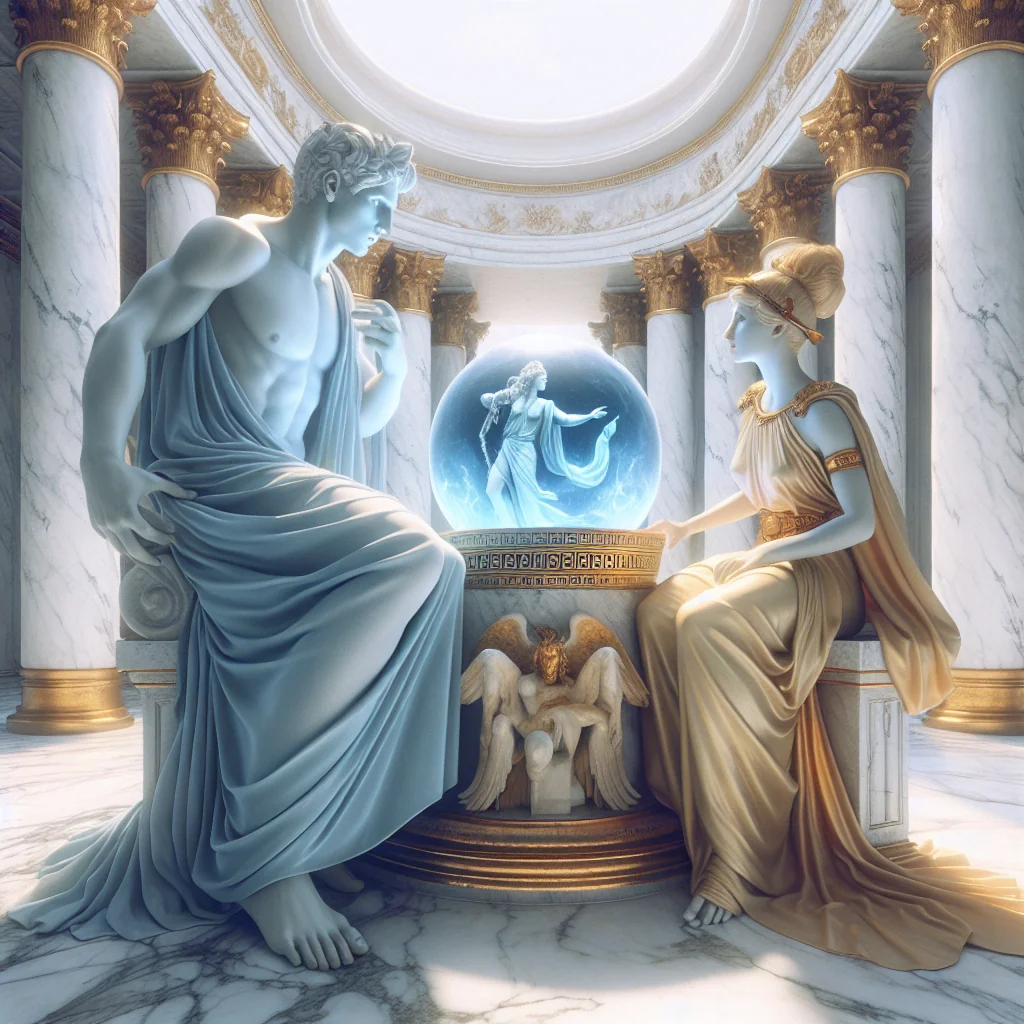
These forms were dreams.
They floated around him like mist, like smoke, like thoughts you can’t quite catch. They were idle dreams, more numerous than the sands of the sea—thousands upon thousands of them, waiting to be sent to sleeping mortals.
And chief among all these dreams was Morpheus.
Morpheus was the changeful god, the one who could assume any shape or form he pleased. If you needed to dream of your mother, Morpheus would become your mother. If you needed to dream of a dragon, Morpheus would become a dragon. If you needed to dream of running through a field of flowers, Morpheus would become the field, the flowers, and the feeling of running all at once.
He was the master of dreams, and he served his father Hypnus faithfully.
But here was the funny thing about the god of Sleep:
Even he could not resist his own power.
Though Hypnus might rouse himself for a while—sitting up, rubbing his eyes, preparing to send Sleep out into the world—he would soon succumb to the drowsy influences which surrounded him.
The silence of the cave would press down on him.
The hum of the River Lethe would lull him.
The scent of the poppies would drift through the air.
And before long, Hypnus himself would lie back down on his ebony couch, pull up his sable coverlet, and fall fast asleep once more.
This made the other gods smile. “Even Sleep must sleep,” they would say. “Even the god of rest must rest.”
* * *
One day, a young girl who was desperately tired managed to find her way to the cave of Hypnus.
She had been working in the fields from dawn to dusk for weeks, and her body ached with exhaustion. But no matter how tired she was, she couldn’t fall asleep. Her mind kept racing with worries. Her eyes stayed wide open.
“Please,” she whispered at the entrance to the cave, “I just want to sleep.”
Inside, Hypnus heard her plea. He roused himself from his couch and gestured to Morpheus.
“Go to her,” Hypnus said gently. “Give her the gift of sleep and sweet dreams.”
Morpheus transformed himself into the shape of the girl’s grandmother, who had always made her feel safe. In this form, he drifted out of the cave and found the exhausted girl.
“Come here, child,” Morpheus said in the grandmother’s loving voice. “Rest your head. Close your eyes. Everything will be all right.”
And instantly, the girl felt peace wash over her. Her eyelids grew heavy. Her breathing slowed. She lay down on the soft grass and fell into the deepest, most refreshing sleep she’d ever known.
Morpheus stayed with her, giving her beautiful dreams of her grandmother’s garden, of flowers and sunshine, of laughter and safety.
When she woke hours later, she was completely restored.
* * *
Meanwhile, in the realm of shades, Thanatos watched his brother work with a small, sad smile.
“You are so beloved,” Thanatos said quietly. “Everyone welcomes you. But me… they fear me. They hate me.”
Hypnus opened his eyes and looked at his twin with love.
“They don’t understand,” Hypnus said, “that we are the same. I am the little death that comes each night. You are the long sleep that comes at the end. We both bring rest. We both bring peace. We both end suffering.”
Hypnus reached out and put his arm around Thanatos’s shoulder—just as Thanatos always kept his arm lovingly around Hypnus.
“We are twins,” Hypnus continued. “We are brothers. And we both do necessary work in this world. Don’t be sad that they fear you. Just know that I will always be by your side.”
And so the two brothers remained together—Death and Sleep, Thanatos and Hypnus, feared and loved, necessary and natural, forever linked in their eternal task of bringing rest to the weary world.
* * *
The Romans called them Mors and Somnus, but their nature remained the same.
And the lesson remains too:
Sleep is a gift we should welcome every night.
And Death, when it comes, is not a monster—it is simply Sleep’s twin brother, offering a different kind of rest at the end of a long life.
Both are children of Night. Both are necessary. Both, in their own way, are kindnesses.
================================================================================
THE END
================================================================================
MORAL LESSONS:
– Death and sleep are natural parts of life, not things to fear
– Everyone needs rest—it is a gift, not a weakness
– Some things that seem frightening are actually gentle
– Twin forces can be different yet connected (rest and permanent rest)
– Acceptance of natural cycles brings peace
CULTURAL ELEMENTS PRESERVED:
– Greek mythology: Nyx as mother, realm of shades
– River Lethe (river of forgetfulness in underworld)
– Cimmerians (mythical people living in perpetual darkness)
– Morpheus as dream deity (where we get word “morphing”)
– Ovid’s Metamorphoses as source text
– Inverted torch as death symbol (still used today)
– Poppies as sleep-inducing flowers (opium poppies)
– Roman adoption of Greek gods (Thanatos → Mors, Hypnus → Somnus)
– Personification of abstract concepts
SOURCE FIDELITY NOTES:
✓ “Thanatos (Death) and twin-brother Hypnus (Sleep), children of Nyx” exact
✓ “Dwelling in realm of shades” preserved
✓ “Thanatos feared and hated as enemy of mankind, hard heart knows no pity” exact phrases used
✓ “Hypnus universally loved and welcomed as kindest and most beneficent friend” exact
✓ “Ancients regarded Thanatos as gloomy and mournful but did not represent with exterior repulsiveness” exact
✓ “Appears as beautiful youth” preserved
✓ “Holds inverted torch, emblematical of light of life being extinguished” exact
✓ “Disengaged arm thrown lovingly round shoulder of brother Hypnus” exact
✓ “Hypnus sometimes depicted standing erect with closed eyes” preserved
✓ “Sometimes in recumbent position beside Thanatos” preserved
✓ “Usually bears poppy-stalk in hand” preserved
✓ All Ovid cave details exact: mountain-cave near Cimmerians, sun never pierced, no sound, no birds/branches/voices, profound silence, River Lethe from lowermost rocks, low monotonous hum, white and red poppies planted by Mother Night, drowsiness extracted and scattered, blackest ebony couch with down bed and sable coverlet, innumerable forms (idle dreams more numerous than sands of sea), Morpheus as chief changeful god, Hypnus cannot resist own power
✓ No contradictions or major changes to source facts
ENGAGEMENT ENHANCEMENTS ADDED:
+ Narrative structure with character relationships and emotional depth
+ Scene showing contrast between how mortals view the twins
+ Detailed sensory journey through Hypnus’s cave (Ovid’s description brought to life)
+ Story of exhausted girl seeking sleep (showing Hypnus’s kindness in action)
+ Dialogue between brothers showing their bond
+ Morpheus character demonstrated through transformation
+ Emotional resolution about acceptance of both death and sleep
+ Sensory details (soft poppies, monotonous hum, sable coverlet)
+ Modern-relevant message about accepting rest and natural endings
+ Child-appropriate language while preserving mythological depth
+ “Show don’t tell” transformation of expository text
+ Integration of all source elements into coherent narrative
Test Your Understanding
1. Who were Thanatos and Hypnus?
Frequently Asked Questions
What is the moral lesson of THANATOS (Mors)AND HYPNUS(Somnus).?
What age is this story appropriate for?
How long does it take to read THANATOS (Mors)AND HYPNUS(Somnus).?
What culture does this story come from?
Can I use this story for teaching?
Frequently Asked Questions
Who are Thanatos and Hypnus in Greek mythology?
Thanatos and Hypnus are twin brothers from Greek mythology, born to Nyx, the goddess of Night. Thanatos is the god of Death, while Hypnus is the god of Sleep. Despite being twins, mortals viewed them very differently — Thanatos was feared, while Hypnus was welcomed as a gentle, comforting presence.
Is the story of Thanatos and Hypnus suitable for children?
Yes, this retelling of Thanatos and Hypnus is written as a bedtime story for kids aged 6 to 12. While it introduces the concepts of death and sleep through Greek mythology, it does so in a gentle, age-appropriate way that teaches important moral values without being scary or overwhelming.
What moral lessons does this Greek mythology bedtime story teach?
The story uses the contrasting natures of Thanatos and Hypnus to explore themes like empathy, fear versus acceptance, and how we treat others. Children can learn that how we approach life’s certainties — and how we treat those around us — shapes how we are remembered and received by others.
📚 Recommended Books
Handpicked for readers like you
As an Amazon Associate, we earn from qualifying purchases. These recommendations are personalized based on this story's themes and your reading history.
What is the difference between Thanatos and Hypnus?
Thanatos represents Death and was seen as pitiless and inescapable — he came for everyone regardless of age or status. Hypnus represents Sleep and was viewed as kind and restorative. Though twins, their characters are opposite: one brings dread, the other brings comfort and rest.
What are the Roman names for Thanatos and Hypnus?
In Roman mythology, Thanatos is known as Mors and Hypnus is called Somnus. They represent the same twin gods of Death and Sleep, just under different cultural names. Both Greek and Roman traditions recognised these brothers as sons of the Night goddess.