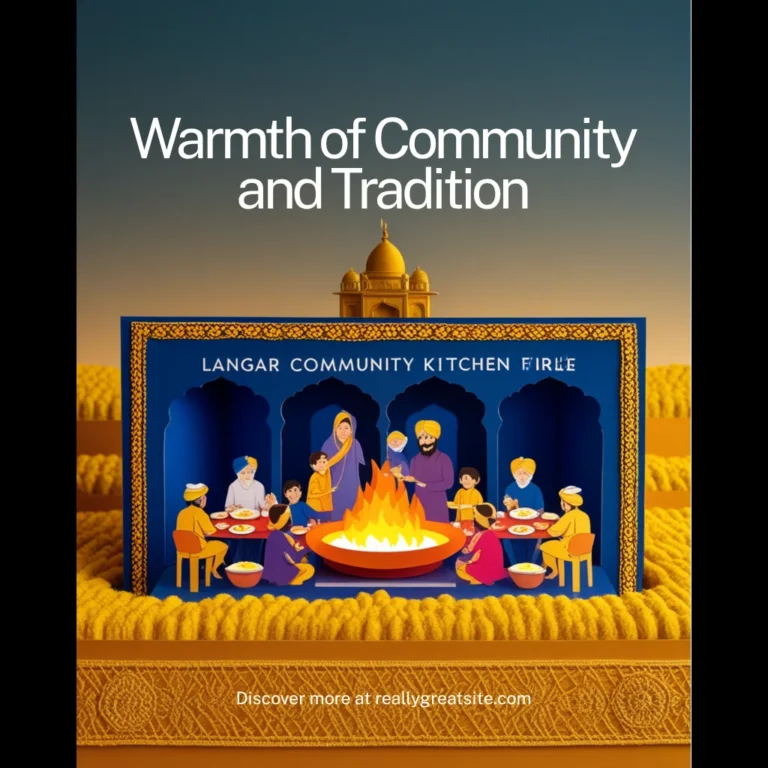
What the Langar Fire Knew
Listen, now. Listen close.
—
On the morning of Baisakhi, when the whole village smelled of marigolds and fresh roti, a girl named Tej ran ahead of her family toward the gurdwara.
The air was sharp and cold, biting at her nose. But the sun was rising like a copper coin over the fields, and the sound of kirtan drifted out through the gurdwara's wide open doors — sweet and slow, like water running over smooth stones. Inside, the langar kitchen was already roaring. Pots clanged. Steam rose thick and yellow with turmeric. Somewhere, someone was frying onions in hot ghee, and the smell of it curled through the whole courtyard like a warm hand.
Tej loved Baisakhi more than any other day. She loved the press of the crowd, the smell of the daal, the way everyone — farmer and merchant, young and old — sat in the same long rows on the floor and ate together. No one was better than anyone else in the langar. That was the law of this place. That was the old way.
But Tej stopped before she reached the doors.
There, on the cold stone steps, sat an old man.
His turban was dusty and frayed at the edges. His hands, folded in his lap, were mapped with deep cracks and calluses — hands that had worked for many, many years. He smelled of long roads and tired feet. His eyes were closed, his lips moving softly — perhaps in prayer, perhaps in memory. And the crowd flowed past him like a river around a stone. One person. Three people. Five. Ten.
Not one of them stopped.
Tej stood very still. She watched. And then she walked over and crouched down beside him.
"Baba ji," she said softly. "Are you hungry?"
The old man opened his eyes. They were the color of deep water — dark, and calm, and full of something she couldn't quite name.
"I have walked three days," he said. "I have not eaten in two."
"Then come," said Tej, and she held out her hand. "The langar is for everyone. That is the way of this place."
—
Inside, her friend Daljit grabbed her arm.
"Tej! Who is he? Why did you bring him? Look at him — he looks like he slept under a bullock cart!"
Tej turned and met her friend's eyes. Steadily. Calmly.
"He is hungry," she said. "That is enough reason."
"But your family is already waiting, and there's barely space on the mats—"
"Daljit." Tej's voice was quiet, but it did not wobble, not even a little. "Look around you. Every single person in this room has a reason to be here. What makes his reason worth less than theirs?"
Daljit opened her mouth. Then she closed it. Then she looked at the old man — truly looked at him, perhaps for the very first time. Something shifted in her face. Something softened.
"All right," she said. And she went herself to fetch him water.
—
The old man ate slowly, and he ate gratefully. He ate the daal, warm and rich with cumin, and the roti, soft and golden at the edges. He ate the way someone eats when they have almost forgotten what food tastes like. When he finished, he pressed his palms together and bowed his head.
"You did not ask me why I was sitting on those steps," he said to Tej.
"It didn't matter why," she said simply.
And the old man smiled then — a wide, warm smile that spread all the way up to his deep-water eyes, the kind of smile that changes a whole face from the inside.
"I am a granthi," he said. "A scripture reader, from a gurdwara three days' walk from here. I was traveling to share a message — a teaching from the Guru Granth Sahib that many communities have been forgetting. But I lost my way in the hills. I lost my bag. I lost everything I was carrying." He touched his chest, gently, with one cracked finger. "Except what I carry here."
"What is the message?" Tej asked.
He leaned forward. The langar fire crackled in the kitchen behind them.
"That Waheguru does not live only in the gilded dome," he said. "Waheguru lives in the hand that is extended. In the word spoken when it costs something to speak it. In the step taken toward someone — when it would be so much easier to walk away."
He looked at her for a long, quiet moment.
"You already know this," he said. "You have known it since before you could name it."
—
That evening, when their own granthi heard the old man's story, he welcomed him to stand before the whole sangat — the whole gathered community. The old man spoke of the Guru's teachings. Of seva, the selfless service that holds a community together like mortar holds stones. Of Ik Onkar — the one truth that runs beneath all things, like a river beneath winter ice. Of the law older than any law: that no soul is a stranger at the table.
Tej sat cross-legged on the cool floor and listened. The kirtan started again, softer now. The langar fire crackled steadily in the kitchen behind the wall. Outside, Baisakhi stars were appearing one by one, like lamps being lit across a very large and very beautiful house.
Daljit leaned close to Tej's ear.
"How did you know?" she whispered. "How did you know to stop?"
Tej thought about it.
"I didn't know," she said. "I just couldn't walk past."
And the langar fire burned on through the night — warm and bright and faithful. The way it always had. The way, if we remember to stop and extend our hands, it always will.
📚 Recommended Books
Handpicked for readers like you
As an Amazon Associate, we earn from qualifying purchases. These recommendations are personalized based on this story's themes and your reading history.