

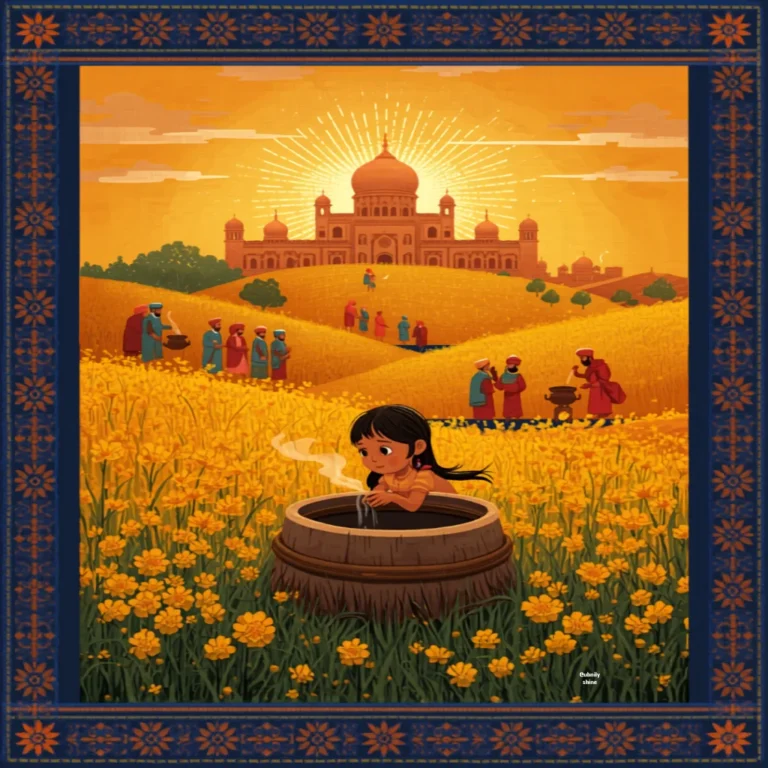
What Kirpa Found at the Well
In the village of Rampur, where the mustard fields turned gold every winter and the gurudwara's Nishan Sahib — its tall blue flag — could be seen from every corner of every lane, there was a well.
And that well had gone dry.
Forty days. Forty hot, cracked, throat-burning days without water from the earth.
The village women walked three miles to the river and back, clay pots balanced heavy on their heads. The fields smelled of dust instead of rain. Even the marigolds in the gurudwara garden had curled up and gone grey at the edges.
But on the forty-first morning, young Kirpa came running.
She was eight years old, with two thick braids, mud on both knees, and a mind as quick as sparrows. She burst into her grandmother's kitchen and grabbed Biji's flour-dusted hands.
"Biji!" she panted. "There is singing coming up from the well."
Her grandmother — old Biji, who had seen seventy-three winters and knew the weight of every kind of silence — looked at her granddaughter for one long, slow moment.
"What kind of singing?" Biji asked.
"Low singing. Like someone is hurt. Or lost."
Biji wiped her hands. She put on her chunni. And she said three words the way she always said important things — once softly, once firmly, once with her eyes steady:
"Then we must go. Then we must go. Then we must go."
—
The whole village gathered around the well.
The air smelled of dry earth and faint woodsmoke. Above them, the Nishan Sahib snapped in a rare small breeze. Down in the darkness of the well, curled on a narrow stone ledge just above where the water used to sit, was an old man.
His turban had come half undone. His hands were shaking. But his lips were still moving — a quiet, steady murmur of *Waheguru, Waheguru, Waheguru* — the name of the Divine, his prayer keeping him calm in the cold dark.
The village headman crossed his arms. "How did he get in there? And why should we spend our ropes and our strength pulling out a stranger?"
It was Kirpa who stepped forward. This is the sort of story that children — kids ages 6-12 especially — lean in close to hear, because they know in their bones what the right answer is before any grown-up says it.
"Because he is cold," said Kirpa simply. "And he is alone. And he is still praying."
Nobody had an answer for that.
They lowered a rope. Three strong men pulled. And out came the old man, blinking in the sharp morning light, his white beard matted, his kurta torn at the elbow. He smelled of cold stone and old wood. His hands, when Biji took them to warm them, felt like dry leaves in autumn.
"Thank you," he whispered. "I fell in three nights ago. I thought nobody would come."
"Someone always comes," said Biji. And she smiled. "That is the way of things."
—
Now they had a problem.
The langar — the gurudwara's free kitchen, where everyone in Rampur ate together without paying a single paisa — was running dangerously low. The drought had been long and hard. The stores of flour, lentils, and ghee were nearly gone. There was maybe enough for one more day. Perhaps two, if everyone took a little less.
That evening, the headman came to Biji's house smelling of pipe smoke and worry.
"We cannot feed the old man," he said. "We do not know him. We have barely enough for our own."
Biji listened. She nodded slowly. She looked at Kirpa.
Kirpa was thinking of the old man's shaking hands. She was thinking of how his lips had never stopped moving, even down in the dark — *Waheguru, Waheguru* — even when he thought no one was coming. She was thinking about what her mother had told her the langar was truly for.
"The langar is not for people we know," said Kirpa quietly. "It is for everyone who is hungry."
The headman looked at this small girl with mud on her knees and braids coming loose and the calm steady voice of someone who has thought very carefully about something.
He did not have an answer for that either.
—
So the old man stayed.
He ate at the langar with the rest of the village — warm dal that smelled of cumin and ginger, thick roti straight from the tawa, and a small spoonful of sweet karah prasad that melted on the tongue like a promise kept. His hands stopped shaking. His eyes grew bright.
And the next morning, when the first pink light crept over the mustard fields, the old man walked to the edge of the well. He reached out with both hands. He closed his eyes.
He said, in a voice like stones settling deep underground: "I know where the water hides."
Everyone stared.
"There is a crack in the east wall," he said. "Blocked for years by a fallen stone. Move the stone, and the water will come back."
The headman sent three young men down with ropes and lanterns. They searched by the flickering orange light. They found the stone — a great grey slab, cold and smooth, wedged against the eastern wall like a secret kept too long.
They pushed.
There was a deep rumble. Then a gurgle. Then a sound like the earth breathing out after holding its breath for forty-one days.
The water came back.
Cool and clean and real, it rose up slowly, shimmering far below. The whole village let out a sound — not quite a cheer, not quite a prayer, but something in between. Something that felt like both at once.
Kirpa leaned over the edge and looked down at the dark water gleaming below.
"How did you know?" she asked.
The old man smiled. His eyes crinkled. His half-undone turban sat crooked on his head.
"I fell in," he said. "And I had three nights to look around."
—
By evening, the old man was ready to leave. He stood facing the gurudwara and folded his hands in a quiet ardas — a prayer of thanks. Then he folded them again to the village. Then once more, just to Kirpa.
She walked with him to the edge of the fields where the road began. The mustard smelled warm and green and alive, as if the earth had already remembered how to breathe.
"Will you come back?" she asked.
He looked down at her. His eyes were kind, and very old, and full of something she couldn't quite name — like water in deep places, still and clear.
"Someone always does," he said. And he smiled. "That is the way of things."
She watched him walk down the road until he was just a small shape moving through gold.
Behind her, the Nishan Sahib flew high and blue against the first evening stars — as it always had, as it always would — snapping once in the breeze, like a greeting, or a blessing, or a promise the sky was keeping.
📚 Recommended Books
Handpicked for readers like you
As an Amazon Associate, we earn from qualifying purchases. These recommendations are personalized based on this story's themes and your reading history.
