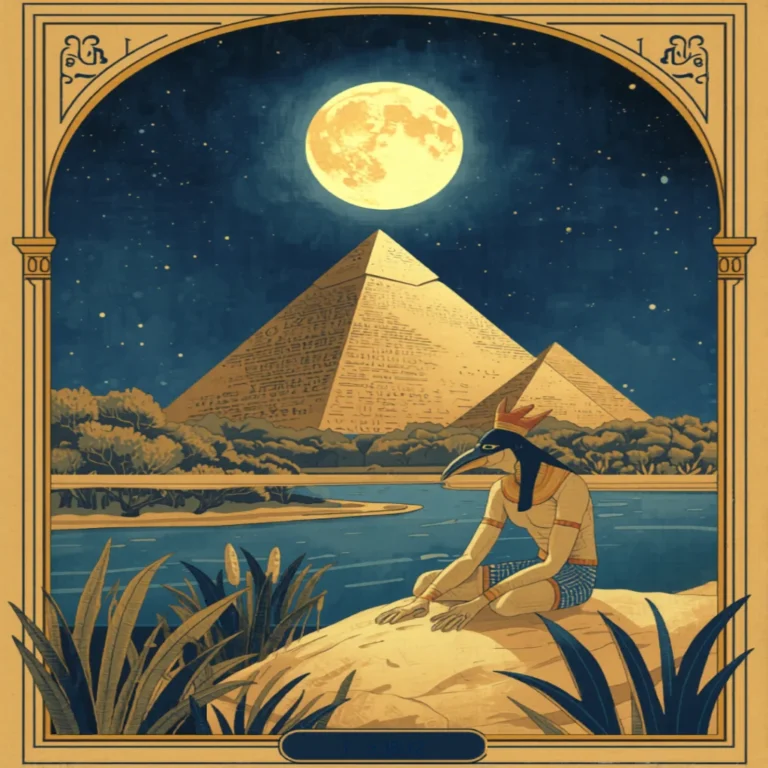
What Thoth Wrote in the Sand
Only one person didn't run.
Twelve-year-old Neferu stood at the river's edge, her bare toes curling in the mud that smelled of fish and green reeds. She watched the black water creep toward her like slow ink spreading across papyrus. Most people would have been terrified. Neferu *was* terrified. But she was also deeply, helplessly curious — and in her experience, curiosity was always stronger than fear.
"What are you?" she whispered to the dark water.
The river didn't answer. But something else did.
From the tall papyrus reeds, a white ibis stepped out. It was enormous — easily as tall as Neferu — with a long curved beak that gleamed like polished bone in the moonlight. Its eyes were golden, and they looked at her with an intelligence that made Neferu's skin prickle all the way up her arms.
"You are the first child in forty years to ask the river a question instead of running from it," the ibis said. Its voice sounded like reed pens scratching on papyrus. Dry. Precise. Ancient.
Neferu's heart hammered. She knew enough about the gods to recognize an ibis in the moonlight. "Are you Thoth?" she asked.
"I am wearing an ibis today," the bird said, which wasn't exactly an answer. "The river is black because someone stole the First Word — the sacred hieroglyph that Ra spoke when he created the Nile at the beginning of time. Without it, the water forgets what it is meant to be. It goes dark. In seven days, it will stop flowing entirely."
"Who stole it?"
"A scorpion spirit," said Thoth. "It lives in a cave beneath the plateau of Giza, three days' walk from here. The Word is locked inside a clay jar sealed with seven knots of shadow."
Neferu thought of her village — the farmers, the fishermen, her little brother Ani who drank three cups of Nile water every morning because he said it tasted like cool, clean stones. "I'll get it back," she said.
The ibis tilted its great head. "You are twelve years old."
"Yes," said Neferu. "And I'm standing here."
—
She walked for three days through the desert, where the sand was the color of burnt honey and the heat pressed down like a heavy hand. On the first day, she found an old man collapsed beneath a palm tree, his lips cracked and bleeding. She had only one clay jar of water left — enough for one more day of walking. She gave him half without hesitating.
"Foolish girl," he rasped, drinking gratefully.
"Maybe," said Neferu. She wet a strip of her linen wrap and laid it across his forehead. The cloth was cool against her fingers, and it still carried the faint, faraway smell of river mud — like a memory of home.
When she looked up, the old man was gone. Written in the sand where he had lain were three words in hieroglyphs. Neferu had spent two years learning to read at the House of Life in Abydos. She sounded out each symbol carefully.
*Kindness opens locks.*
She stared at the words for a long moment. Then she kept walking.
—
On the third day, she found the cave.
It smelled of cold stone and something sharp and bitter — the copper smell of fear itself. The entrance was a crack in the rock barely wide enough to squeeze through sideways, and inside, the darkness was total. Not the soft dark of a bedroom. The absolute, crushing dark of a place that had never seen sunlight.
Neferu lit the small oil lamp she carried and stepped through.
The cave opened into a vast underground chamber. Limestone columns rose to a ceiling she couldn't see. And there, coiled around a small clay jar in the center of the floor, was the scorpion spirit — enormous, its body the color of shadow, its curved tail held high. Its many eyes glittered like chips of black obsidian.
"A child," it hissed. The sound bounced off every wall. "Children are easy to scare."
Neferu's lamp trembled in her hand. The flame bent sideways. She thought about running. She thought about Ani's three cups of morning water.
She took one step forward.
"I've come for the First Word," she said. Her voice only shook a little. "It doesn't belong to you."
"Brave words," the spirit sneered. "But bravery without power is just noise. What can a small child possibly offer me?"
Neferu thought carefully. She thought about the message scratched in the sand. She thought about the old man in the desert.
"I can't fight you," she said honestly. "I'm not stronger than you. But I think you're lonely down here. I think you've been forgotten, and that's the worst feeling in the world. And I think that's why you steal things that belong to others — because you want something that truly belongs to *you*."
The scorpion spirit went very still.
"You don't know anything about me," it whispered. But the hissing had drained from its voice.
"I know you've been down here a very long time," said Neferu quietly. "Long enough that nobody even remembers your name." She paused. "What *is* your name? Your real one."
A long silence. The oil lamp flame steadied.
"Khesef," it said at last. The word sounded like something that hadn't been spoken aloud in centuries. Raw. Small. Real.
"Khesef," Neferu repeated carefully. "I'll remember it. I promise." She reached into her bag and pulled out her last flat barley loaf — slightly squashed, still smelling of the clay oven at home, of her mother's hands. She set it on the cave floor. "I'd share this with you, if you'd like."
The scorpion spirit stared at her for a very long moment.
Then, slowly, the seven knots of shadow around the clay jar began to unravel, one by one — as if untying themselves.
The jar's lid cracked open. A sound came out of it — not a word, exactly, but something older than words. A sound like the first rain striking dry earth. Like water remembering the way home.
"Take it," said Khesef.
Neferu picked up the jar with both hands. It hummed warmly against her palms. "Thank you," she said. "I meant what I said. About your name."
She walked back toward the light.
—
When Neferu reached the Nile three days later and poured the First Word into the current, nothing happened for one breathless moment. Then the black color washed away — upstream and downstream at once — like a blanket being pulled from the world. The river ran blue-green and sparkling in the morning sun, and the smell of cool, clean water and fresh mud hit her so hard that she sat down on the bank and cried a little, just quietly, all by herself.
The white ibis was waiting.
"You could have fought," Thoth said. "You could have tricked. But you saw something in the darkness that everyone else had missed." The golden eyes studied her. "That is a harder skill than courage, and rarer."
Neferu wiped her face with the back of her hand. "I just did what made sense."
The ibis was quiet for a moment. Then it spread its enormous white wings and lifted into the blue Egyptian sky, climbing higher and higher, becoming a bright speck aimed at the sun.
Neferu watched it go.
Then she turned toward home — toward the sound of the river running clean and strong, toward the smell of bread baking in her mother's oven, toward the thought of her little brother's three morning cups waiting in the cool shade of the doorway.
She walked quickly. She was very, very ready to go home.
📚 Recommended Books
Handpicked for readers like you
As an Amazon Associate, we earn from qualifying purchases. These recommendations are personalized based on this story's themes and your reading history.