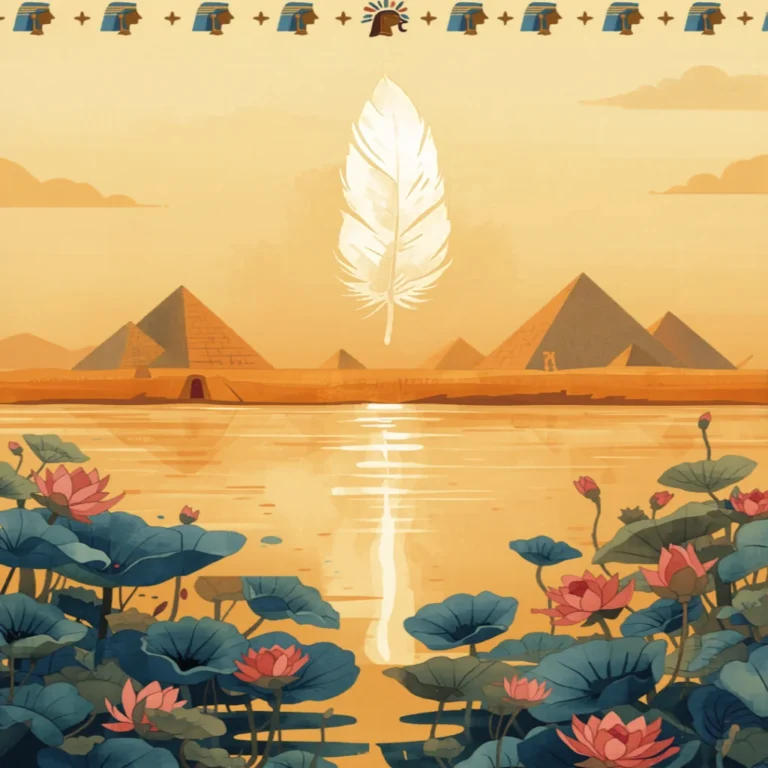
The Feather That Answered the Flood
Every year, like a giant waking from sleep, the great river flooded its banks and spread thick, dark mud across the fields. Crops would shoot up green and tall. Children would splash in the shallows. The whole village of Ipet would fill with music, laughter, and the smell of fresh bread baking in clay ovens.
But this year — nothing. The riverbank was cracked and pale. The fields were hard and thirsty. And nobody knew why.
It's exactly the kind of mystery that makes a good bedtime story — a moral lesson passed down through the sand and starlight of Egypt for thousands of years, whispered to kids ages 6-12 under skies blazing with more stars than you could ever count.
At the water's edge, a twelve-year-old girl named Nefret sat and stared at the low, slow river. She dipped her fingers in. The water felt warm — almost feverish, like something was wrong with it from the inside.
Then a white ibis waded up beside her and stopped.
Ibises were sacred birds, messengers of Thoth, the great god of wisdom and writing. Nefret had seen plenty of ibises before. But none had ever fixed her with one sharp golden eye the way this one did.
"Child," said the ibis, in a voice like dry papyrus rustling, "the river cannot rise. Something blocks it upstream — not here, but far above. A stone has fallen across the mouth of a hidden spring. The spring feeds the flood."
Nefret's heart thumped. "Who put it there?"
"No one. A great earthquake, three moons past. But only a brave heart may shift it."
The ibis spread its white wings and shot straight up into the blazing blue sky — and was gone.
—
Nefret ran back to the village elder, an old man named Kha who sat in the shade of a sycamore tree.
"Elder Kha!" she said, breathing hard. "There's a blocked spring upstream. We have to go move the stone!"
The old man squinted at her. "You spoke to a bird?"
"A sacred ibis. A messenger of Thoth."
Kha was quiet for a long moment. He rubbed the silver amulet at his neck — a tiny figure of Thoth, ibis-headed, carrying a scroll. Then he said slowly: "I believe you. But the path upstream runs through the Red Cliffs. No one from this village has walked it in twenty years."
"Then I'll walk it now," said Nefret.
She didn't feel brave when she said it. Her knees were shaking. But she said it anyway.
—
The Red Cliffs were as tall as temple columns and twice as hot. The sun pressed down like a heavy hand. Nefret climbed, her sandals slipping on orange rock, sweat stinging her eyes. The air smelled of dry stone and something sharp — like copper, or old lightning.
Halfway up, she heard a sound.
Crying.
She almost kept climbing. The spring was up there. The village needed water. Every minute mattered.
But the crying was small and scared.
Nefret stopped. She followed the sound around a boulder and found a boy — maybe seven years old — sitting in a narrow crack in the cliff with his ankle wedged between two rocks. He was covered in red dust, his face streaked with tears. He'd been stuck there for hours.
"Hold still," said Nefret. She knelt and looked carefully at his foot. One of the rocks tilted if you pushed it at exactly the right angle. She pushed — hard — and the boy's ankle slid free.
"Thank you," he gasped. "I was so scared."
"Me too," she said honestly. "Can you walk?"
"I think so. Where are you going?"
"To move a stone." She looked at him. "Do you want to help?"
The boy blinked. "You'd let me come?"
"Two pairs of hands are better than one."
—
The hidden spring was real — a round, dark pool tucked between two walls of red rock, fed by water pushing up from deep underground. And blocking its main channel was exactly what the ibis had described: a jagged slab of stone, half the size of a door, wedged tight across the gap where the water desperately tried to push through.
Nefret studied it the way she'd seen builders study walls. She spotted a long, flat piece of driftwood nearby — dry and hard, perfect. She jammed one end deep under the edge of the slab.
She had discovered something important: a lever works by giving you the power of a giant when you only have the arms of a child. Push one end down, and the other end lifts. The longer the lever, the heavier the load you can move.
"Push down on this end," she told the boy. "When I say three."
"One," she said.
"Two."
"Three."
They pushed with everything they had. The wood creaked. The stone groaned. Then — with a deep, satisfying *thunk* — it shifted sideways and tumbled into the pool below with an enormous SPLASH.
The water surged. It rushed through the gap with a hiss and a roar, tumbling and frothing down through channels in the rock, heading downstream. Heading toward Ipet.
Nefret stood up straight, her arms aching, her whole body dripping with cool spray. She started to laugh. The boy did too. Their laughter bounced off the red walls and came back to them twice as loud.
Above, a white ibis circled once — dipped one wing, as if nodding — and disappeared into the hot Egyptian sky.
—
Three days later, the Nile rose.
Ipet filled with the smell of wet earth and green things growing. Children ran into the black mud, squealing. Elder Kha stood at the river's edge with tears cutting clean lines through the dust on his face and an ibis feather in his hand — the one Nefret had found on the path home, and given to him as proof.
She never told the story the same way twice. Sometimes she said the ibis spoke. Sometimes she said she just had a feeling and followed it. But everyone in Ipet understood what had really happened: a girl was brave enough to climb, kind enough to stop, and smart enough to use a stick.
The feather hung in the village temple for a hundred years after that — bone white, soft as a secret, still smelling faintly of the river.
📚 Recommended Books
Handpicked for readers like you
As an Amazon Associate, we earn from qualifying purchases. These recommendations are personalized based on this story's themes and your reading history.