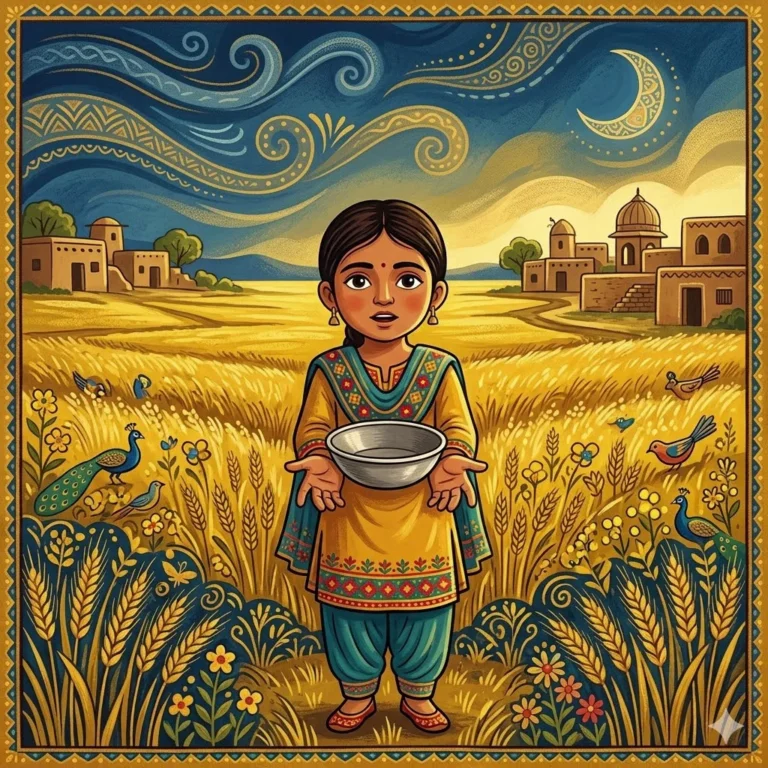
The Weight of an Empty Bowl
—
Preet was ten years old. He lived with his grandmother, Naniji, in a small clay-walled house at the edge of the village of Sultanpur Lodhi. The house smelled always of dried marigolds and cardamom, and in the evenings, when the prayers floated down from the Gurdwara on the hill, Preet would sit on the front step and listen with his eyes half-closed.
But that autumn was a hard one. The rains had failed, and the crops were thin. In the market, the price of atta — the wheat flour that made their daily roti — had climbed so high that many families went to bed with empty stomachs.
At the Gurdwara, the Granthi, an old man named Baba Nihal Singh, had opened the langar — the community kitchen — to everyone who needed a meal. The langar never refused anyone: rich or poor, young or old, known or stranger. Every morning, volunteers cooked great steaming pots of dal and stacked thick rotis on iron griddles, and people came with their bowls, and no one went away hungry.
That particular morning, Preet's grandmother was too weak to walk the hill.
"Go, my piara," she said, her voice thin as paper. "Take the big brass bowl. They will fill it for us."
Preet held the bowl in both hands. It was cool and heavy even when empty, and it caught the morning light like a slice of moon.
The road up the hill was long and dusty. Preet could smell the dry earth — that sharp, powdery smell of a land that hadn't drunk rain in too long. His sandals slapped the path, and the sun sat on his shoulders like a hot stone, and the dust rose in little puffs around his ankles.
But halfway up the hill, he stopped.
Sitting on a wide stone wall across the path was Ranveer — the son of the village landlord. Ranveer was fourteen and broad as a door, and he had two friends beside him, picking at sticks and looking for trouble.
"Where do you think you're going, little sparrow?" Ranveer called out. His friends laughed, a sharp sound like gravel thrown against a tin roof.
Preet felt his heart thump in his chest like a dhol drum. He could hear it. He wished he couldn't.
"To the langar," Preet said. "For my grandmother."
Ranveer slid off the wall and planted himself in the middle of the path, arms crossed. "My father says the langar is a waste. He says strong people feed themselves. He says only weak people go begging with bowls."
The words stung like nettles against bare skin. Preet looked down at the brass bowl. He thought of Naniji's thin voice that morning, the way her hands had trembled when she pressed the bowl into his. He thought of the words Baba Nihal Singh had once read aloud from the Guru Granth Sahib, words that had settled somewhere deep: *The hungry are fed at the Lord's kitchen. No one goes without.*
He looked up at Ranveer.
"Guru Nanak sat on the ground and ate with the poorest farmer," Preet said. His voice was steady, even though his knees were not. "He said that hands that serve others are holier than hands that only serve themselves. My grandmother needs this bowl filled. And I'm going to fill it."
Ranveer blinked. He had not expected that.
"You're just a little kid," he said, but the loudness had drained out of his voice like water through cracked clay.
"I'm a little kid," Preet agreed. "But the teaching is the Guru's. Would you like to argue with him?"
For a long moment, the three boys on the wall were very still. A crow called somewhere above them in a dry neem tree. The wind stirred the dust between them.
Then, slowly — the way a heavy gate swings on a rusted hinge — Ranveer stepped aside.
Preet walked through. He didn't run. He didn't look back.
—
At the Gurdwara, the smell reached him before the door did — rich and round and warm, the deep perfume of dal simmering with ginger and turmeric and black pepper, fresh rotis puffing on the griddle, and something sweet underneath it all: suji halwa, golden and fragrant with ghee, like a promise made in a language older than words.
Baba Nihal Singh saw Preet come through the archway and smiled, his white beard lifting at the corners.
"Sat Sri Akal, little one. Where is your Naniji today?"
"She is unwell, Baba ji. She sent me."
The old man's eyes were soft and dark as river stones polished smooth. He looked at the big brass bowl. He looked at Preet's face — the dust on his cheeks, the steadiness in his eyes.
"You walked alone?"
"Yes, Baba ji."
The old man was quiet a moment. The griddle hissed behind him. Somewhere, a child laughed. Then Baba Nihal Singh said, "Was it hard?"
Preet thought about Ranveer's voice, hard as gravel. He thought about his own knees shaking against the inside of his trousers. He thought about the Guru's words climbing up from somewhere inside him when he needed them most — like a lamp lighting itself in a dark room.
"A little," Preet said. "But I knew what was true."
Baba Nihal Singh nodded very slowly, the way old people nod when something matters greatly and there is no hurry.
"Then you already understand more than most grown men," he said softly.
He filled the brass bowl himself — dal, roti, halwa — all the way to the brim.
—
The bowl was heavy when Preet carried it home. Heavy with warmth, heavy with the smell of spice and ghee, heavy in the best possible way — the kind of heavy that fills your arms and your chest at the same time.
His grandmother ate every bite.
That evening, when the prayer bell rang from the Gurdwara on the hill, Preet sat on the front step and listened — and for the first time, the words didn't just float over him like something beautiful and distant. They settled into his chest like something permanent.
📚 Recommended Books
Handpicked for readers like you
As an Amazon Associate, we earn from qualifying purchases. These recommendations are personalized based on this story's themes and your reading history.
Something real. Something his.