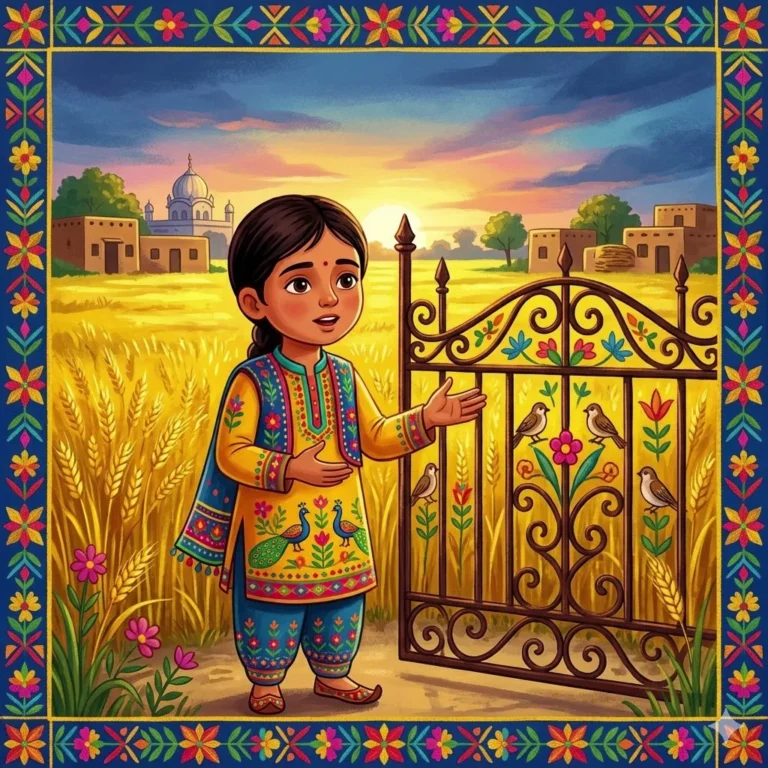
Preet and the Iron Gate
In the village of Amritpur, nestled between mustard fields and a winding blue river, there lived a girl named Preet. She was ten years old — the kind of curious, quick-eyed child that elders noticed without knowing why. Every morning she woke to the smell of her mother's roti on the griddle and the distant hum of the Gurdwara's harmonium threading through the cool pre-dawn air like a golden ribbon.
The trouble began the day Sardar Baljit Singh bolted the iron gate at the edge of his land. The wealthiest man in Amritpur, he owned the mango orchard that held the shortcut connecting the eastern half of the village to the market, the school, and the Gurdwara. For as long as anyone could remember, that dirt path — shaded, soft underfoot, smelling of fallen fruit in summer — had been everyone's road. Now, with the gate locked and chained, the villagers had to walk forty minutes around the long road, through dust and punishing heat.
The farmers grumbled. The elders shook their turbans. But no one said a word to Sardar Baljit, because his eyes were as cold as river water in January, and his word in the village was final as stone.
—
One afternoon, Preet sat beside Giani Ji — the gentle old teacher at the Gurdwara — while he sorted through worn prayer books. The room smelled of incense and old sandalwood, cool and still even in the thick of summer.
"Giani Ji," she said, "why is everyone afraid of Sardar Baljit?"
The old man set down his book and looked at her over his glasses. "Fear grows in silence, child. When no one speaks, fear believes it is welcome."
"But what if speaking makes things worse?"
He smiled, and the deep lines of his face shifted like rivers carving new channels. "Wisdom is knowing *how* to speak. Courage is choosing to speak at all. Together, they are stronger than any locked gate."
Preet turned that over in her mind like a smooth river stone in her palm. She pressed it there, and it stayed.
—
The next morning, before her mother could call her back, Preet walked to Sardar Baljit's haveli. The grand house rose at the end of a long path, its pillars painted deep blue, its courtyard full of pigeons the soft grey-white color of clouds before rain. She knocked three times on the heavy wooden door.
A servant answered. Then Sardar Baljit himself appeared — broad-shouldered, white kurta pressed, his indigo turban crisp and serious.
"What does a little girl want at my door?" he asked, not unkindly, but with the tone of a man who had never been made to wait.
Preet stood straight, even though her heart was hammering loud enough, she was quite sure, for the pigeons to hear. "Sardar Ji," she said, "I came to ask about the gate."
His eyebrow rose. "Did your father send you?"
"No, Sardar Ji. I came myself." She let a breath out slowly. "I walk that path to school. So do many families. But instead of asking you to open it, I came to ask something else first." She met his eyes. "Can you tell me why you closed it?"
Baljit Singh blinked. It was not the question he expected.
He was quiet for a long moment. A pigeon landed on the courtyard wall and cooed softly into the warm air. Then he said: "Someone left the gate open last month. My youngest mango trees were stripped bare overnight. Thieves."
"I'm sorry about your trees," Preet said, and she meant it. "They must have taken a long time to grow."
Something shifted in his face — a thawing, barely visible, the way river ice cracks before it breaks. "Seven years," he said quietly.
"What if the village helped guard them?" Preet offered. "Three families could take turns locking the gate at dusk. In return, it stays open during the day. Your trees would be safer than they've ever been."
He looked at her for a long moment — not at a child, but at a thought he hadn't thought yet.
"You are a strange one," he said at last.
"My teacher says I ask too many questions," Preet agreed.
The corner of Baljit Singh's mouth moved — just slightly, just barely — toward something that might have been a smile.
—
By the following week, the iron gate swung open each morning with a deep, resonant clang that echoed across the mustard fields. Three families from the eastern side took turns latching it at dusk. The mango trees were never stripped again. Baljit Singh, for his part, began leaving a small bowl of mangoes beside the gate each July — placed there without ceremony, as if it had always been the custom.
This kind of tale — where one quiet question changes everything — is exactly the sort perfect for kids ages 6-12 who are learning that the bravest thing you can do is sometimes simply to ask.
On evenings when rain softened the earth and the Gurdwara's harmonium drifted over the rooftops, Preet still paused at the gate sometimes. She'd run her fingers along the cool, rust-flaking iron bars and think about the morning her heart had hammered and she'd spoken anyway.
Giani Ji was right.
📚 Recommended Books
Handpicked for readers like you
As an Amazon Associate, we earn from qualifying purchases. These recommendations are personalized based on this story's themes and your reading history.
The gate had been open all along. It just needed someone brave enough — and wise enough — to knock.