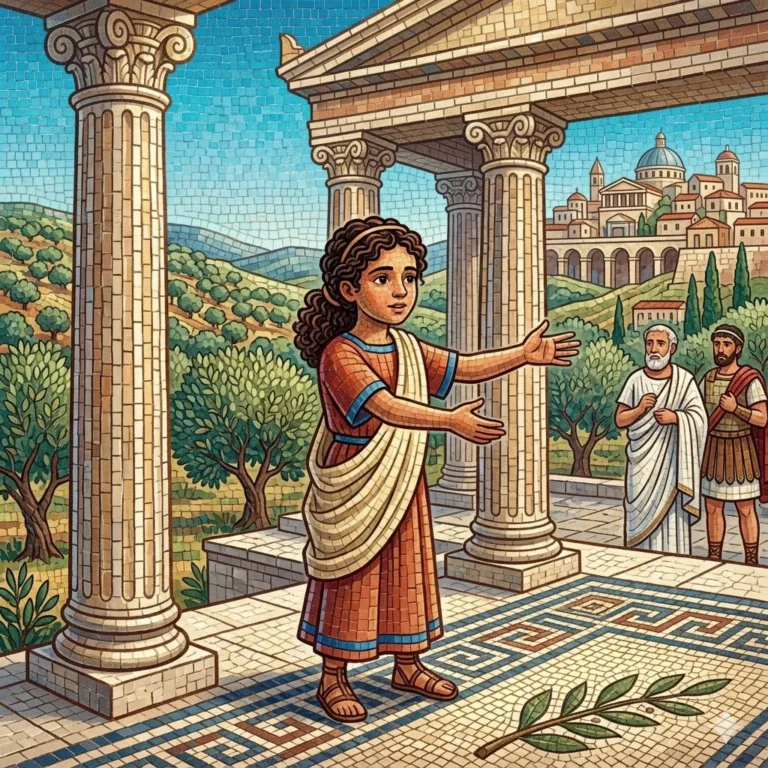
Camilla and the Temple's Missing Gold
Camilla was twelve years old, right in the sweet spot for kids ages 6–12 who love stories of daring and wit. She had tangled brown hair and ink-stained fingers because she read every scroll she could find, which her older brother Lucius said was a waste of time for a girl.
"You should be learning to weave," he told her once, tossing a grape in the air and catching it in his mouth.
"You should be learning to think," she replied. "Then maybe you would not lose your sandal in the Tiber every spring."
They argued like that, but they loved each other fiercely — the way fire loves its own warmth.
Then one cold morning in the month of March, the priests of the Temple of Juno announced that a golden votive bowl — offered by the governor himself — had vanished from the inner sanctum. It was worth more than ten oxen. The city hummed with the news like a disturbed beehive.
The smoke from the morning sacrifices still hung in the cold air, grey and bitter, when the temple guards came to the door of Camilla's house. Her father, a modest cart-maker named Quintus, went pale as chalk.
The head guard — a broad man with a red sash and a voice like stones rolling downhill — folded his arms and spoke. "Your son Lucius was seen near the temple before dawn. He will come with us."
"He was walking home from his friend Tullus's house," Quintus said, his voice cracking. "He does that some nights."
"That is for the Chief Priest to decide," the guard said, and they took Lucius away.
Inside, Camilla's father sat at the table and put his face in his hands. The smell of sawdust from the workshop next door drifted through the window, and somewhere a cart wheel shrieked against cobblestones. Everything ordinary kept going. That made it worse.
"I will speak to the Chief Priest," Camilla said.
Her father looked up. "You? A child? The Chief Priest does not receive children in matters of law."
"Then I will wait until he does," she said, and she put on her wool cloak and walked out into the sharp morning air.
The temple sat on the Capitoline Hill, white and enormous, its columns throwing long shadows across the steps like outstretched arms. Camilla climbed every one of those steps, her legs burning, the cold wind pressing against her cheeks like a firm hand. She stood at the threshold for a long time before a young priest with kind eyes finally noticed her.
"What do you want, child?"
"I want to see the place where the bowl was kept," she said. "Not to take anything. Only to look."
He opened his mouth to refuse — she could see it forming — so she said quickly, "If Lucius did not take the bowl, then something else happened. Do you not want to know what that something else is?"
The young priest hesitated, then led her inside.
The inner room smelled of incense and cold stone. The morning light came through a high, narrow window, falling in a single beam onto the altar shelf where the bowl had rested. The shelf was made of polished travertine, smooth and pale as a winter sky. Camilla crouched low, her eyes moving slowly across every surface.
Then she saw it.
Near the base of the shelf — not on the floor, not near the door, but along the high window ledge — there were scratches. Thin, paired scratches in the stone, like little brackets pressed in by something sharp and repeating. And on the outside sill, half-caught on a chip of mortar, lay a single black feather.
She picked it up.
"Your largest crow," she said quietly to the young priest. "The one that roosts in the cedar near the north wall — does he not steal shiny things? Silver buttons. Brass pins. Anything that catches the light?"
The young priest stared at her. His eyes moved slowly to the window, then to the cedar tree swaying beyond it.
It took three priests and one very long pole to investigate the nest. Inside it, wrapped in dry grass and a scrap of linen: the golden bowl, only slightly dented, gleaming like a small sun among the twigs.
When Lucius was brought home that evening — sheepish, tired, hungry — Camilla was sitting at the table eating olives and reading a scroll.
"I heard what you did," he said, standing in the doorway. His voice was rough, the way voices get when someone has been frightened for a long time and is only now, slowly, becoming unafraid. "How did you know to look there?"
She set the scroll down. "Grandmother used to say: before you look for a human answer, look for a natural one. Most trouble is not caused by evil. It is caused by a crow."
He laughed — a big, surprised, relieved laugh that filled the small room and made their father look up from his workbench with wet eyes.
"You are strange, Camilla," Lucius said.
"You are welcome," she replied, and went back to her reading.
📚 Recommended Books
Handpicked for readers like you
As an Amazon Associate, we earn from qualifying purchases. These recommendations are personalized based on this story's themes and your reading history.
Outside, the seven hills of Rome settled into the violet evening. The river moved quietly past the reeds. The laurel trees rustled in the dark. And somewhere in a cedar nest high above the temple, a crow tucked his glossy head beneath his wing and slept, entirely pleased with himself, dreaming of golden things.