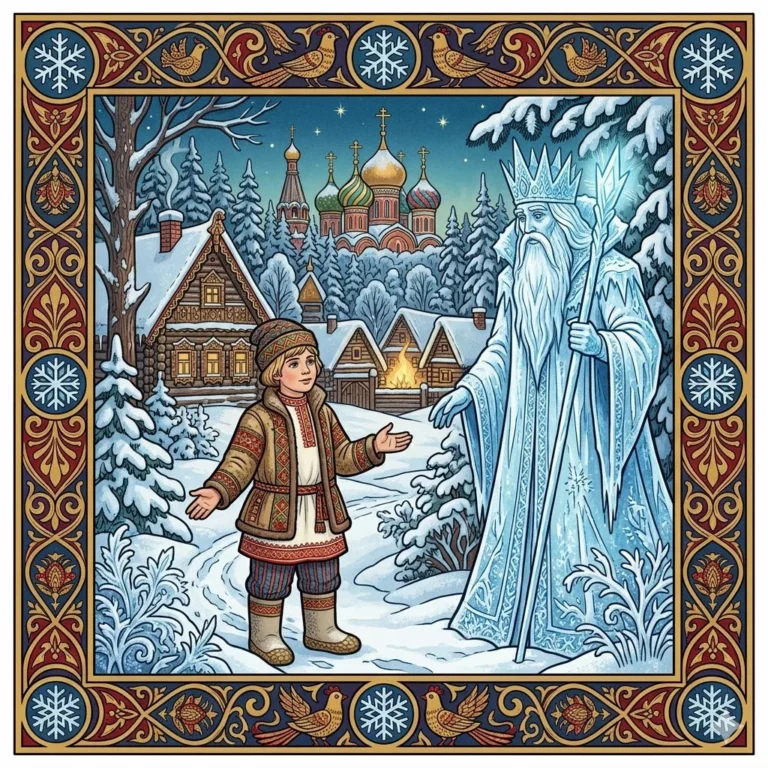
The Boy Who Outwitted Winter
The villagers were frightened. Their grain stores had grown thin as paper. Their cattle lowed miserably in dark, frozen barns. And though the elders gathered each evening to argue, no one had a plan — except for a boy named Misha, who was eight years old and had ideas too big for his boots.
"I will go to the Iron Forest," Misha announced one morning at breakfast.
His grandmother, Babushka Vera, set down her ladle with a clang. "You will do no such thing." Her voice was as firm as frozen ground. "The Iron Forest is where old Morozna lives — the Winter Spirit. She has swallowed brave men whole."
"Then I'll be smarter than the brave men," Misha said quietly.
Babushka Vera looked at him for a long time. Her eyes, dark and deep as forest pools, searched his face. Then she sighed — a soft, warming sound — and went to the cedar chest in the corner.
She pulled out a small pouch stitched with red thread. "Sunflower seeds," she said. "Morozna loves them. And Misha — listen carefully — she will ask you three questions. Do not lie. Not once. Not even kindly."
Misha tucked the pouch inside his coat, where it sat warm against his chest.
—
The forest beyond the village was a world made of glass and silence. Every branch wore a coat of ice that clinked softly when the wind moved through, like faraway bells. Misha's boots crunched a steady rhythm into the deep snow, and his breath made small clouds that disappeared almost before they formed. The cold bit at his cheeks, sharp and mean, and the pine trees rose around him like tall, patient guards watching to see what he would do.
At the heart of the Iron Forest stood a hut on crooked stilts, smoke rising from its chimney in blue ribbons. The door was made of blackened oak, and carved into it was a snowflake so detailed Misha could see every tiny branch. He knocked three times.
The door swung open on its own.
Inside, beside a fire that burned without wood, sat an old woman wrapped in silver furs. Her hair was white as birchbark, her fingers long and thin as icicles. She smelled of pine resin and frozen midnight air. She did not look up when Misha entered.
"You brought seeds," she said. It was not a question.
Misha set the pouch on the table before her. "My babushka sends her respects."
Now Morozna looked up. Her eyes were pale blue — the colour of sky just before a blizzard breaks. "Vera's grandson," she murmured. "Sit, then."
Misha sat. The fire crackled and popped between them, throwing orange light across her ancient face.
"Three questions," Morozna said. "If you answer with truth, I will consider your request. If you lie — even once, even gently — the winter stays forever, and you stay with it. Do you understand?"
"Yes," said Misha. His hands trembled in his lap, but his voice held steady.
"First question." She folded her long fingers together. "Are you afraid?"
Misha thought about lying. It would have been easy — a small, clean word. But he remembered his grandmother's eyes and said, "Yes. Very much."
A sound rose from Morozna then — not quite a laugh, but something lighter than silence.
"Second question: Do you believe you are worthy of spring?"
Misha opened his mouth and closed it again. He thought of his village — the thin, tired neighbours, the cattle, the empty grain stores. Then he thought of himself: a boy of eight in too-big boots, sitting before a spirit older than memory.
"I don't know," he said honestly. "But my village is."
Morozna was quiet for so long that the fire dimmed to embers. Then it blazed back up, higher than before. "Third question," she said, and her voice had changed — softer now, like snow falling instead of ice cracking. "If I release spring and the cold returns next year — as it always does — will you come again?"
Misha did not hesitate. "If I need to," he said. "Yes."
The old woman rose from her chair. She was taller than he'd expected — tall enough that her head nearly touched the rafters. She crossed to the window and pressed one long palm against the frozen glass. Where she touched it, the ice turned to water and ran in thin rivers down the pane.
"Go home, Vera's grandson," she said quietly. "You answered honestly, which takes more courage than a sword. Spring will follow you out of the forest."
—
And it did. Misha walked home as the ice above him slowly began to drip, sending a soft, musical tapping down through the trees — a sound like a thousand tiny fingers playing a song. This is exactly the kind of tale for kids ages 6–12 told on long winter evenings when everyone is warm and close and the candles burn down to their nubs.
By the time Misha reached the village, he could smell it — that thin, sweet scent of mud and thawed earth, the first breath of a world waking up.
His babushka was waiting at the door. She looked at him for a long moment, then folded him into her arms, which smelled of bread and woodsmoke.
"Did you lie?" she whispered into his hair.
"No," he said into her shoulder.
She held him tighter. "Good boy," she murmured. "Good, brave boy."
The river began to sing that afternoon — a low, rushing sound as the ice broke apart and the water, dark and fast and cold, found its way once more. The villagers came out into the pale golden light to listen and to wonder. None of them quite knew what had changed.
📚 Recommended Books
Handpicked for readers like you
As an Amazon Associate, we earn from qualifying purchases. These recommendations are personalized based on this story's themes and your reading history.
But Misha sat on the muddy bank with spring water running cold over his fingers, watching the current carry the last of winter away, and he felt — not like a hero, exactly. Only like himself. Only more so.