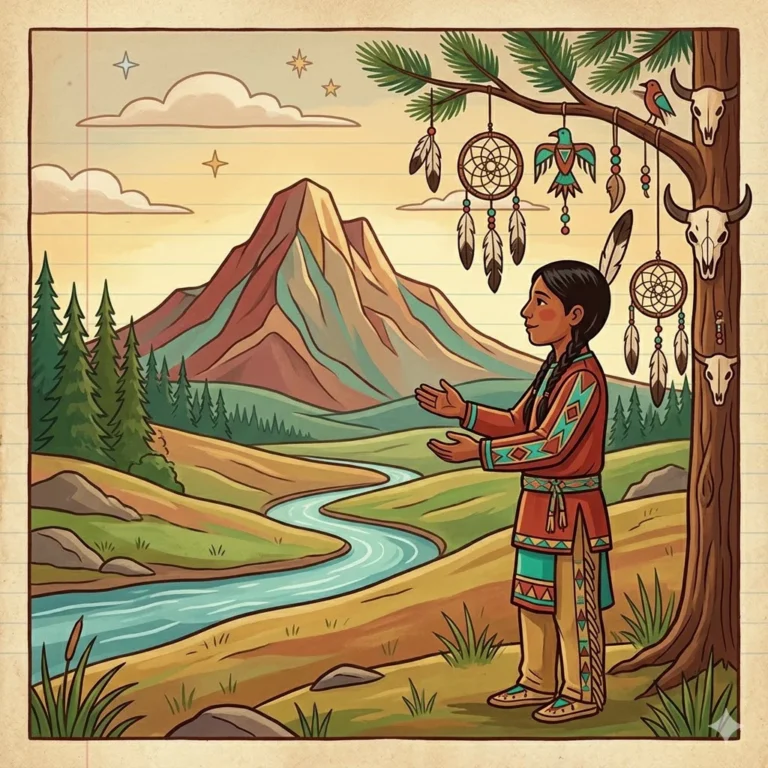
The Boy Who Listened to the Mountain
—
Koda was ten winters old, with quick dark eyes and feet that never seemed to be still. He lived in his village at the foot of a great mountain the elders called Sleeping Bear Peak. The mountain's shadow stretched long over the lodges each evening, and the old ones said the mountain breathed — slowly, like someone deep in a dream.
Koda didn't believe that. Not yet.
One autumn morning, he raced to the river to fill the clay pot his grandmother had given him. The air smelled of damp earth and pine needles crushed underfoot. Orange and red leaves floated past his knees as the cold water rushed over his fingers, sharp as a hawk's cry.
"Koda."
He looked up. Old Mika sat on a boulder, her silver braid catching the thin morning light. She was the village storyteller, the one the children called Grandmother-of-Everyone.
"You're in a hurry again," she said.
"There's nothing slow worth doing," Koda answered, lifting his dripping pot.
Mika smiled. "The river disagrees."
He didn't know what that meant. He ran home anyway.
—
That same week, the hunters returned with worry written across their faces. The elk had moved east. The berry bushes by the south ridge had withered early. And three nights running, the coyotes had howled from the wrong direction — from the mountain's side, not the valley floor.
The elders gathered around the fire. Smoke curled upward, sweet with cedar. Koda pressed close enough to feel the heat on his cheeks and hear the low murmur of adult voices.
"Someone must climb to the upper meadow," said Elder Runs-Far, "and see what has disturbed the animals."
The men shifted. The mountain path above the tree line was treacherous in autumn. Ice gathered on the rocks before sunrise. Three times in living memory, travelers had slipped and not come down.
"I'll go," said Koda's uncle, a broad-shouldered man named Takoda.
"Your ankle," said Mika gently. Takoda had twisted it just days before, chasing a runaway horse.
Silence thickened like smoke.
"I'll go," said Koda.
Every adult face turned toward him.
"You're a child," said Runs-Far, not unkindly.
"I know the path to the first ridge," Koda said. His voice only wavered a little. "I've climbed it a hundred times."
"The upper meadow is twice that far," his uncle said.
"I know." Koda breathed slowly. Something in his chest felt like ice and fire at once. "But nobody's ankle is twisted."
—
Mika walked with him to the mountain's base before dawn. The sky was purple-black, pinpricked with stars. Frost made the grass crunch softly beneath their feet, and Koda could see his own breath floating ahead of him like a small ghost.
"What do I do when I get scared?" he asked, though he hadn't meant to say it out loud.
Mika handed him a smooth stone, grey and round as a sparrow's egg. "Hold this. It's river stone — it has listened to water for a thousand years. When you're frightened, stop walking. Listen the way this stone has listened."
"That doesn't make sense," Koda said.
"No," Mika agreed. "Not yet. Go carefully."
—
The climb was harder than he imagined. By the time the trees thinned and the wind hit his face with full force, his legs burned and his fingers inside his hide gloves felt like river stones themselves — numb and heavy. The smell of snow hung in the air, clean and sharp, even though none had fallen yet.
At the first ridge, he looked down. The village was a cluster of tiny fires, impossibly small. The sight made his stomach lurch.
He stopped walking.
He held the stone in his palm.
He listened.
At first he heard only wind. Then, beneath it, a low groaning, rhythmic, almost like — breathing. He turned. On the rock face twenty steps above him, he saw the crack. A long, jagged split in the mountain's shoulder where a ledge of stone had begun to pull away from the cliff. Beneath it, a choke point — the narrowest part of the trail, where the whole village must pass during the winter migration to lower ground.
If that ledge fell, the path would be buried.
Koda sat very still for a long moment. Then he turned around and ran — not from fear, but toward the village, toward the elders, toward the people who would know what to do with what he had found.
—
The men came with ropes and pointed sticks, and they confirmed what Koda had seen. The migration route was changed. New trail markers were set before the first snowfall closed the pass.
That evening, the fire burned high and warm. Takoda put his hand on Koda's shoulder.
"You were frightened," his uncle said. It wasn't a question.
"Yes," Koda said.
"But you stopped and listened anyway."
Koda turned the river stone over in his fingers. The firelight made it glow like something alive. Outside, the wind moved through the pines with a long, slow sound — like breathing. Like something enormous, resting.
Like a mountain, dreaming.
📚 Recommended Books
Handpicked for readers like you
As an Amazon Associate, we earn from qualifying purchases. These recommendations are personalized based on this story's themes and your reading history.
Mika caught his eye across the fire and said nothing at all. She didn't need to.