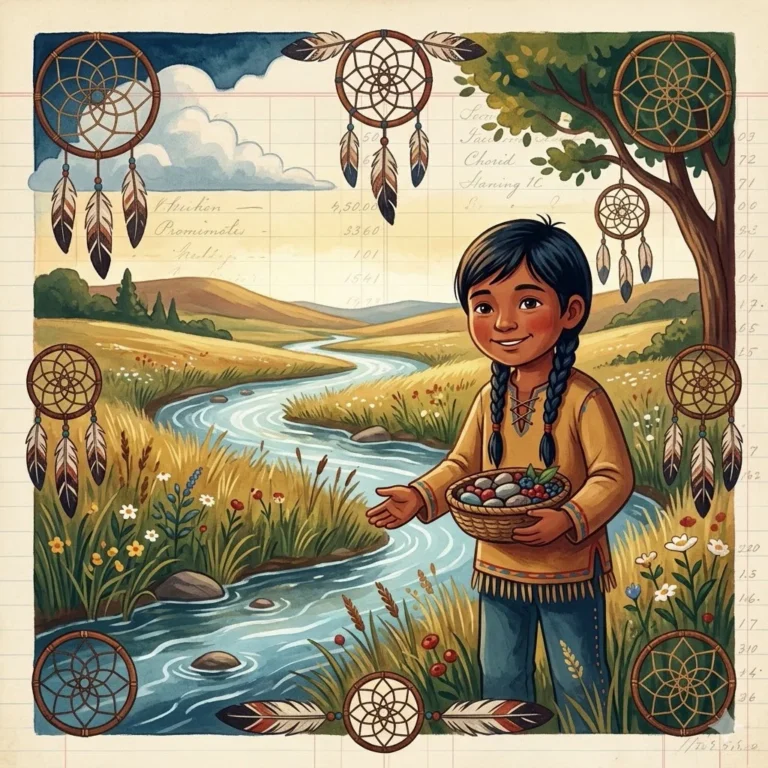
The Boy Who Listened to the River
—
The village of Whispering Reeds sat at the bend of a wide, slow river, where the cattails grew taller than a man and the morning mist smelled like wet cedar and earth. Every child there knew one rule above all others: do not cross the river alone when the autumn moon was thin.
Ten-year-old Kaya knew the rule. He also knew that his little sister Wren had wandered past the cattails at dusk, following what she swore was a firefly no bigger than a pine needle — and she had not come back.
Their grandmother, Nookomis, stood at the water's edge, her feet bare on the cold mud. She pressed her palm flat against Kaya's chest.
"You will go to Tall Elk," she said. "He knows the crossing. You do not."
"There's no time," Kaya said. His voice cracked. Across the river, the cottonwoods were turning black against the dim orange sky. "She went in *before* dark. She's already been over there alone."
Nookomis looked at him a long moment. Her eyes were the color of river stones after rain — not hard, but settled. "Then run fast."
—
Tall Elk was the oldest man Kaya had ever seen, with a face folded like old bark and hands that moved slowly, the way river water moves around a boulder — never in a hurry, always certain.
Kaya burst through his door flap, breathing hard, and explained everything in one tangled sentence.
Tall Elk did not stand up. He poured two cups of tea that smelled of pine and dried berries and set one in front of Kaya.
"Drink," the old man said.
"*Now?*" Kaya stared at him.
"You are making decisions with a galloping heart." Tall Elk's voice was even and low, like the hum of the river itself. "A galloping heart sees only one step ahead. Drink."
Kaya wanted to shout. Instead, furious, he drank. The tea was warm and tasted of smoke. And in the fifteen seconds it took to swallow, he felt something unclench behind his ribs. His breathing slowed. His thoughts, which had been a flock of startled birds, began to land.
"Good," said Tall Elk, rising at last. "Now tell me again — where exactly did she cross?"
—
They moved through the cattails together. This time Kaya noticed things he had missed in his panic: the way the reeds bent *downstream* where something small had pushed through them, the smear of mud on a half-submerged log where a foot had slipped, the single moccasin print pressed into the silt like a little moon.
"She went left of the cottonwood, not right," Tall Elk said quietly. "The current is gentler there. Smart girl."
Kaya felt a rush of pride, then fresh fear. "But it's deep on the other side."
"It is. Which is why we do not wade. We walk the old stone path." Tall Elk crouched and pressed one palm to the river surface, feeling something Kaya couldn't see. "Three steps out, then angle. The stones are still there. They do not move. *We* are the ones who forget them."
Kaya studied the dark water. He could not see any stones. His whole body screamed at him to plunge in and swim.
"What if I step wrong?" he asked.
"Then you will be wet and cold and we will both pull you out," Tall Elk said simply. "Step wrong is not the end of the world. *Not stepping at all* — that is the end of the search."
Kaya took a breath. He stepped.
—
The stones were there. Each one solid and slightly tilted, slick with moss, demanding attention, demanding that he feel with his whole foot before trusting his weight. It was the slowest crossing he had ever made — slower than it would have taken to swim — but he arrived on the far bank without falling.
Tall Elk was right behind him, dry as sand.
The far forest smelled different — darker, mulchy, full of things decomposing back into earth. An owl called twice and went silent.
Then: a small voice.
"Kaya?"
Wren was sitting at the base of an enormous cottonwood, her knees pulled to her chest, her cheeks still wet from crying but her chin lifted bravely. She had twisted her ankle on a root but had stayed exactly where she was, because Nookomis had always said: *if you are lost, stay where the last person saw you go.*
"You remembered," Kaya said, crouching to hug her so hard she squeaked.
"I was scared," she admitted. "But being scared and being still are different things."
Tall Elk looked at her with something that wasn't quite a smile — more like recognition. "Yes," he said. "They are."
—
The crossing back was easier. Kaya went first, and this time he could feel where the stones were — he had learned them on the way over, the way your feet learn the shape of a familiar floor in the dark.
Nookomis was waiting with a fire already built. She wrapped Wren in a blanket that smelled of sweetgrass and smoke, and she didn't say *I told you so*, which Kaya thought was the kindest thing a person could do.
Later, this story — perfect for kids ages 6-12 who love tales of real bravery — was told many winters in the village of Whispering Reeds. People remembered two things: that Kaya had run to get help instead of charging in alone, and that for fifteen seconds, furious and desperate, he had stopped and drunk his tea.
📚 Recommended Books
Handpicked for readers like you
As an Amazon Associate, we earn from qualifying purchases. These recommendations are personalized based on this story's themes and your reading history.
That was the part that made grandmothers smile the widest when they told it.