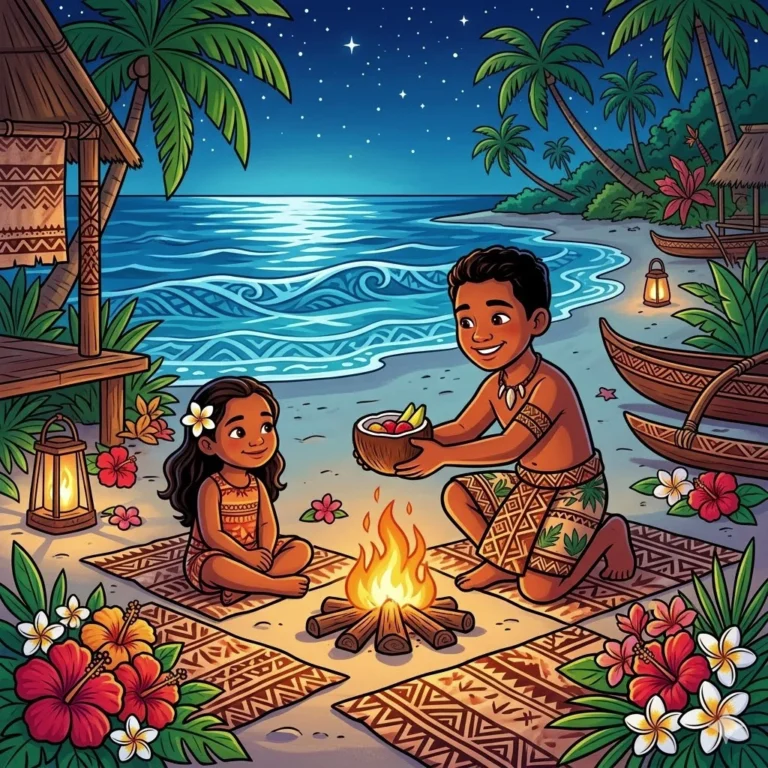
The Boy Who Listened to the Sea
—
On the island of Motu Roa, where breadfruit trees grew heavy with fruit and the air always tasted of salt and rain, there lived a boy named Kai.
Kai was small for ten, with dark eyes that missed nothing and hands that were always busy — braiding rope, mending nets, tracing the shapes of stars in the black sand with a stick. Every morning he crept down to the shore before sunrise, when the sea was silver and the only sound was the hush and pull of the waves against the coral reef.
He wanted, more than anything, to sail beyond the reef.
"You are too young," said the older boys when he asked to join their fishing trips. They smelled of fish oil and laughed loudly, and they did not look at him when they said it.
"You are too small," said his uncle, whose canoe was the fastest on the island. His uncle smelled of coconut wood shavings and spoke with the finality of someone who had already decided.
But there was one person who never said Kai was too young or too small. That was Nana Hine.
—
Nana Hine was the oldest person on Motu Roa. She lived at the eastern point of the island, where the palms grew in a curve like a cupped hand, and the wind came in off the open ocean carrying the smell of somewhere far away. Her skin was mapped with wrinkles, and her hair was white as seafoam. She had sailed, people said, to islands so distant you could not see them even from the highest cliff.
One evening, when the sun was melting into the horizon in ribbons of orange and violet, Kai sat beside her on the flat rock she used as a chair.
"Nana," he said, "how do you know where to go when there is nothing to see but water?"
Nana Hine was quiet for a long time. The wind pushed past them, warm and thick, carrying the distant call of a frigate bird.
"You do not look," she said at last. "You listen. The sea speaks in swells. The stars tell you your name, if you learn theirs first. The birds know where land is before your eyes do."
Kai turned this over in his mind like a smooth stone. "Will you teach me?"
She looked at him then — really looked — and something flickered in her dark eyes like a flame deciding whether to catch.
"Come back tomorrow before the sky turns pink," she said. "Bring nothing. Just your ears."
—
For weeks, this is how it went. Kai would wake before the roosters, pad silently past his sleeping family, and arrive at the eastern point. Nana Hine taught him to feel the deep swell beneath the surface chop — a slow, rolling pulse, like the island breathing. She taught him the names of seven steering stars. She taught him how a certain brown booby always flew toward land at dusk.
The knowledge settled into his body like weight. He felt different — steadier, somehow, even on dry ground.
Then came the night the storm struck.
—
It arrived fast, the way the worst storms do, with a sky that turned the color of a bruise and a wind that bent the palms sideways and tore the smell of rain from somewhere still distant. The village men ran to pull canoes above the tide line. Women gathered children inside. Thunder rolled across the water like a falling mountain.
And then someone cried: "The twins! The twins are on the reef!"
Kai's heart dropped into his stomach. His little cousins — six-year-old Loa and Mara — had gone to catch crabs that afternoon. No one had thought to check. In the panic, no one could see them through the whipping grey rain.
Every man on the beach looked at the sea and did not move.
The waves at the reef entrance were high now, white and roaring, crashing on the coral with a sound like the world breaking apart.
Kai looked at the water. He looked at the reef entrance. He felt the swell.
It was coming from the southwest. That meant the channel between the two coral heads — the one Nana Hine had shown him, the one the adults always ignored — would be calmer, protected by the larger formation. Not safe. But possible.
His hands shook. His legs shook. But something inside him had gone very still.
He pushed a small outrigger into the surge before anyone could stop him.
"KAI!" his uncle bellowed from the shore.
"THE CHANNEL!" Kai shouted back over the wind. "THE SOUTHWEST CHANNEL!"
He didn't wait to see if his uncle understood. He paddled. The rain hit his face like tiny stones. The sea smelled like metal and deep cold things. Each wave that rose beneath him he felt — not just with his hands, but with everything Nana Hine had pressed into him over those weeks. He read them the way she had taught him. He let the water speak.
He found the twins crouched on a coral shelf, soaked and screaming, clinging to each other in the dark. Loa had a cut on her knee. Mara had lost one sandal. They were both shaking so hard he could feel it through the hull of the canoe when he pulled them in.
The return trip was slower and harder. But he knew the swells. He knew the stars behind the clouds by where the clouds were darkest. He knew the sound the reef made when you were too close.
When the outrigger ground onto the sand and the whole village surged forward, Nana Hine was there at the edge of the crowd. She did not cheer or weep like the others. She simply looked at Kai with those steady eyes and gave one small nod.
That nod was worth more to him than any words.
—
📚 Recommended Books
Handpicked for readers like you
As an Amazon Associate, we earn from qualifying purchases. These recommendations are personalized based on this story's themes and your reading history.
This is the kind of story — just right for ages 6-12 — that the islands have always told: that knowledge is what makes courage possible, and that the bravest act is the one you've spent your life quietly preparing for.