THE WOLVES ON THE LATIN ROAD
—
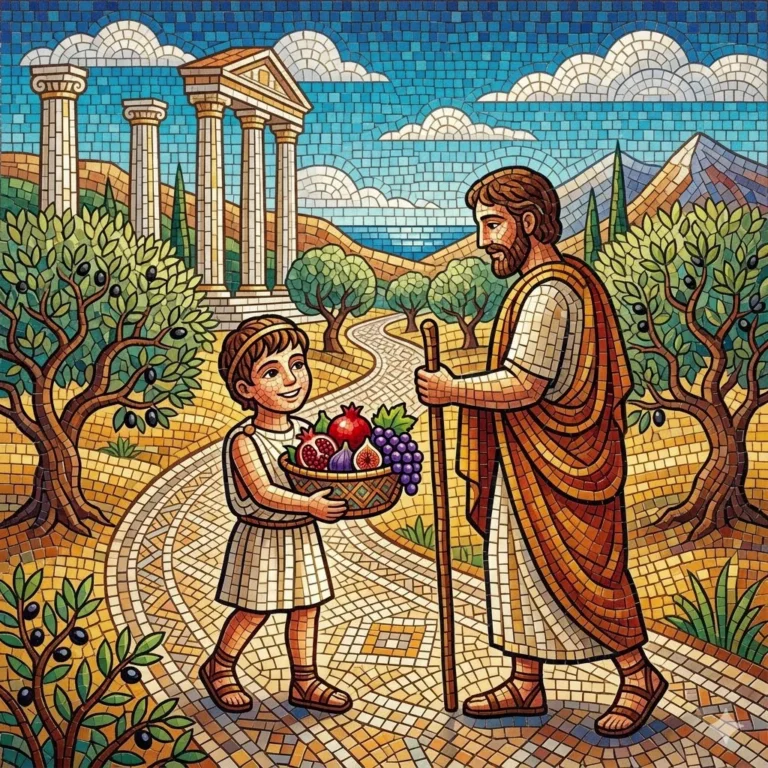
Long ago, when Rome's seven hills cast long shadows across the countryside, there lived a boy named Quintus who had never once walked the Latin Road alone.
He was ten years old, small for his age, with dusty sandals and a leather satchel that smelled of his father's spice trade — cinnamon and dried figs and just a little of the sea. His father, Gaius, was a merchant who bought olive oil in the hill towns and sold it in the Forum below. That morning they had set out together before sunrise, the road hard and pale beneath their sandals, the air still cool and smelling of lavender and night-damp stone.
They had not gone three miles when it happened.
Gaius's foot slipped between two rocks on a steep downward turn. There was a crack — not loud, but sharp, like a branch in winter — and Gaius sat down heavily in the dust, his face gone white as chalk.
"Your ankle?" Quintus knelt beside him, feeling the sun already burning the back of his neck.
"I cannot walk on it." His father's voice was even, careful. "You must go ahead to Tusculum. Find Marta the healer — everyone knows her house by the red shutter. Bring her back before evening, or I'll spend the night on this road."
Quintus looked up ahead. The olive groves were thick and grey-green in the midday heat. Cicadas screamed in the silver leaves. "I heard the shepherd boys say there are rough ones on this stretch. They stop travelers. Take things."
His father reached out and took the boy's face in both his large, warm hands. The calluses felt like smooth bark. "Listen to me. Fear is not your enemy. Foolishness is. Your greatest weapon is neither your fists nor your feet. Do you understand me?"
Quintus wasn't sure he did. But he nodded, shouldered his satchel, and walked on.
—
The olive grove closed around him like a cool green room. The smell of road dust gave way to the deep, oily scent of old bark and sun-warmed leaves. Somewhere above him a dove called softly into the still air.
At the fork in the road, an old woman sat on a flat stone, spinning wool. Her fingers moved without looking, the thread growing long and steady between them.
"You're Gaius the merchant's boy," she said without lifting her eyes.
"I am." Quintus stopped. "How do you know?"
"Your father buys oil from my nephew." She finally looked at him — bright dark eyes under heavy white brows, sharp as a hawk's. "I know where you're going. And I know what's ahead." She nodded down the left fork, toward Tusculum. "Three boys. They call themselves the Wolves of the Road. They've taken two merchants' purses this week." She tilted her head. "Will you turn back?"
Quintus thought of his father sitting in the pale dust with his foot at a wrong angle. "No."
"Then don't run," she said simply. "Wolves chase what runs. Stand still. Look them in the eye. And whatever you have to give — give it freely, before they demand it."
He stared at her. "But they'll take it —"
"Sometimes losing a small thing saves a larger one." She returned to her spinning. "Go on, then."
—
He heard them before he saw them — laughter and the sharp crack of a stick against a gate-stone. Three boys, older than him by two or three years, sprawled in the shade of a crumbling wall. They had hard eyes and dirty elbows and the lazy, watchful look of those who have learned that waiting is its own kind of power. The air around them smelled of woodsmoke and something sour.
"Where are you going, little sparrow?" the tallest one called out.
Quintus stopped walking. His heart hammered so hard he could feel it in his teeth. His palms were slick.
But he did not run.
He looked the tall boy full in the face and let the silence sit between them for one whole breath. "To Tusculum," he said — and was surprised by how steady his own voice sounded. "My father is injured on the road behind me. I need a healer."
The tall boy blinked. He had not expected this.
Quintus reached into his satchel and drew out the small bundle of dried figs his mother had packed for the journey. His throat tightened; he loved those figs. He held them out anyway, arm fully extended, the bundle dark and sweet-smelling in the hot white light.
"I have nothing else worth taking," he said. "But you could help me instead. One of you could run to Tusculum faster than I can. I'll owe you a favor — and my father, Gaius the merchant, will remember it."
A long silence stretched between them. The cicadas screamed on without mercy.
The tall boy stared at the figs. He stared at Quintus's face — the steady eyes, the outstretched arm that wasn't shaking. Something moved behind his expression, something almost like surprise at being spoken to plainly, without trembling and without contempt.
"Keep your figs," he said at last, and stood. He looked at the youngest of the three. "Tiro. Run to Marta's house. Tell her there's a man hurt on the road."
The small boy shot off down the hill before Quintus could draw another breath.
The tall boy sat back down in the shade and said nothing more.
—
Marta arrived before the light turned golden. She bound Gaius's ankle with linen strips and the sharp, clean sting of vinegar and rosemary, and by evening Gaius could hobble the last stretch to Tusculum on a shepherd's staff she found by the road.
That night they ate bread and lentil soup in the warm smoky light of the inn, the fire popping, the smell of garlic and herbs rising from their bowls. Gaius looked at his son across the table for a long moment.
"Were you afraid?" he asked quietly.
Quintus turned his wooden spoon in his hands. The fire crackled. Outside, Rome's hills stood dark against a sky full of stars.
"Yes," he said at last. "The whole time."
His father reached across and gripped his son's hand once — firm and slow, tight as a promise made before the gods.
📚 Recommended Books
Handpicked for readers like you
As an Amazon Associate, we earn from qualifying purchases. These recommendations are personalized based on this story's themes and your reading history.
And nothing more needed to be said.