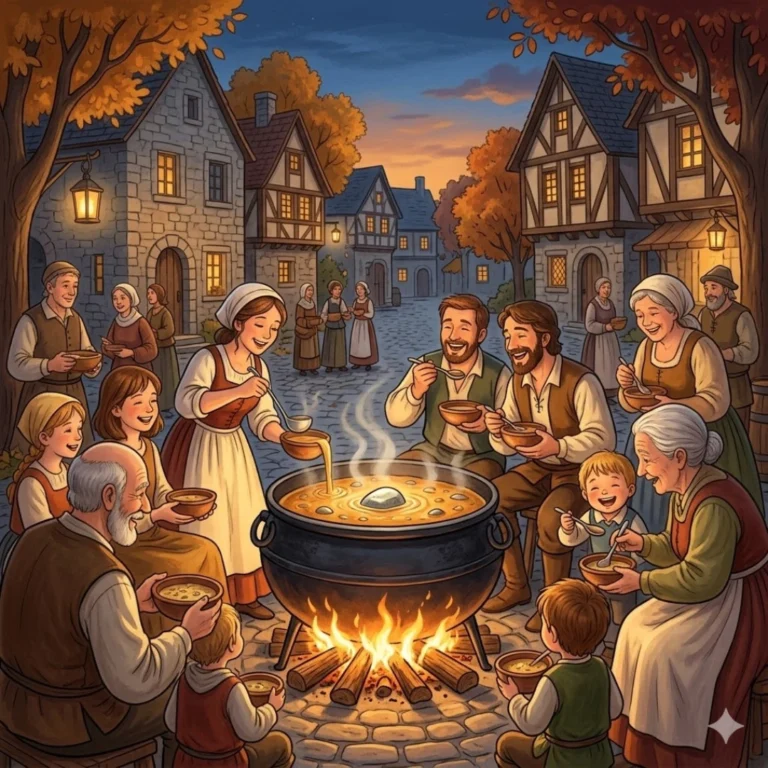
Hungry strangers arrive at a village with only a pot and a stone—and through one small deception and much community spirit, they make a feast.
Three weary travellers arrived at a village late one autumn afternoon. They had been walking for many days and were very hungry.
They knocked on door after door.
“We have nothing to spare,” said the first house.
“Times are hard,” said the second house.
“We cannot feed strangers,” said the third.
The travellers sat in the village square. They built a fire and put a large pot of water over it. Then one of them reached into her bag and pulled out a smooth, round stone.
“What are you doing?” asked a curious child who had crept over to watch.
“Making stone soup,” said the traveller cheerfully. “It is delicious when it’s done. Would you like to try some?”
Word spread quickly. The villagers drifted over, suspicious and curious.
“Stone soup? What does that taste like?”
“It is quite good,” said the traveller, stirring thoughtfully. “Though, now that I think of it—it would be much better with just a few carrots.”
One farmer, curious, went home and brought back carrots.
“Wonderful! Though I confess, stone soup with carrots and a few potatoes—that is remarkable.”
A woman fetched potatoes.
“Stone soup with vegetables is quite good. My grandmother always added a little barley.”
Someone brought barley.
“And an onion—”
An onion appeared.
“Some salt and herbs—”
These came too.
When the soup was finally finished and ladled into bowls, the whole village ate together in the firelight—the travellers and all the people who had said they had nothing to spare.
It was, everyone agreed, the best soup they had ever tasted.
The travellers cleaned the stone carefully, thanked the village, and walked on.
The villagers looked at each other over their empty bowls. Each of them had “nothing to spare.” Together, they had made a feast.
The stone was still in the pot. It had added nothing to the soup. But it had added everything to the meal.
Moral of the Story
Generosity is contagious. When one person begins to give, others find they have more than they thought. Together, people who ‘have nothing’ can create abundance.
Learn These Words
- weary
- very tired, usually from long activity
- suspicious
- having a feeling that something is wrong or untrue
- ladle
- to serve liquid food using a large deep spoon
- abundance
- a very large quantity of something
- contagious
- spreading easily from one person to another
Test Your Understanding
1What did the villagers say when the travellers asked for food?
2What did the travellers put in the pot first?
3How did the travellers get the villagers to contribute?
4What did the stone actually add to the soup?
5What lesson does this story teach?
Frequently Asked Questions
What is the moral of The Stone Soup story?
The Stone Soup teaches that when everyone contributes a little, the whole community benefits. It shows that sharing and cooperation can create abundance even when people believe they have nothing to spare. The story also gently illustrates how a small act of cleverness can inspire generosity in others.
What happens in The Stone Soup folk tale?
Three hungry travellers arrive at a village where no one will share food. They place a stone in a pot of boiling water, claiming they’re making delicious ‘stone soup.’ Curious villagers each contribute a small ingredient—carrots, potatoes, and more—until together they’ve created a hearty feast the entire village enjoys.
Is The Stone Soup a true story or a folk tale?
The Stone Soup is a traditional folk tale with versions found across many cultures, including European, Asian, and South American traditions. It is not based on a true event, but its enduring popularity comes from its universal message about community, generosity, and the power of working together.
📚 Recommended Books
Handpicked for readers like you
As an Amazon Associate, we earn from qualifying purchases. These recommendations are personalized based on this story's themes and your reading history.
What age group is The Stone Soup story best for?
The Stone Soup is ideal for children ages 3 to 10. Younger children enjoy the repetitive structure as each villager adds an ingredient, while older kids appreciate the clever trick the travellers use. It’s a popular choice for read-alouds, classroom discussions about sharing, and teaching cooperation.
Why did the villagers refuse to help the travellers at first?
The villagers told the travellers they had nothing to spare and that times were hard. This is common in versions of the story—each household feared giving away food they might need. The Stone Soup trick worked because it shifted the villagers’ mindset from scarcity and suspicion to curiosity and communal generosity.