

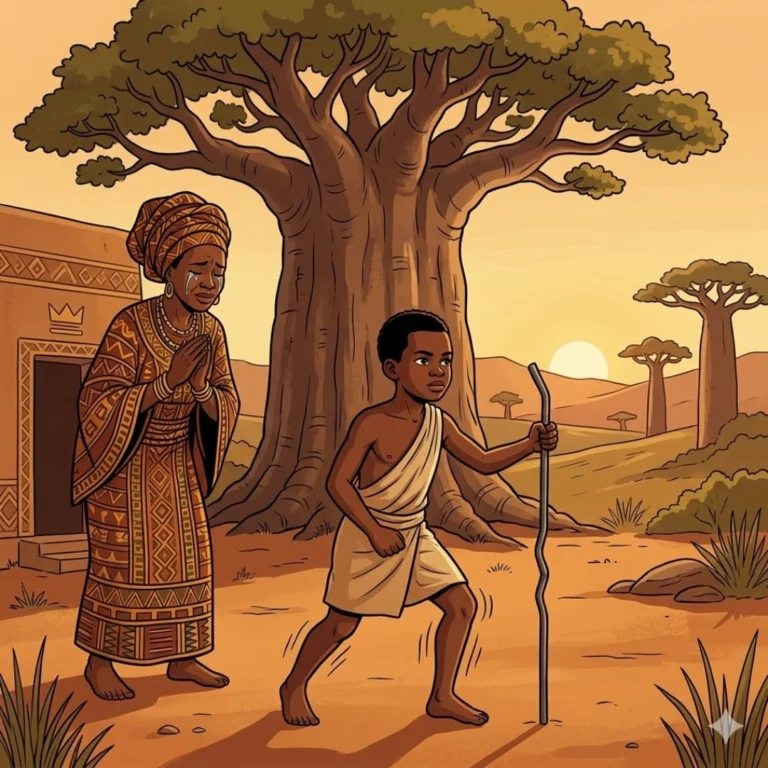
The boy who could not walk becomes the king who could not be stopped—because he refused to give up on himself.
There was once a boy named Sundiata who could not walk.
He was the son of the king of Mali, but his legs would not carry him. While other princes practised with swords and horses, Sundiata dragged himself across the palace floor. People whispered. The king’s other wife sneered. Her son would be king, not this cripple.
Sundiata’s mother, Sogolon, wept. She had been told by a hunter-prophet that her son would become the greatest king in Africa. Looking at the child who could not stand, she found it difficult to believe.
One day, Sogolon was publicly humiliated by the king’s other wife, who had grown powerful. The queen waved a branch of baobab leaves in her face. “Your son cannot even bring me the leaves I ask for. What kind of son is that?”
Sundiata saw his mother’s tears.
He asked for an iron rod.
The blacksmiths brought a rod as thick as a man’s wrist. Sundiata grasped it and pushed. The rod bent.
Another rod, thicker.
This one bent too.
A third, the strongest iron the smiths had.
Sundiata pushed. And pushed. And his legs—slowly, trembling, refusing to stop—began to straighten.
He rose.
He stood.
He walked to a baobab tree, gripped it with both hands, and pulled it from the earth, roots and all. He carried it to his mother and set the branch of leaves at her feet.
“No one will humiliate you again,” he said.
Sundiata became the greatest ruler the Mali Empire ever knew. He united twelve kingdoms. He defeated the sorcerer-king Soumaoro. He created laws that protected the poorest people.
But the griots—the storytellers of West Africa—always begin his tale with the same image: a boy, an iron rod, and a refusal to stop.
Moral of the Story
Determination means deciding to rise—even when rising seems impossible. The person who refuses to stop is not yet defeated.
Learn These Words
- determination
- firm decision to do something and not give up
- griot
- a West African storyteller, historian, and keeper of oral tradition
- humiliate
- to make someone feel deeply ashamed in front of others
- prophet
- a person who delivers messages from God or predicts the future
- unite
- to bring together into one
Test Your Understanding
1Why could Sundiata not walk?
2What made Sundiata finally decide to stand?
3What did Sundiata do with the baobab tree?
4What did Sundiata become?
5What lesson does this story teach?
Frequently Asked Questions
Who was Sundiata and why is he famous?
Sundiata Keita was the real founder of the Mali Empire in West Africa during the 13th century. He is famous because, despite being unable to walk as a child, he overcame his disability through sheer determination and went on to become one of the greatest kings in African history. His story is passed down through West African oral tradition by griots, or storytellers.
What is the moral of the Sundiata and the Lion’s Walk story?
The central moral is that refusing to give up on yourself can transform your life. Sundiata faced a severe physical disability and constant ridicule, yet he persevered. The story teaches children that limitations—whether physical, social, or emotional—don’t define your future, and that inner strength and determination matter more than present circumstances.
Is the story of Sundiata based on a real person?
Yes, Sundiata Keita was a real historical figure who founded the Mali Empire around 1235 CE. While the story includes legendary elements passed down through centuries of oral tradition by West African griots, historians confirm that Sundiata united the Mandinka people and built one of the most powerful empires in African history.
📚 Recommended Books
Handpicked for readers like you
As an Amazon Associate, we earn from qualifying purchases. These recommendations are personalized based on this story's themes and your reading history.
What age group is the Sundiata and the Lion’s Walk story best suited for?
This retelling is ideal for children ages 5 to 10. The straightforward narrative, vivid imagery of Sundiata bending iron rods and learning to walk, and the clear theme of perseverance make it accessible for young readers. It also works wonderfully as a read-aloud story for parents and teachers exploring African history and folklore.
Why did Sundiata ask for an iron rod in the story?
Sundiata asked for an iron rod after watching his mother be publicly humiliated by the king’s other wife. Her tears motivated him to finally stand on his own. The iron rod served as a support to pull himself upright, and the fact that he bent multiple rods before succeeding symbolises his extraordinary strength and relentless determination.
