The most generous man in Arabia gives away his final treasure—and gains something far greater in return.
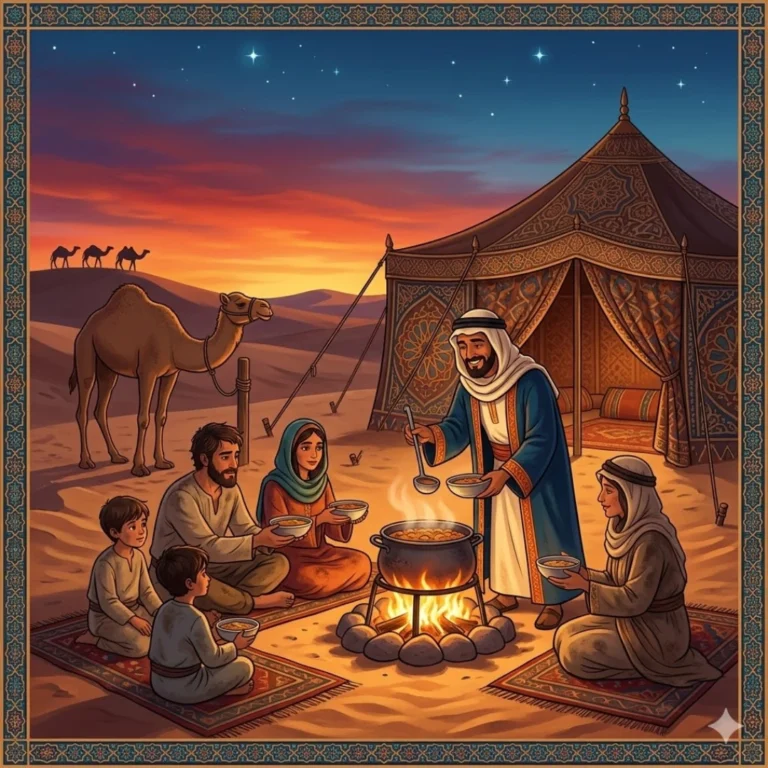
Long ago in the deserts of Arabia, there was a man so generous that poets sang of him for centuries. His name was Hatim al-Tai, and he came from the tribe of Tayy. He gave away horses, camels, food, and clothing until people said, “If you are hungry and there is no other door to knock on, knock on Hatim’s.”
One year, a long drought came. Hatim’s tribe moved. His flocks grew thin. His stores of grain ran low. But still, travellers arrived at his tent—hungry, thirsty, with nowhere else to go.
His wife worried. “We have almost nothing left, Hatim. Not even enough for our own children.”
Hatim looked at the travellers. A family from far away, dust-covered and exhausted. “Our children will eat after them,” he said.
He slaughtered his last camel—a prized mare he had raised from a foal. He cooked a great feast. The family ate until they were full, rested, and went on their way blessing his name.
When the Arabian king heard this story, he laughed. “Hatim is a fool. He has given himself into poverty.”
But the poets said otherwise. They composed verses about Hatim that spread across Arabia, Persia, and beyond. Merchants mentioned his name to gain trust. Parents told children: “Be like Hatim.” A century after his death, his generosity was still making people feel braver about giving.
The king’s gold is gone. His name is barely remembered. Hatim al-Tai’s name is still spoken with warmth by people who have never met him.
The story ends with this question—asked by generations of Arabian storytellers: What is wealth? Is it the gold in your chest, or the blessings of those you have fed?
Hatim knew the answer. He always did.
Moral of the Story
True wealth is not what you keep, but what you give away. Generosity lives on long after gold is spent.
Learn These Words
- drought
- a long period with little or no rain
- slaughter
- to kill an animal for food
- prized
- valued very highly
- poverty
- the state of being very poor
- verse
- a line or group of lines in a poem
Test Your Understanding
1What was Hatim al-Tai famous for?
2What happened during the drought?
3What did Hatim give to the travelling family?
4What did the king think of Hatim?
5What lesson does this story teach?
Frequently Asked Questions
Who was Hatim al-Tai and why is he famous?
Hatim al-Tai was a legendary figure from the Tayy tribe in ancient Arabia, celebrated for centuries as the most generous man in the Arab world. He was known for giving away horses, camels, food, and clothing to anyone in need. Poets sang about his extraordinary generosity, and his name became synonymous with selfless giving in Arabian culture.
What is the story of Hatim al-Tai’s last feast about?
The story tells how Hatim al-Tai, during a severe drought when his own family had almost nothing left to eat, slaughtered his last prized camel to feed a dust-covered, exhausted family of travellers. Despite his wife’s concerns for their own children, Hatim chose to serve others first—and ultimately gained lasting fame and honour far greater than any material wealth.
Is Hatim al-Tai a real historical person or a legend?
Hatim al-Tai is believed to have been a real pre-Islamic Arab poet and chieftain from the Tayy tribe, though many of the stories about him have taken on legendary proportions over the centuries. His generosity is referenced in classical Arabic literature, poetry, and even mentioned in some historical texts, making him a blend of historical figure and folk hero.
📚 Recommended Books
Handpicked for readers like you
As an Amazon Associate, we earn from qualifying purchases. These recommendations are personalized based on this story's themes and your reading history.
What moral lesson does Hatim al-Tai’s last feast teach children?
The story teaches that true generosity means giving even when it costs you something significant. Hatim gave away his last possession to help strangers, showing that kindness and selflessness bring lasting honour and respect—rewards far more valuable than material wealth. It encourages children to be compassionate and share with others, especially those in desperate need.
Why did the king call Hatim al-Tai a fool for his generosity?
The Arabian king viewed Hatim’s actions through a purely practical lens—giving away your last resources during a drought seemed reckless and unwise. However, the poets disagreed, recognising that Hatim’s generosity earned him something the king’s wealth could never buy: an immortal reputation and the deep respect of people across Arabia for generations to come.