A young weaver’s pride leads her to challenge the goddess Athena—and learn the hardest lesson of her life.
Long ago in ancient Greece, there lived a girl named Arachne whose fingers worked magic with thread. From a tiny village, she grew into the most celebrated weaver in all the land. People traveled from distant cities to watch her fingers fly across the loom, producing tapestries so beautiful they seemed to breathe.
The praise went to Arachne’s head like wine. “No one weaves as well as I do,” she would boast. “Not even the gods on Olympus.” Word of her arrogance reached Athena, goddess of wisdom and crafts—the very deity who had gifted mortals with the art of weaving.
Athena disguised herself as a bent old woman and visited Arachne’s workshop. “Child,” the old woman said gently, “be careful how you speak of the gods. Boast about your skill, yes—it is remarkable! But do not challenge Olympus.”
Arachne laughed. “Are you afraid I might win?” she asked. “Let Athena come down herself. I fear no one’s needle.”
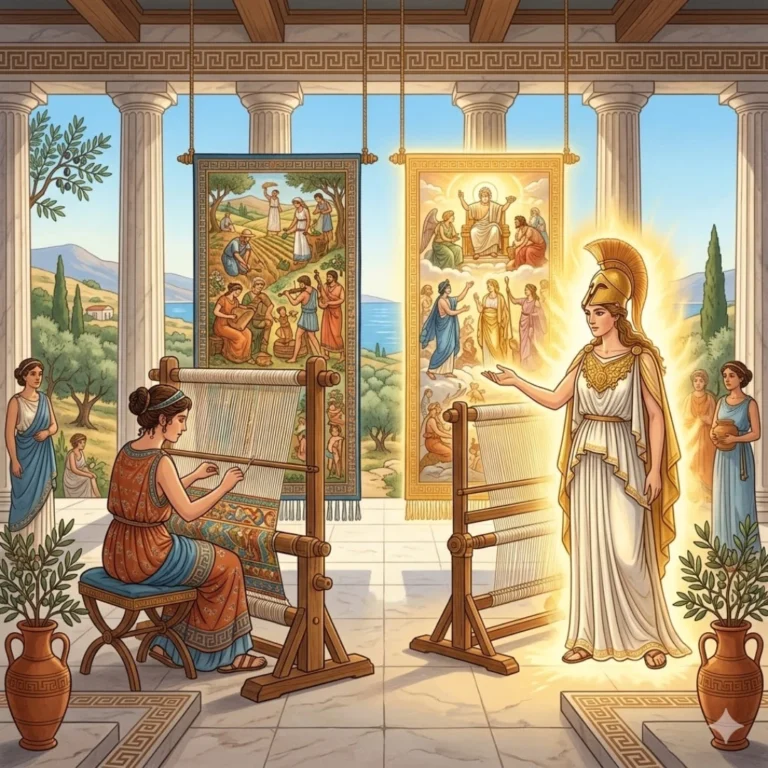
The old woman straightened, her disguise falling away in a blaze of light. Athena stood tall, grey eyes flashing. “Then let us weave,” said the goddess, her voice quiet and calm.
Two looms appeared. Athena wove a tapestry showing the twelve Olympians in all their majesty, surrounded by scenes of mortals who had dared defy the gods and suffered for it—gentle warnings woven in gold and silver thread.
Arachne wove no warnings. She wove the gods’ own foolishness and pride, their moments of weakness and vanity. It was brilliant work. Breathtakingly honest. And every bit as fine as Athena’s own.
Athena examined the finished cloth. She could find no flaw in the weaving itself. But the disrespect burned in her chest. She touched the loom—and the tapestry tore apart.
Arachne stared at her ruined masterpiece and felt shame for the first time in her life. Overcome, she wept.
Athena’s anger softened. She saw not pride now but a broken girl. “You shall weave forever,” the goddess said quietly, “so your skill is never lost.” She sprinkled herbs upon Arachne, and the girl shrank smaller and smaller until she was a tiny spider—and her fingers, still nimble, began spinning silk.
To this day, spiders weave their perfect, patient webs—a reminder that talent is a gift, not a throne.
Moral of the Story
True skill deserves pride, but arrogance blinds us to our own limits. Humility lets our gifts shine longer than boasting ever could.
Learn These Words
- arrogance
- an attitude of being better than everyone else
- tapestry
- a heavy cloth woven with pictures or patterns
- mortal
- a human being, as opposed to a god
- deity
- a god or goddess
- vanity
- too much pride in one’s own appearance or abilities
Test Your Understanding
1What was Arachne famous for?
2Who visited Arachne disguised as an old woman?
3What did Athena weave into her tapestry?
4What did Arachne become at the end?
5What lesson does this story teach?
Frequently Asked Questions
What is the story of Arachne’s Web about?
Arachne’s Web retells the ancient Greek myth of a talented young weaver named Arachne whose pride and boasting lead her to challenge the goddess Athena to a weaving contest. The story explores themes of humility, hubris, and the consequences of defying the gods, teaching readers that extraordinary talent should be paired with respect and modesty.
Why did Athena challenge Arachne to a weaving contest?
Athena challenged Arachne because the young weaver boasted that her skills surpassed even the gods of Olympus. Athena, who invented weaving, first visited Arachne disguised as an old woman and warned her to show humility. When Arachne refused and openly dared the goddess to compete, Athena revealed herself and accepted the challenge.
What is the moral lesson in Arachne’s Web?
The central moral is that pride and arrogance can lead to downfall. While talent and skill deserve recognition, boasting that you are better than everyone—especially without showing gratitude or humility—invites consequences. Arachne’s story teaches children to take pride in their abilities without belittling others or overestimating themselves.
📚 Recommended Books
Handpicked for readers like you
As an Amazon Associate, we earn from qualifying purchases. These recommendations are personalized based on this story's themes and your reading history.
Is Arachne’s Web based on a real Greek myth?
Yes, Arachne’s Web is a retelling of a well-known myth from ancient Greek mythology, most famously recorded by the Roman poet Ovid in his work Metamorphoses. The myth explains the origin of spiders, as Arachne’s name comes from the Greek word for spider, and has been retold for centuries as a cautionary tale about hubris.
What age group is the story of Arachne’s Web suitable for?
This retelling of Arachne’s Web is written in accessible, engaging language ideal for children ages 6 to 12. Its clear moral about humility and pride makes it a great read-aloud for younger kids, while the dramatic mythological setting and vivid characters appeal to older elementary readers exploring Greek myths for the first time.