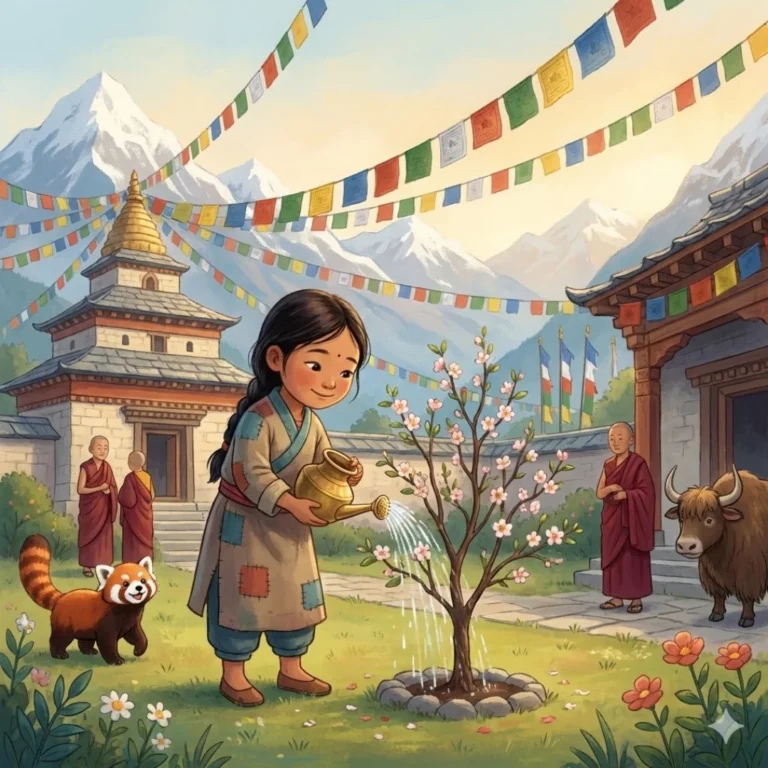
High in the Himalayas, where the mountains pierce the clouds and the air is thin and crystalline, there was a small Tibetan village called Lhakpa. It clung to the mountainside like a bird’s nest, its white stone houses with their colorful prayer flags fluttering in the wind. The villagers lived simple lives, tending their yak herds, growing barley in the short summer season, and following the teachings of the old lamas at the monastery above.
In this village lived a girl named Pema, whose name meant “lotus flower.” She was eight years old, with bright, curious eyes and a heart that beat too quickly with impatience. Everything took too long for Pema. Her barley bread took too long to bake. Her wool took too long to spin. The seasons took too long to change. She wanted everything now, immediately, without waiting.
“Pema, patience,” her grandmother, Ama-la, would say gently, her prayer beads clicking softly in her weathered hands. “The lotus flower does not bloom in a single day. It grows slowly, patiently, and then it opens at exactly the right moment.”
But Pema would huff and turn away. She didn’t want to hear about lotus flowers and right moments. She wanted things when she wanted them.
One winter morning, Pema woke to find fresh snow had fallen during the night, covering the village in pristine white. She looked out her window toward the high peaks and saw something that made her heart leap—tracks! Large paw prints in the new snow, leading up the mountain. snow leopard tracks!
Snow leopards were rare and sacred animals. The villagers believed they were manifestations of the mountain spirits, guardians of the high places. To see a snow leopard was considered a blessing that might come once in a lifetime—if you were very lucky.
Pema had never seen one, though she had heard stories. Her grandfather had seen one forty years ago. The head lama had seen one as a young man. But most people lived their whole lives without such a blessing.
Pema made an immediate decision: she would follow those tracks and find the snow leopard. Today. Right now. This morning.
She dressed warmly, packed some tsampa (roasted barley flour) and dried yak cheese, and slipped out of the house before anyone could stop her. The tracks led up the mountain, clear and fresh in the new snow. Pema followed them eagerly, her breath coming in white puffs in the cold air.
Up and up she climbed, following the tracks through rocky areas and across small ravines. The snow leopard had gone this way, and she would find it. Surely it couldn’t be far!
But as the morning wore on, the tracks led higher and higher, always just ahead, never ending. Pema’s legs grew tired. Her fingers grew cold. But she pushed on, impatient to reach her goal.
By midday, she reached a wide plateau where the tracks seemed to circle and then disappear among the rocks. Pema searched everywhere, growing more and more frustrated. Where had the snow leopard gone?
As she stood there, disappointed and exhausted, a voice spoke behind her: “You are looking for something, child?”
Pema spun around and saw an old hermit sitting in the entrance to a small cave. He wore the simple robes of a Buddhist practitioner, and his face was peaceful despite the harsh surroundings.
“I’m looking for the snow leopard!” Pema said. “I followed its tracks all morning, but now they’ve disappeared!”
The hermit smiled. “Ah, the snow leopard. Yes, I saw it pass by just before dawn. A magnificent creature.”
“Where did it go?” Pema demanded. “I must see it!”
“Must you?” the hermit asked mildly. “Why?”
“Because… because I want to! Because I’ve never seen one! Because everyone says they’re special!”
“And you wish to see this special thing right now? This moment?”
“Yes! Why should I wait?”
The hermit was quiet for a moment, watching Pema with eyes that seemed to see more than just a frustrated child. “Come,” he said finally. “Sit with me a while. You are tired from your climbing. Rest.”
Pema didn’t want to rest. She wanted to find the snow leopard! But her legs were tired, and the hermit seemed kind, so she sat down reluctantly on a flat rock near his cave.
The hermit offered her butter tea from a small pot warming over a tiny fire. Pema drank it quickly, barely tasting it, her eyes scanning the rocks for any sign of the leopard.
“Tell me, child,” the hermit said, “do you see that juniper tree over there?”
Pema glanced at it impatiently. “Yes.”
“That tree is over three hundred years old. Do you know how long it takes a juniper to grow at this altitude? Many, many years. Each year, it grows just a tiny bit. Slowly. Patiently. If it tried to grow quickly, the harsh conditions would kill it. But because it grows slowly, at the right pace, it becomes strong. Strong enough to survive centuries.”
Pema shifted restlessly. “That’s very interesting, but I really need to find the snow leopard before—”
“Before what?” the hermit asked gently. “Before it’s too late? Before your chance is gone? But child, who says this is your chance? Perhaps today is not the day you are meant to see the snow leopard.”
“But I want to see it now!” Pema burst out. “I don’t want to wait! Why does everything take so long? Why can’t things happen when I want them to?”
The hermit was quiet for a long moment. Then he said, “Would you like to hear a story?”
Pema wanted to say no, wanted to jump up and continue her search. But something in the hermit’s voice made her nod.
“Once,” the hermit began, “there was a young boy who loved birds. More than anything, he wanted to see the rare black-necked crane that visited the valley each spring. But the cranes only came for a short time, and they were very shy.
One year, when the boy was about your age, he heard that a crane had been spotted. He ran immediately to the valley, calling out, ‘Crane! Crane! Show yourself!’ He searched everywhere, stomping through the wetlands, making noise, moving quickly.
But the crane, frightened by all this commotion, flew away. And it didn’t return to that valley for two years.
The boy was heartbroken. He asked a wise teacher, ‘Why did the crane leave? I only wanted to see it!’
The teacher said, ‘Because you moved according to your time, not the crane’s time. You wanted what you wanted when you wanted it. But the crane exists in its own time, its own rhythm. If you wish to see a crane, you must learn to wait patiently, to be still, to let the crane come to you in its own time.’
The next time cranes were spotted in the valley, the boy went quietly. He sat still near the water. He waited. His legs cramped. His nose itched. He wanted to move, to fidget, to do something. But he waited. And waited. And waited.
And after many hours, when he had almost given up hope, a crane walked out from the reeds, not ten feet away from him. It was the most beautiful thing he had ever seen. And because he had been patient, because he had waited, he watched the crane for almost an hour as it fed and preened and simply existed in its own time.
That boy was me,” the hermit said, his eyes distant with memory. “And I learned that day that good things come to those who wait. Not because waiting is magic, but because some things have their own time, their own rhythm. You cannot force them. You can only be patient and ready when the moment comes.”
Pema felt something shift inside her chest. She looked at the hermit with new understanding. “But how do you know when the right time is?”
“You don’t, always,” the hermit admitted. “But you learn to trust the timing of things. You learn that rushing and forcing rarely bring good results. You learn that patience is not passive waiting, but active readiness. Like an archer who pulls back the string slowly, slowly, and releases the arrow at exactly the right moment.”
He gestured to the mountain around them. “Look at this landscape, child. The mountains did not rise in a day. The snow does not melt in an hour. The seasons do not rush from one to another. Everything happens at its own pace, in its own time. And it is beautiful because of that timing.”
Pema sat quietly, really quietly, for perhaps the first time in her young life. She let the hermit’s words sink deep into her heart. She stopped scanning the rocks for the leopard. She stopped feeling the urgency to rush off to the next thing. She simply sat.
And as she sat, she began to notice things she had missed in her impatient rushing. The way the sunlight turned the snow into diamonds. The sound of the wind singing through the rocks. The intricate patterns of lichen on the stones. The vast, patient silence of the mountains.
Time passed—though Pema couldn’t have said how much. Minutes? Hours? It didn’t matter.
And then, in the stillness, there was movement.
Pema’s breath caught in her throat.
There, not thirty feet away, stepping silently onto the plateau from behind a boulder, was a snow leopard.
It was more beautiful than Pema had imagined. Its thick coat was silvery-gray with dark rosettes, perfect camouflage against the rocks and snow. Its long tail curved elegantly. Its eyes were pale green, clear and intelligent.
The hermit, sitting beside Pema, smiled but remained perfectly still.
The snow leopard looked directly at them. For a long, eternal moment, girl and leopard regarded each other. Pema felt tears slip down her cheeks—not from sadness, but from overwhelming beauty, from gratitude, from something she couldn’t quite name.
She didn’t move. Didn’t call out. Didn’t rush toward it. She simply sat in patient, reverent witness as the sacred creature moved across the plateau with liquid grace, every movement poetry, every step a blessing.
The snow leopard paused at the far edge of the plateau, looked back once at Pema with those luminous eyes, and then vanished like morning mist into the rocks.
Pema and the hermit sat in silence for a long time after the leopard disappeared. Finally, Pema whispered, “It came.”
“Yes,” the hermit said softly. “In its own time. Not your time. Its time. And because you learned to be patient, to be still, to wait—you were blessed with one of the great gifts of these mountains.”
Pema understood then, with a knowing deeper than words. If she had continued to rush around the plateau, searching impatiently, making noise and commotion, the snow leopard would never have appeared. It came only when she was still. Only when she was patient. Only when she stopped forcing her own timing onto the world and accepted the world’s timing.
As the sun began to lower toward the western peaks, Pema prepared to descend to her village. The hermit walked with her part of the way.
“Thank you,” Pema said. “For teaching me about patience. About waiting.”
“I taught you very little,” the hermit replied. “The snow leopard taught you. The mountain taught you. Your own heart taught you when you finally learned to listen.”
Pema descended carefully through the deepening dusk. When she reached her village, her grandmother was waiting, worried but not angry.
“Where have you been, child?” Ama-la asked.
“Learning,” Pema said simply. “Learning to wait.”
And she told her grandmother about the tracks, the hermit, the long stillness, and finally, the snow leopard’s blessing.
Ama-la’s eyes filled with tears. “You saw the snow leopard,” she breathed. “Oh, my lotus flower. You have been blessed indeed.”
From that day forward, Pema was different. She didn’t change completely overnight—patience is itself something learned patiently, over time. But she began to notice the value of waiting. When she planted seeds in spring, she didn’t dig them up every day to check their growth. When she spun wool, she didn’t rush and tangle the thread. When her grandmother told stories, she listened all the way through without interrupting.
She learned that bread tastes better when the dough has risen slowly. That wool spins stronger when the spindle turns at a steady pace. That stories reveal their wisdom only when you have the patience to hear them completely.
Years later, when Pema had children of her own, she would tell them about the day she climbed the mountain seeking the snow leopard. She would tell them about the wise hermit and the lesson of patience. And she would end by saying:
“Good things come to those who wait—not because waiting is magical, but because some things have their own time. The flower blooms when it’s ready. The snow melts when the warmth comes. The snow leopard appears when the moment is right. We cannot force these things. We can only be patient, be ready, be still. And then, when the time is right, we will receive what we are meant to receive.”
And in the high mountains, where the snow leopards still walk their ancient paths, where prayer flags still flutter in the endless wind, this lesson is remembered: Patience is not weakness. Waiting is not wasting time. Good things come to those who wait—in the right way, at the right time, with open hearts and still spirits.
For as the Tibetan saying goes: “A hundred rivers flow into the sea, but the sea is never in a hurry to receive them.”
And that is the way of all deep wisdom—patient, timeless, and perfectly content to wait for the moment when all things align, and blessing naturally flows.
Frequently Asked Questions
What is the moral lesson of The Snow Leopard’s Gift – Tibetan Patience Story for Kids?
What age is this story appropriate for?
How long does it take to read The Snow Leopard’s Gift – Tibetan Patience Story for Kids?
What culture does this story come from?
Can I use this story for teaching?
Frequently Asked Questions
What is The Snow Leopard’s Gift story about?
The Snow Leopard’s Gift is a Tibetan folktale-style children’s story about a girl named Pema who lives in a Himalayan village and struggles with impatience. Through an encounter with a snow leopard, she learns a valuable life lesson about patience, timing, and why good things are worth waiting for.
What is the moral lesson in The Snow Leopard’s Gift?
The core moral of The Snow Leopard’s Gift is the value of patience. The story teaches children that rushing things can cause more harm than good, and that — just like a lotus flower — the best outcomes unfold at exactly the right moment when we allow time and trust the process.
Is The Snow Leopard’s Gift suitable for young children?
Yes, this story is written for children around ages 5 to 10. It uses simple, warm language and a relatable main character to deliver its message. The Himalayan setting also makes it a wonderful way to gently introduce kids to Tibetan culture and traditions.
📚 Recommended Books
Handpicked for readers like you
As an Amazon Associate, we earn from qualifying purchases. These recommendations are personalized based on this story's themes and your reading history.
What age group is The Snow Leopard’s Gift written for?
The Snow Leopard’s Gift is ideal for children aged 5 to 10, though its gentle wisdom can resonate with older readers too. Parents and teachers often use stories like this at bedtime or in classroom settings to spark conversations about emotions like impatience and frustration.
Why does the snow leopard appear in this children’s story?
The snow leopard serves as a symbolic and magical guide in the story. In Himalayan cultures, snow leopards are considered rare, sacred creatures. Its appearance in Pema’s life acts as a turning point, helping her experience firsthand why patience and careful waiting lead to truly meaningful and beautiful rewards.