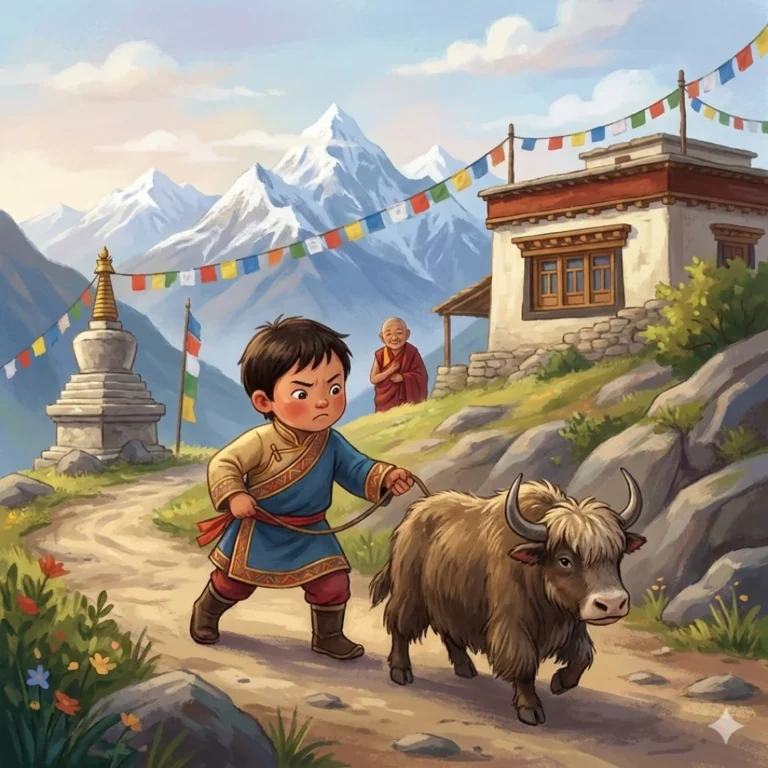
In a small village nestled among the foothills of the great Himalayas, where prayer flags fluttered like the wings of countless butterflies and the morning mist rolled down from the peaks like the breath of mountains, there lived a boy named Tenzin.
Tenzin was small for his eleven years, with thin arms and a persistent cough that sometimes woke him in the night. But what he lacked in physical strength, he made up for in spirit. His eyes held the quiet determination of a mountain stream – gentle on the surface, but capable of wearing away stone given enough time.
In Tenzin’s village, there was a tradition. Each year, the children who had reached their twelfth year would climb to the monastery high on the mountain, a journey that took a full day. There, they would receive a blessing from the old lama and would be considered ready to begin learning the deeper teachings of the Buddha.
Tenzin longed to make this journey. His birthday would come with the next full moon, and more than anything, he wanted to reach the monastery like the other children. But everyone in the village – his parents, his neighbors, even his friends – gently suggested that perhaps he should wait another year. The path was steep and difficult. The air grew thin. It required strength and endurance.
‘Your body is not yet strong enough,’ his mother said with worry in her eyes.
‘The mountain will still be there next year,’ his father added gently.
But Tenzin felt a quiet certainty deep in his heart, like a seed that knows it must grow toward the light even through hard soil. This was his year. This was his journey.
On the morning of the climb, Tenzin woke before dawn. The autumn air was crisp and cold, carrying the scent of pine and rhododendron. Seven other children gathered at the edge of the village, all of them bigger and stronger than Tenzin. They looked at him with a mixture of pity and doubt.
The village elder, a woman named Dolma with silver braids and eyes like deep pools, spoke the traditional words: ‘The path to the monastery teaches many lessons. Walk with mindfulness. Rest when needed. Never give up, even when the way seems impossible. For it is not the strongest who always reach the summit, but those who persevere.’
The children set off as the sun rose, painting the snow-capped peaks in shades of gold and pink.
At first, the path was easy, winding through familiar forest where Tenzin had played since he was small. The other children walked quickly, eager and confident. Tenzin walked more slowly, breathing carefully, pacing himself. He noticed things the others missed in their haste – a family of red pandas sleeping in a tree hollow, the way the morning light filtered through the pine needles like liquid gold, the sound of a hidden stream singing its endless song.
After two hours, they emerged from the forest onto a rocky trail that climbed steeply. Here, the other children began to pull ahead. Tenzin’s legs ached and his breath came harder, but he continued, step by step, like the ticking of a patient clock.
By midday, the gap between Tenzin and the others had grown wide. The strongest children were already out of sight, and even the slowest of them were far ahead. Tenzin stopped to rest on a flat rock, his chest heaving, his legs trembling. From here, he could see the monastery, tiny and distant, perched on the mountainside like a bird’s nest clinging to a cliff.
It seemed impossibly far away.
For the first time, doubt crept into Tenzin’s heart. Perhaps everyone was right. Perhaps he wasn’t strong enough. Perhaps he should turn back.
As he sat there, he noticed a tree growing from a crack in the rocks beside the path. It was a small juniper, twisted by wind and weather, its trunk no thicker than Tenzin’s wrist. Yet it lived and grew in this harsh place, its roots finding nourishment in the tiniest pockets of soil, its branches reaching toward the sky despite every difficulty.
Tenzin thought about that tree. It had not given up. It had not said, ‘This rock is too hard, this wind is too strong, I will stop trying.’ It had simply continued to grow, day by day, season by season, until it became strong in its own unique way.
Tenzin stood up. His legs still ached, his breath still came hard, but his heart was quiet again. He would continue. Step by step. Breath by breath.
The afternoon grew hot, and the thin mountain air made Tenzin dizzy. Several times he had to stop and rest, sitting on rocks while his breathing steadied. At one such stop, he saw a line of ants crossing the path, each carrying a piece of leaf many times its own size. The ants moved slowly but steadily, never stopping, working together to cross obstacles that must have seemed like mountains to their tiny bodies.
Tenzin smiled. The ants understood. It wasn’t about being the biggest or the fastest. It was about continuing, about not giving up.
As the sun began to lower toward the western peaks, Tenzin reached a part of the path that climbed almost vertically, a series of rough stone steps carved into the mountainside. His legs felt like they would not carry him another step. His chest burned with each breath. Every part of him wanted to stop, to rest, to give up.
But he remembered the juniper tree and the ants. He remembered Dolma’s words: ‘Never give up, even when the way seems impossible.’
He climbed one step. Then another. And another.
Time seemed to stretch and blur. Tenzin was no longer thinking about the monastery or the other children or anything except the next step. Just this one step. Then the next. And the next.
He climbed until the sun touched the horizon, painting the sky in shades of orange and purple and deep blue.
He climbed until the first stars appeared.
He climbed until his mind was as clear as mountain water, focused only on the simple act of continuing.
And then, quite suddenly, the path leveled out. Tenzin looked up and found himself standing before the monastery gates.
He had made it.
The other children were already inside, eating soup and warming themselves by the fire. They turned in surprise when Tenzin stumbled through the door.
‘You made it!’ they cried. ‘We didn’t think you would!’
The old lama of the monastery, a man whose age was beyond counting, looked at Tenzin with eyes that seemed to see everything – the difficult journey, the moments of doubt, the quiet determination that had carried the boy up the mountain.
‘Come,’ the lama said gently. ‘Sit and rest.’
When all the children had eaten and rested, the lama gathered them in the meditation hall. Oil lamps flickered, casting dancing shadows on the walls painted with images of the Buddha and the great teachers.
‘You have all completed the journey,’ the lama said, ‘but you have learned different lessons along the way. Some of you learned that you are strong and capable. This is good. But there is one among you who learned the most important lesson of all.’
He looked at Tenzin. ‘Tell me, young one, what did you learn on the mountain?’
Tenzin thought carefully before answering. ‘I learned that perseverance is more important than strength,’ he said slowly. ‘I learned that when you feel you cannot continue, you can still take one more step. And then another. I learned that many small steps, continued patiently, can carry you to the top of a mountain. I learned to never give up, even when things seem impossible.’
The lama nodded with a smile that held deep understanding. ‘This is the wisdom of the Buddha’s teaching. Life is like climbing a mountain. There will be difficult paths, moments of doubt, times when you want to give up. But if you persevere, if you continue step by step with mindful determination, you will reach your goal.’
He placed his hand on Tenzin’s head in blessing. ‘Your body may be small, but your spirit is as strong as the mountain itself. You will go far in your practice, not because you are the strongest or the fastest, but because you understand perseverance.’
That night, Tenzin slept deeply in the monastery, his dreams filled with juniper trees and lines of ants and endless mountain paths that led ever upward.
In the morning, the journey down was much easier, as down-mountain journeys often are. When Tenzin reached his village, his parents embraced him with tears of pride and joy.
The story of Tenzin’s climb spread throughout the valley. People spoke not of the children who had climbed the fastest or the strongest, but of the small boy who had persevered when everyone doubted he could succeed.
Years later, Tenzin did indeed become a devoted student of the dharma. He was never the most scholarly student, never the one who memorized texts the quickest or understood complex philosophy the easiest. But he was always the one who never gave up, who continued patiently, who took things step by step.
And when he became old himself, with silver in his hair and his own students to teach, he would take them on walks in the mountains. He would show them the juniper trees growing from rocks, the ants carrying their impossible loads, the mountain paths that seemed too steep to climb.
‘Life will give you many mountains to climb,’ he would tell his students. ‘Some will seem impossible. Your strength may fail, your confidence may waver, and you may feel you cannot continue. But remember: you can always take one more step. And then another. Perseverance is not about never feeling tired or discouraged. It is about continuing anyway, step by patient step, until you reach the summit.’
And his students would nod and remember, carrying this lesson with them as they faced their own mountains, their own difficult paths.
For the wisdom Tenzin learned that day on his journey to the monastery was a truth as old as the mountains themselves and as eternal as the sky: Never give up, even when things seem impossible. For it is not the impossible that stops us, but the belief that we cannot continue. And that belief, like morning mist, dissolves in the light of determined perseverance.
The mountain path is still there, winding up from the village to the monastery, worn smooth by countless feet over countless years. And the juniper tree still grows from its crack in the rocks, a little bigger now, a little stronger, a living reminder that perseverance, quiet and patient, can overcome any obstacle.
Just like Tenzin. Just like the children who climb the path each year. Just like you, when you face your own mountains and must find the courage to take one more step.
Frequently Asked Questions
What is the moral lesson of Tenzin and the Mountain Path – A Buddhist Perseverance Story for Kids?
What age is this story appropriate for?
How long does it take to read Tenzin and the Mountain Path – A Buddhist Perseverance Story for Kids?
What culture does this story come from?
Can I use this story for teaching?
Frequently Asked Questions
What is the story of Tenzin and the Mountain Path about?
Tenzin and the Mountain Path is a children’s moral story about a small, physically weak boy named Tenzin who lives in a Himalayan village and dreams of climbing to a mountain monastery. Despite others doubting him, he shows that inner strength and quiet determination can overcome physical limitations.
What is the moral lesson in Tenzin and the Mountain Path?
The core lesson of Tenzin and the Mountain Path is that inner spirit and perseverance matter more than physical strength. Tenzin proves that self-belief and determination can carry you further than others expect, even when everyone around you suggests giving up or waiting.
Is Tenzin and the Mountain Path a good story for kids?
Yes, it’s an excellent story for children aged 6 to 12. It draws on Himalayan and Buddhist cultural traditions to deliver an uplifting message about courage and resilience. The gentle, descriptive language makes it engaging for young readers while the moral feels meaningful without being preachy.
📚 Recommended Books
Handpicked for readers like you
As an Amazon Associate, we earn from qualifying purchases. These recommendations are personalized based on this story's themes and your reading history.
What Himalayan traditions are featured in this story?
The story features prayer flags, mountain monasteries, lamas, and Buddhist blessings — all rooted in real Tibetan and Himalayan culture. A key tradition involves children climbing to a hilltop monastery on their twelfth birthday to receive a blessing and begin deeper spiritual learning.
Where does the mountain path story take place?
The story is set in a small village in the foothills of the Himalayas, surrounded by mist-covered peaks and prayer flags. The journey Tenzin undertakes leads up a steep mountain path to a monastery, reflecting the spiritual and physical landscapes of the Tibetan highlands.