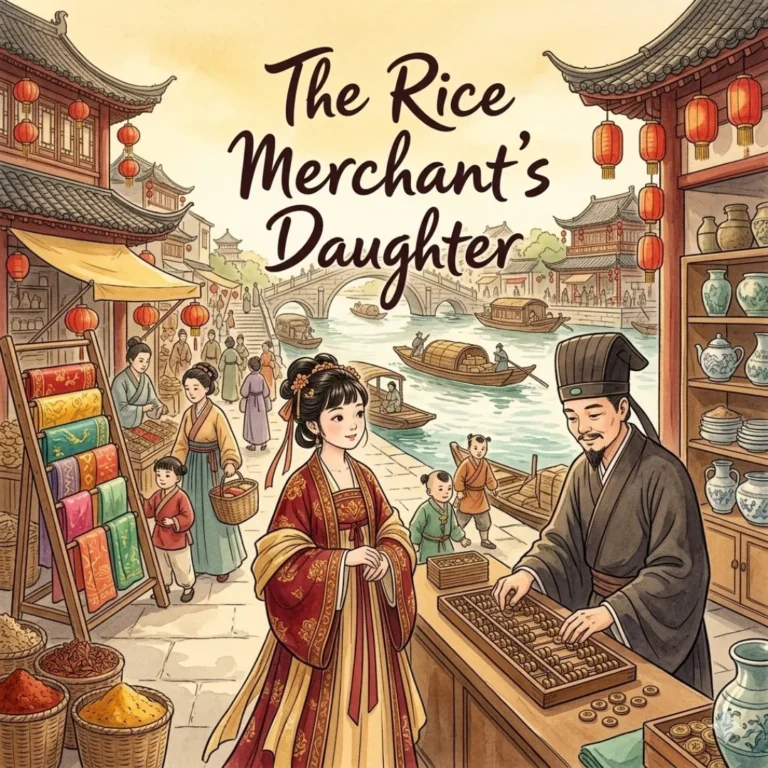
In the bustling city of Hangzhou, during the time when the Song Dynasty ruled China and the West Lake reflected the willow trees like a mirror of jade, there lived a girl named Mei-Lin. She was twelve years old, and if you had met her on any ordinary day, you might have thought her rather selfish.
Mei-Lin’s father was a wealthy rice merchant, and she had grown up surrounded by comfort and plenty. Her silk robes were the finest in the district, her room was filled with beautiful things, and she had more toys and treasures than ten children could play with. But despite all this abundance, Mei-Lin clutched everything close, never sharing, always wanting more.
‘Mine,’ she would say when other children admired her toys. ‘You can’t play with them. They might get broken.’
When beggars appeared at her father’s shop, she would turn away. ‘Why should we give them our rice?’ she would ask. ‘If we give it away, we’ll have less for ourselves.’
Her father, a kind man who had built his fortune through hard work and fair dealing, watched his daughter with growing concern. He remembered his own childhood, when his family had been poor and hungry, and he worried that Mei-Lin’s comfortable life had made her heart small and tight, like a closed fist.
One autumn, as the moon festival approached, Mei-Lin’s father made an unusual announcement at dinner.
‘Mei-Lin,’ he said, ‘I must travel to the northern provinces on business. While I am gone, you will manage the household and the shop.’
Mei-Lin’s eyes widened with excitement. She had never been allowed such responsibility before! Surely this meant she was finally grown up, finally important!
‘You will give the servants their instructions, keep the accounts, and make decisions about the shop,’ her father continued. Then he added, almost casually, ‘And you will also distribute rice to anyone who comes asking for help.’
‘What?’ Mei-Lin’s excitement deflated like a punctured lantern. ‘Give away our rice? But Father, that’s wasteful! What if we run out?’
Her father smiled mysteriously. ‘Trust me, daughter. Do as I ask, and you will learn something important.’
The next day, her father departed, and Mei-Lin found herself in charge. At first, she reveled in the authority, giving orders to the servants and carefully counting the coins in the shop. But then the requests for help began.
An old woman came, her back bent with age, asking for rice to feed her grandchildren. Mei-Lin’s first instinct was to send her away. But she remembered her father’s instructions. Reluctantly, she measured out a small portion of rice – the smallest amount she could possibly give.
The old woman bowed gratefully and left.
Then came a young mother with a sick child, asking for rice. Again, Mei-Lin gave the smallest portion possible, begrudging every grain.
Then a farmer whose crops had failed. Then a widow. Then a family whose house had burned down.
Each time, Mei-Lin gave the absolute minimum, keeping careful count of every grain that left the warehouse. She felt virtuous for obeying her father, but also resentful. All this rice, leaving the warehouse! Surely they would run out soon!
But something strange began to happen.
Each evening, when Mei-Lin counted the inventory, she found that the warehouse still seemed full. More puzzling still, the shop’s business was thriving. More customers came than ever before, all wanting to buy rice from Mei-Lin’s father’s shop.
‘Your father is so generous,’ they would say. ‘We heard he helps those in need. We want to give our business to someone who cares about the community.’
Mei-Lin didn’t understand. They were giving rice away, yet somehow they weren’t running out. They were being generous, yet somehow they were prospering.
Then one morning, Mei-Lin woke to find that something had changed in the night. The autumn weather had turned suddenly cold, and frost painted the windows with delicate crystals. Worse, Mei-Lin had developed a terrible fever. She was too sick to get out of bed, her head pounding, her throat burning.
The servants called for the doctor, but he was away in another city. They sent for medicine, but the herbalist’s shop was closed for the festival. Mei-Lin lay in her bed, frightened and miserable, feeling more alone than she had ever felt before.
Then, something unexpected happened.
The old woman with the bent back came to the house, carrying a pot of healing soup. ‘I heard the merchant’s daughter is ill,’ she said. ‘My grandmother taught me how to make this soup. It cured my grandchildren when they were sick. I brought some for her.’
The young mother with the sick child came next, carrying herbs. ‘These helped my little one,’ she said. ‘Perhaps they will help Mei-Lin too.’
Then came the farmer with honey from his few remaining hives. The widow with a warm quilt she had sewn. The family whose house had burned, bringing firewood they had painstakingly collected.
All day long, people came – all the people Mei-Lin had reluctantly helped. They brought food, medicine, comfort, and kindness. They sat with her so she wouldn’t be alone. They told stories to distract her from her discomfort. They cared for her as if she were their own daughter.
Mei-Lin lay in her bed, tears streaming down her cheeks. But these weren’t tears of pain or fever. They were tears of understanding.
She had given so little, so grudgingly, and yet these people were giving so much, so freely. She had measured out rice grain by grain, worried about running out, and they were pouring out their kindness without measure, without hesitation.
In that moment, something inside Mei-Lin shifted, like a door opening to let light into a dark room. She understood, finally, what her father had been trying to teach her.
When Mei-Lin recovered from her illness – which she did quickly, thanks to all the loving care – she was a changed girl. Not changed on the outside; she looked exactly the same. But inside, where it mattered, she was entirely different.
The next person who came asking for help found a new Mei-Lin. Instead of measuring out the smallest portion possible, she filled their sack generously.
‘Please,’ she said warmly, ‘take as much as you need. And if you need more later, come back.’
She began to notice the people around her in a new way. The street sweeper who worked before dawn – didn’t he look tired and hungry? She brought him breakfast. The children playing in the street – weren’t they cold? She gave them warm clothes she had outgrown. The stray dogs looking for scraps – didn’t they deserve kindness too? She left food for them.
The more Mei-Lin gave, the more she wanted to give. And the strangest thing happened: the more she gave away, the more she seemed to have. Not just rice and material things, but something far more valuable.
She had friends now, real friends, not just other wealthy children who came to play with her toys. She had people who smiled when they saw her, who greeted her warmly, who genuinely cared about her. She had a warm feeling in her heart that she had never experienced before – the joy of making others happy.
The warehouse never ran out of rice. In fact, business grew even better. People came from across the city to buy from the generous merchant’s shop. And when they bought rice, they often left a little extra payment. ‘For your kindness,’ they would say.
When Mei-Lin’s father returned from his journey, he hardly recognized his daughter. She rushed to greet him, her face glowing with excitement.
‘Father!’ she cried. ‘The most wonderful thing has happened! I gave away so much rice – really gave it, generously, not like at first when I was stingy – and instead of running out, we have more business than ever! And I made so many friends! And I learned that helping people makes me happier than keeping everything for myself! How did you know this would happen?’
Her father embraced her, his eyes shining with pride and happiness. ‘I knew because I learned the same lesson when I was young,’ he said. ‘My dear Mei-Lin, you have discovered one of life’s greatest secrets: the more you give, the more you receive.’
‘But how does it work?’ Mei-Lin asked, genuinely curious. ‘It seems like magic!’
‘It’s not magic,’ her father explained gently. ‘When you help others, they remember your kindness. They want to help you in return. They want to do business with you. They become your friends and allies. Generosity creates a circle – what you give away comes back to you in many forms, often multiplied. But more importantly, giving makes your heart bigger and your spirit richer. A generous person is a wealthy person, no matter how much money they have.’
Mei-Lin nodded, understanding deeply now. She thought of the old woman’s soup, the young mother’s herbs, the farmer’s honey, the widow’s quilt. She thought of all the smiles and kind words she received now everywhere she went. She thought of how much bigger and lighter her heart felt.
‘You were right, Father,’ she said. ‘I used to think that if I gave things away, I would have less. But really, I have so much more now than I ever did before.’
From that day forward, Mei-Lin became known throughout Hangzhou for her generous heart. When she grew up, she expanded her father’s business not by hoarding wealth, but by sharing it – helping farmers buy seeds, lending money without interest to those who needed it, making sure no one in her district went hungry.
And the remarkable thing was that the more generous she became, the more prosperous the business grew. It was as if the universe itself delighted in rewarding kindness with abundance.
Years later, when Mei-Lin had children of her own, she would tell them the story of the autumn when she was twelve, when she learned the greatest lesson of her life.
‘Remember,’ she would say, ‘a closed fist can hold only a little. But an open hand can receive the whole world. The more you give, the more you receive – not just in material things, but in love, friendship, joy, and the deep satisfaction of knowing you’ve made a difference in someone’s life.’
And her children would nod and remember, growing up to be generous themselves, understanding that true wealth isn’t measured by what you keep, but by what you share.
In Hangzhou, by the beautiful West Lake where the willow trees still sway and the moon still reflects on the water during festival time, they still tell stories of Mei-Lin, the generous merchant’s daughter who learned that an open heart is the richest treasure of all.
Frequently Asked Questions
What is the moral lesson of The Rice Merchant’s Daughter – A Chinese Generosity Story for Kids?
What age is this story appropriate for?
How long does it take to read The Rice Merchant’s Daughter – A Chinese Generosity Story for Kids?
What culture does this story come from?
Can I use this story for teaching?
Frequently Asked Questions
What is The Rice Merchant’s Daughter story about?
The Rice Merchant’s Daughter is a children’s moral story set in Song Dynasty China. It follows twelve-year-old Mei-Lin, a wealthy but selfish girl who refuses to share her possessions or show kindness to others. The story explores how she learns the value of generosity and compassion through her experiences in the city of Hangzhou.
What moral lesson does The Rice Merchant’s Daughter teach kids?
The Rice Merchant’s Daughter teaches children that true happiness and fulfilment come from generosity rather than hoarding possessions. Mei-Lin begins the story believing that sharing means having less, but gradually discovers that giving to others enriches her own life. It’s a gentle reminder that kindness and compassion matter more than wealth or material things.
Is The Rice Merchant’s Daughter suitable for young children?
Yes, The Rice Merchant’s Daughter is written for children around ages 6 to 12. The language is accessible and engaging, and the story uses a relatable main character to explore themes of selfishness and generosity. Parents and teachers can also use it as a conversation starter about sharing and empathy.
📚 Recommended Books
Handpicked for readers like you
As an Amazon Associate, we earn from qualifying purchases. These recommendations are personalized based on this story's themes and your reading history.
What historical setting is used in The Rice Merchant’s Daughter?
The story is set in Hangzhou during China’s Song Dynasty, a period known for its culture, trade, and prosperity. The vivid descriptions of the West Lake and daily life help bring the historical backdrop to life, making it both an entertaining read and a subtle introduction to ancient Chinese history for young readers.
Why does Mei-Lin refuse to share in The Rice Merchant’s Daughter?
Mei-Lin refuses to share because she grew up surrounded by wealth and developed a fear of having less. She worries that giving away toys or rice will leave her with not enough, even though she already has more than she needs. Her selfish behaviour is the central problem the story challenges, as she slowly learns a different way of thinking.