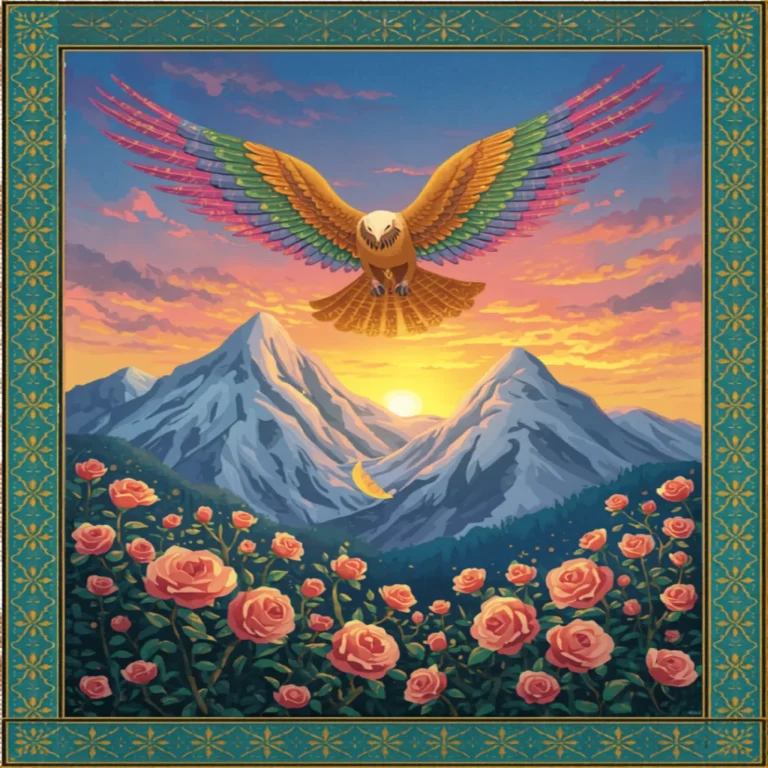
The Last Feather of the Simurgh
—
The night Dara's mother stopped speaking, the sky above Isfahan turned the color of a bruise.
He stood at her bedside, watching her chest rise and fall — barely, barely — and felt the whole world shrink to the size of that one small room. The healer had come and gone, shaking her head. The neighbors had brought food that sat untouched. And now there was only Dara, eleven years old, with nothing but a lantern and a clawing, terrible fear.
"I'll find a cure," he whispered. "I promise."
His mother's fingers — cold as river stones — twitched once. Almost like she'd heard.
—
In the bazaar the next morning, Dara pushed through crowds of spice sellers and silk merchants, past towers of saffron as bright as tiny flames and a sharp, sweet smell of cardamom that hung in the air like perfume. He found old Maryam, the fortune-reader, sitting cross-legged beside her brass bowl of water.
"Tell me what will save her," he said.
Old Maryam looked at him for a long, long moment. Her eyes were the color of faded amber.
"Only one thing," she said quietly. "A single feather from the Simurgh."
Dara's stomach dropped. The Simurgh. The great bird of Mount Qaf — the mountain at the very edge of the world, where the sky cracked open and the stars were close enough to touch. Creatures twice Dara's size had tried to reach it. None had come back.
"How do I get there?" he asked.
"You walk east," said old Maryam, "until the road runs out. Then you keep walking."
She turned back to her brass bowl as if the conversation was over.
Dara squared his shoulders. "Then I'll walk east."
—
He walked for three days through the great salt desert, where the ground shimmered like a white mirror and the heat sat on his shoulders like a heavy cloak. His water ran out on the second day. His sandals split on the third. The sun was enormous and merciless.
Right when his legs were about to simply stop working, he found a boy sitting alone beside a crumbled wall.
The boy was small — maybe seven — crying quietly into his hands.
Dara almost walked past him. He had so far to go. He had so little water left. But something made him stop.
"What's wrong?" he asked.
The boy looked up. His face was streaked with white dust. "I was with the caravan," he said between sniffles. "I fell asleep and they left without me. I haven't had water since yesterday."
Dara looked at his own water pouch. Half-empty. Barely enough for one person.
He handed it over anyway.
"Drink," he said. "All of it."
The boy stared at him. "But you'll be thirsty."
"I know," said Dara simply. "Drink anyway."
The boy drank. And the strangest thing happened — when the pouch came back, it was completely full again, as if it had never been touched. Dara blinked. He turned around — but the boy was gone. Just small footprints in the white dust, leading nowhere.
He kept walking.
—
The road did eventually run out, just as Maryam had promised. Beyond it, the land rose steeply into black rock and biting cold wind, with a smell like lightning crackling in the air. Mount Qaf towered ahead like a fortress built for giants.
Halfway up the slope, a great Div blocked the path.
One of the old demons of Persian legend — smoke curling from its nostrils, eyes like glowing red coals — it was so enormous that its shadow swallowed Dara whole. Its voice came out like boulders rolling downhill.
"No human climbs higher," it rumbled. "Turn back."
Every part of Dara wanted to run. His legs felt like water. His heart banged against his ribs.
But he stood still.
"I'm not here to fight you," he said — surprised at how steady his voice sounded. "I only want to ask the Simurgh for a feather to heal my mother. That's all."
The Div tilted its enormous head. "And if I don't let you pass?"
"Then I'll sit here," said Dara, "and wait until you do."
A long silence. The wind screamed through the rocks like something alive.
Then the Div stepped aside — just barely — and muttered, low and gruff: "Clever answer."
Dara walked through.
—
The Simurgh was even more magnificent than the stories said.
She was enormous — big enough to shade a whole village — with feathers the colors of sunset, each one tipped with living silver. She smelled of cedar and roses and old rain, all at once. When she spread her wings, the whole mountain shuddered.
She looked down at Dara with eyes as deep and still as wells.
"You've come a long way, small boy," she said. Her voice was warm and low, like a fire in a good hearth.
"Please," said Dara. "My mother is dying."
"Many have asked me for feathers," said the Simurgh. "Most I have turned away. But first — I will tell you a story. Listen carefully."
And so, in the very heart of this story, a second story began.
—
*The Simurgh's Story:*
"Once there was a king," said the great bird, "whose kingdom was crumbling. He called his three wisest advisors.
The first said: *Be strong. Show your enemies no mercy.*
The second said: *Be cunning. Trick them before they trick you.*
The third said: *Be kind. Make friends of your enemies.*
The king thought for a long time. Then he invited his greatest enemy to dinner.
They talked. They laughed. By morning, the enemy was an enemy no longer.
The kingdom flourished."
The Simurgh's silver feathers rustled like windswept grass.
"Now, child," she said. "Which advisor was right?"
Dara thought about the boy in the desert — and the water pouch that had filled itself back up. He thought about the Div, and the steady voice that had surprised even himself. He thought about old Maryam, quiet and unhurried, who saw everything without looking.
"All three," he said slowly. "You need all three together. Strength alone is cold. Cunning alone is lonely. And even kindness goes nowhere without the courage to act and the wisdom to know when."
The Simurgh was quiet for a long moment. Her great eyes shone.
Then she reached back with her enormous beak and drew out one single shining feather. She held it out to him, and it felt — when he took it — warm as sunlight on skin, and lighter than a whisper.
"Take it home," she said softly. "You have understood what most kings never do."
—
Dara ran home faster than he'd walked out. The feather glowed in his hands the whole way, warm and smelling of cedar and roses, never fading.
He touched it gently to his mother's forehead.
Her eyes opened. Color rushed back into her cheeks like dawn spreading across the desert.
"Dara," she said — just his name, nothing more.
It was the best sound he'd ever heard.
Outside, above the rooftops of Isfahan, one silver-tipped feather drifted high in the evening sky, catching the last red light of the sun before the stars came out.
A passerby on the street might have thought it was just a cloud.
But Dara knew better.
📚 Recommended Books
Handpicked for readers like you
As an Amazon Associate, we earn from qualifying purchases. These recommendations are personalized based on this story's themes and your reading history.