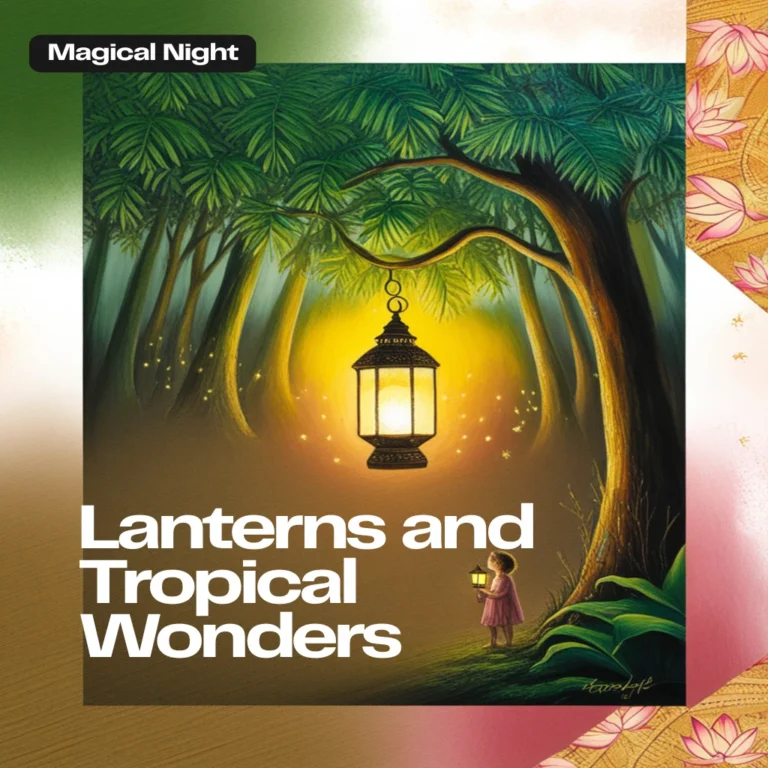
The Lantern at the Edge of the Forest
Her grandmother, Lola Caring, was already at the tree. She was crouching at its great twisted roots, placing a small bowl of white rice and a circle of sampaguita flowers — an offering, the way the old people did when the Diwata were near.
"What does it mean?" Maia asked.
Lola Caring did not look up. "It means something lost is trying to find its way home," she said softly. "And it will need help."
The village elders said to leave the lantern alone. But all day it tugged at Maia's thoughts, warm and golden, like a coal inside her chest. That night, when the crickets began their slow, tired songs and every lamp in the village went dark, Maia slipped out of bed.
The forest beyond the Balete tree was a different world. The trees pressed close, their roots curling out of the earth like enormous fingers. The air smelled of wet moss and night flowers and something older — green and deep and alive. Maia felt the cold dew on her bare feet. She heard the soft drip of water falling from leaf to leaf, far above her head. Her heart was beating very fast.
And then she heard it. A thin, small sound. Like someone crying very quietly, so they wouldn't bother anyone.
There, curled beside a root, was an old woman. Tiny and thin, wrapped in cloth that had once been beautiful — green and gold, like a dragonfly's wing, now muddy and torn. Her eyes were shut. She was shivering.
Every story Maia had ever heard said the same thing: do not approach what you find in the forest at night. But the old woman was trembling so hard, and Maia's heart spoke louder than her fear.
She knelt down in the damp earth. "Are you hurt?" she asked.
The old woman opened her eyes. They were dark and deep — the kind of eyes that held rivers in them.
"Cold," she whispered. "I have been walking a very long time."
Without thinking, Maia pulled the thin cotton wrap from her own shoulders and draped it around the old woman. It wasn't much. But the shivering slowed.
"Can you walk?" Maia asked.
"Not yet. Sit with me a while."
So Maia sat. This is the kind of moment that stories for kids ages 6-12 are made of — not battles or great journeys, but one child sitting still in a dark forest because someone needed company. The night breathed around them: frogs calling, leaves dripping, the distant hush of the river running somewhere in the black.
After a long, quiet time, the old woman spoke again.
"You were afraid," she said. "I could smell it."
"Yes," Maia said.
"Then why did you come?"
Maia looked at her hands. "Because being afraid doesn't mean you should go away."
The old woman was quiet. Then: "What do you want most in the world, child?"
Maia thought carefully. She thought about the river, lower every month, the rice fields cracking at the edges. She thought about her grandmother's worried face.
"For the river to fill again," she said. "For the village to have enough."
"And for yourself?"
Maia looked up at the dark canopy, where a few stars showed through the leaves like seeds of light.
"To know how to know," she said at last. "How to understand when something is right."
The old woman looked at her for a very long time.
Then she stood. She was taller than she'd seemed. The muddy cloth shifted, and Maia saw it — a shimmer beneath, green and gold, like the inside of an abalone shell, like a thousand fireflies breathing together. A Diwata. A spirit woven from forest and river and old, old memory.
Maia's breath stopped in her throat.
The Diwata touched Maia's cheek with one cool, gentle hand. "Take the lantern home. Hang it at your door." Her voice was soft as rain on leaves. "And remember — the river does not ask who is worthy before it flows."
Then the forest folded around her, the way water closes over a stone, and she was gone.
Three days later, rain came. Soft at first, barely a whisper on the roof, then steady and wide and singing. The river swelled. The soil turned dark. The rice seedlings lifted their thin green arms toward the sky.
Maia hung the lantern at the door, just as she'd been told. It glowed through the wet nights, warm as a held hand. Neighbors asked about it. She only smiled and said it helped lost things find their way.
One evening, Lola Caring watched Maia standing in the rain with her arms wide open and her face turned up, laughing, tasting the sweetness of it on her tongue.
"What did the forest teach you?" she called.
Maia turned. Rain ran down her face. Her eyes were bright.
"That the bravest thing," she said, "is to give your warmth to someone who is cold — even when your own heart is shaking."
Lola Caring looked up at the Balete tree. Its white flowers were still blooming, quiet and luminous in the grey light.
She smiled and said nothing. Some things the heart already knows, long before the words arrive.
📚 Recommended Books
Handpicked for readers like you
As an Amazon Associate, we earn from qualifying purchases. These recommendations are personalized based on this story's themes and your reading history.