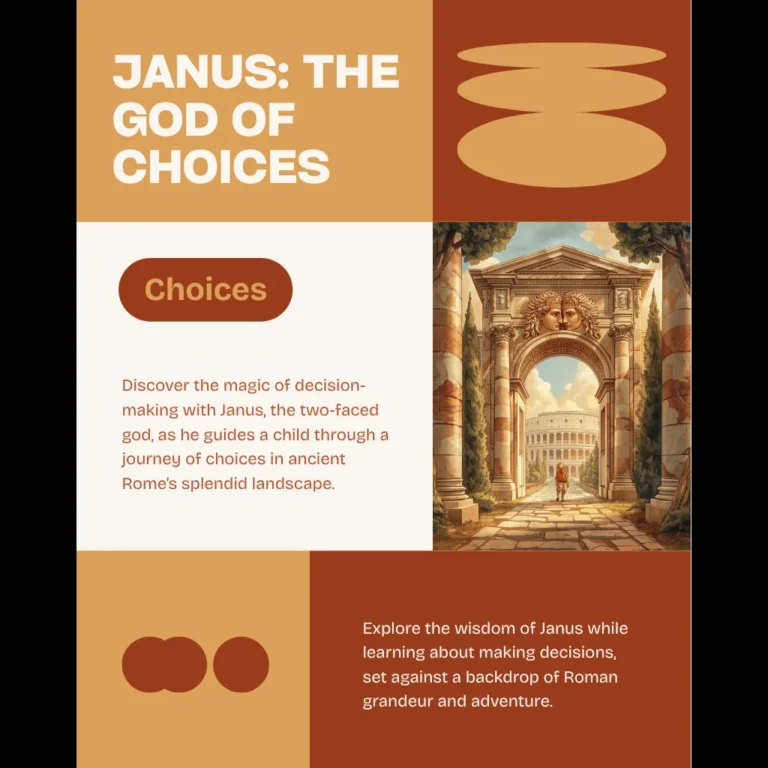
The Gate That Would Not Choose
—
The gates of Janus's temple had stood at the heart of Rome for a thousand years. They had a simple rule, older than any law carved on stone: open during wartime, closed during peace. Everyone knew it. Everyone trusted it.
But one cold January morning — the very month named for the god — the gates froze. Not open. Not closed. Trembling halfway between, like a question no one knew how to answer.
Priests pressed their palms against the iron. Generals pushed with their shoulders. Even the Consul himself arrived with fifty soldiers, and the gates did not move — not one finger's width in either direction.
A whisper crept through the Forum like smoke: *Something is wrong with Rome.*
—
Marcus was eleven years old and smelled of flour. His father ran a bakery three streets from the Forum, and Marcus made deliveries every morning through the winding stone lanes. He was small for his age, quiet, easily forgotten — the kind of boy who slipped through crowds like water between rocks.
On the third morning of the stuck gates, carrying a basket of warm rolls past the Tiber river, Marcus noticed an old man sitting alone on a stone bridge. The man's cloak was grey as pigeon feathers. His back was curved like a question mark.
And his face — Marcus blinked twice — his face looked in two directions at once. One side gazed upstream, toward yesterday. One side looked downstream, where the morning sun was cracking the water into gold.
*He must be wearing a festival mask*, Marcus thought.
But the old man wore no mask.
—
"Are you hungry?" Marcus asked, because when you don't know what else to do, his mother always said, *offer bread.*
The old man turned — both faces turned, somehow, together. His eyes were the color of river water at dusk: deep, slow, and a little sad.
"Everyone who has passed me today asked what I *am*," the old man said, his voice low and rolling, like stones shifting in deep water. "You are the first to ask if I'm *hungry*."
Marcus held out a warm roll. The old man's fingers wrapped around it — and for one strange moment, pressing Marcus's hand, he felt something odd wash through him. Like standing in a doorway between a warm room and a cold night. Belonging to both places at once.
"The gates," Marcus said carefully. "Do you know why they won't move?"
"They're waiting."
"For what?"
The old man chewed slowly. "For someone who understands that going forward and looking back are the same journey. Most people," he said, watching the river, "only ever walk one way."
—
Marcus carried those words all the way to the Forum. He didn't understand them — not yet. But he held onto them the way you hold a warm stone in a cold pocket.
When he arrived at the temple, his stomach clenched. A small girl — six years old, maybe — had dropped a clay votive figure in the mud near the gate and was crying softly, her shoulders shaking. Men and women in togas stepped around her without looking down. The cobblestones smelled of wet earth and crushed flower offerings, but the air felt cold in a way that had nothing to do with wind.
Marcus stopped.
He crouched and picked up the little clay figure. It was Vesta, goddess of the hearth, her tiny flame still painted orange despite the mud. He cleaned her gently on his tunic and placed her back into the girl's small hands.
The girl's face opened like a window in sunshine.
"Thank you," she whispered, and her eyes were bright as lit oil lamps.
—
Marcus turned to the frozen gates. He didn't know why. He just did.
He placed both palms flat against the cold iron. It was rough under his fingers, ancient and heavy and real. And he thought — really thought, for the first time — about the old man's words. *Going forward and looking back are the same journey.* He thought of the girl's wet face, and then her smile. Sad becoming better. Winter becoming spring. Past and future, held in the same pair of hands.
He pushed. Not with his muscles.
With both feelings at once.
The gates groaned. An inch. Then two. Then — with a sound like a mountain clearing its throat — they swung fully open. Gold morning light poured through the archway like warm honey. Every pigeon on every rooftop exploded upward in a rush of wings and wind, and people in the Forum stumbled backward, gasping, reaching for each other's arms.
—
Marcus ran back to the bridge.
The old man was gone. Only the faint smell of warm bread hung in the river air, drifting downstream toward the sea.
That evening, his father heard the story and grew very quiet. He stirred the fire before he spoke.
"Janus guards every door, every beginning and every ending," his father said at last, his eyes on the flames. "But he can only open them from the inside."
Marcus looked at the little clay Vesta sitting on the table — the girl had pressed her into his hands before running home — and watched the painted flame glow and glow in the firelight.
Outside, Rome breathed again. Warm as a bakery. Busy as a river. Full of people walking past each other, some looking back, some looking forward, a few — just a few — doing both at once.
📚 Recommended Books
Handpicked for readers like you
As an Amazon Associate, we earn from qualifying purchases. These recommendations are personalized based on this story's themes and your reading history.