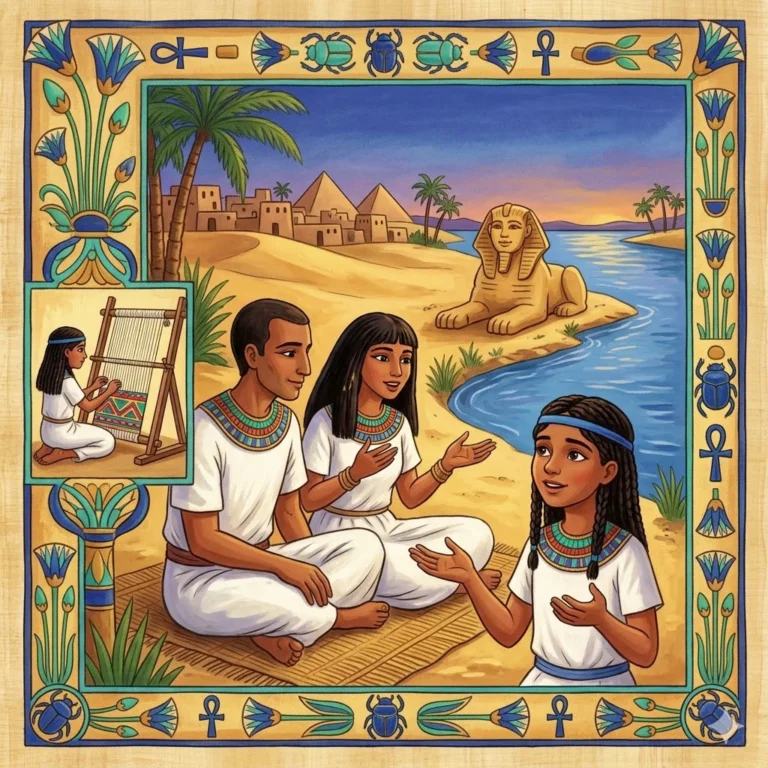
The Weaver's Daughter and the Sphinx
A girl named Nefret lived in Bakhet with her father, Kha, the finest weaver in the valley. Every morning she woke to the rhythmic click-clack of his loom, to the warm scratch of linen thread between her fingers as she helped him wind the spools before sunrise. It was quiet, patient work, and she had grown up watching her father follow a tangled problem slowly, never yanking, never forcing, until the answer appeared in his hands like something that had been there all along.
But the year Nefret turned ten, the rains did not come.
The river shrank. The reeds turned pale and brittle as old parchment. The soil cracked in the fields like a mosaic of dry lips. The village well began to fail, giving only a bucket of muddy, copper-tasting water each morning where there had once been five.
The village elder, Harkhuf, called everyone to the acacia tree at the center of the lane. His voice, rough as sun-baked papyrus, cut across the murmuring crowd.
"There is an oasis," he said. "Three hours east, beyond the Red Dune. But no one has gone there in many years — not since the Sandstone Sphinx set itself across the path."
A wave of unease moved through the crowd. Children pressed closer to their mothers. Even the dogs sat down and went still.
"It speaks," a farmer said, his eyes wide as polished obsidian. "It asks a riddle. Those who answer wrong are turned back — some say worse."
Nefret looked up at her father. Kha was silent, his jaw tight, his fingers worrying the hem of his robe.
"I will go," she said.
Every head turned toward her.
"You?" said Harkhuf. "You are a child."
"I am ten," said Nefret, "and I have been listening to my father think through hard problems my whole life. He untangles knots with patience every single day. I have learned something from watching him."
Her father placed his hand on her head — warm, steady, certain. He did not say no.
—
Nefret set out at dawn, before the sun could turn the desert into a furnace. The sand was cool and almost purple in the early light, whispering against her sandals with each step. She carried a waterskin, a small loaf of bread still warm from the oven, and nothing else.
As she climbed the flank of the Red Dune — named for the iron in its sand, which stained her feet the color of a late sunset — she heard it: a low, resonant sound, like a stone being dragged slowly across another stone. It seemed to come from the earth itself.
At the crest of the dune, she saw the Sphinx.
It was smaller than the great ones carved for pharaohs — about the size of a large ox — but it held a heaviness that had nothing to do with size. Its limestone face was worn smooth by centuries of wind. Its carved eyes seemed to contain the heat of ten summers at once. The air around it smelled of hot dust and something older — something Nefret had no word for but felt in the back of her teeth.
"Who approaches?" the Sphinx said. Its voice came from everywhere and nowhere, like thunder heard inside a sealed jar.
"Nefret, daughter of Kha the weaver, of the village Bakhet," she said. Her voice shook only a little, and she was proud of that.
"Many have come. All have failed. Why should you succeed?"
"I don't know if I will," said Nefret honestly. "But the village needs water, and someone had to try."
The Sphinx studied her for a long, windless moment.
"Then hear your riddle," it said at last. "I have no mouth, yet I swallow the sun each evening. I have no arms, yet I hold the Nile each morning. I am broken every day and made whole again by night. What am I?"
Nefret sat down in the hot sand, right in front of the Sphinx, crossed her legs, and closed her eyes. She thought of her father at his loom — the way he never forced the thread, never yanked at a knot, only followed the weave patiently, patiently, until the answer revealed itself.
She thought about the water. She thought about the sun. She thought about what is broken and remade every single day without anyone asking it to be.
"The horizon," she said. "It swallows the sun at dusk and cradles the Nile's reflection at dawn. Each new day is a new horizon — it breaks apart and returns, always."
Silence.
Then the Sphinx made that deep, grinding sound again — and slowly, with the unhurried dignity of something very old, it shifted aside. The path east lay open. Beyond it, green and trembling in the white morning light, Nefret could see the swaying crowns of palm trees.
"You may pass," said the Sphinx. "And you may bring others."
She was already moving forward when she stopped and turned back.
"Why did you let me speak at all?" she asked. "You could have turned me away before I even said a word."
The Sphinx tilted its ancient, wind-worn head. "I let anyone try who is honest about their fear. Those who claim to have none — I send them home. They are not yet ready to find anything."
Nefret considered that for a moment. Then she nodded once, the way her father nodded when a hard thing had finally been understood, and walked on.
—
The oasis smelled of cool water and crushed green leaves — the most magnificent smell Nefret had ever known. She knelt at the pool's edge and cupped her hands. The water was so cold it made her gasp, then laugh, the sound scattering a pair of white ibis birds from the palms above her in a rush of feathers and startled cries.
📚 Recommended Books
Handpicked for readers like you
As an Amazon Associate, we earn from qualifying purchases. These recommendations are personalized based on this story's themes and your reading history.
She filled her waterskin, tucked her warm loaf under her arm, and turned back toward Bakhet to bring her village home.