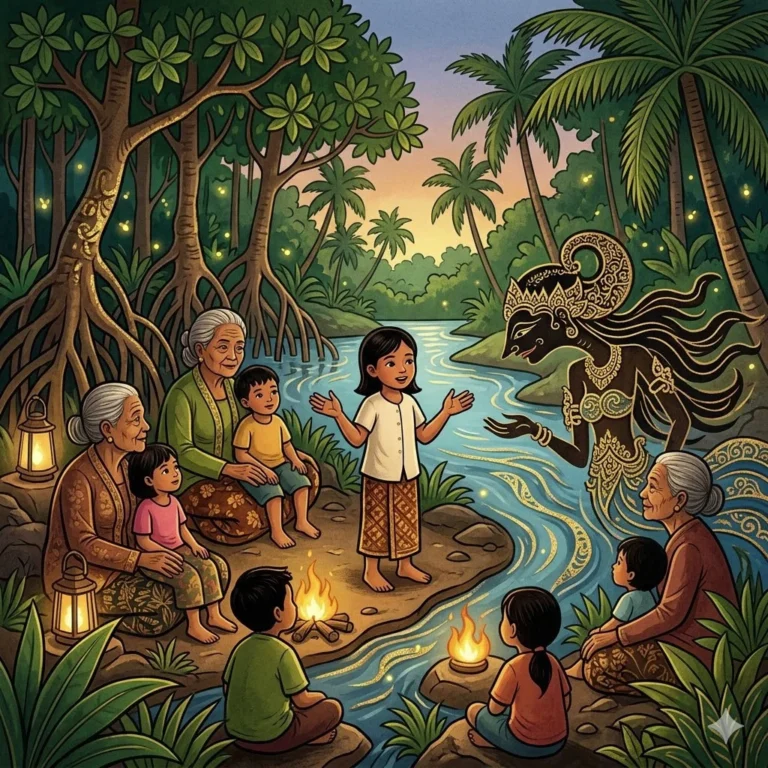
The Girl Who Bargained with the River
In those days, the Sampan River ran wide and green through the heart of the village. Its water tasted faintly of earth and sweetness, and every family carried their stories the way the river carried leaves — quietly, without fuss. But one dry season, the river began to change. The fish disappeared. The water turned murky and still, heavy with the smell of rot, and the rice paddies cracked open like old palms left too long in the sun.
The village elder, Pak Danang, called everyone together beneath the great banyan tree. Its roots clutched the red earth like fingers, and the air around it smelled of bark and old rain.
"The River Keeper has grown angry," Pak Danang said, his voice low and careful. "Someone must go to the deep bend where the old kapok tree stands and speak to it directly."
No one moved. The deep bend was where the water turned darkest, where the current coiled in strange circles, where children were told never to swim alone.
Then Anika stepped forward. She was twelve years old, small enough that people sometimes forgot she was in the room — which was, she had always thought, a useful kind of thing to be.
"I will go," she said.
Her grandmother, Nenek Sari, grabbed her wrist. Her grip was warm and dry, like river clay left in the sun.
"Anika, you do not know what waits there."
"That is why I need to go, Nenek," Anika said softly. "Because I can find out."
The old woman held her gaze for a long moment, studying her the way she studied the sky before rain. Then she released her hand.
Anika walked alone along the riverbank as the afternoon light turned the water to hammered copper. The air grew cooler and heavier with the scent of wet moss and fallen flowers. Dragonflies hung motionless above the surface. The mud under her feet was soft and cold, pressing between her toes with each careful step. And then, at the deep bend where the old kapok tree trailed its roots into the water like tired arms, she saw it.
The River Keeper sat on a stone in the middle of the current. It looked like a very old man — or perhaps a very old woman — draped in green cloth that swayed even when the air was perfectly still. Its eyes were the colour of pale river glass, seeing everything at once.
"You are small," it said. Its voice sounded like water moving over smooth stones, cool and unhurried. "Why are you here?"
Anika kept her feet planted on the bank, though her heart was hammering hard enough that she could feel it in her ears.
"The river is sick," she said. "My village is thirsty. I came to understand why."
The River Keeper tilted its head. "Everyone who has come before you turned and ran. Why do you stay?"
"Because running will not bring the water back."
A silence opened between them, wide as the river itself. Kapok flowers drifted down around them, white and feather-soft, settling on the dark surface of the water.
"Three questions," the creature said at last. "Answer them well, and I will hear your request. Fail, and you walk home empty-handed."
"Ask," said Anika.
"What is stronger — a sword or a reed?"
Anika thought of the bamboo fences near her home, how they bent nearly to the ground in typhoon winds and yet stood again each morning. "A reed," she said. "A sword can break. A reed bends and returns."
The pale eyes flickered. "What is louder — a shout or a whisper?"
Anika thought of her grandmother, who never raised her voice and yet whose words were the ones everyone remembered long after the shouting had faded. "A whisper," she said. "Because people must lean in to hear it."
The creature shifted on its stone. "Last question. What is more dangerous — a deep river or a shallow one?"
Anika was quiet. She looked at the dark swirling water before her, then thought of the small, bright streams near the village — the ones that looked innocent as puddles until the rains came, and they rose fast and cold and swept away everything in their path without warning.
"A shallow river," she said slowly. "Because people underestimate it."
For a long moment, there was only the sound of the current and the soft landing of kapok flowers on water.
Then the River Keeper smiled — not unkindly.
"Upstream," it said, "three great stones were thrown into my source by men who did not ask permission and did not consider the cost. Move them, and I will flow again freely. You have earned the answer."
Anika bowed — not out of fear, but out of genuine gratitude. There is a difference, and the River Keeper noticed it.
She returned to the village and told Pak Danang everything. Within a day, twelve men waded upstream and found the stones, heavy as sleeping buffalo, and rolled them aside one by one. By nightfall, the river was running clear and cold again, filling the air with that familiar scent of earth and sweetness. By morning, the first small fish had returned.
📚 Recommended Books
Handpicked for readers like you
As an Amazon Associate, we earn from qualifying purchases. These recommendations are personalized based on this story's themes and your reading history.
No one in Sampan Raya ever forgot who had stood at the dark bend and stayed — a story shared still today with kids ages 6 through 12, long after the fireflies come out and the bamboo huts glow warm against the night.