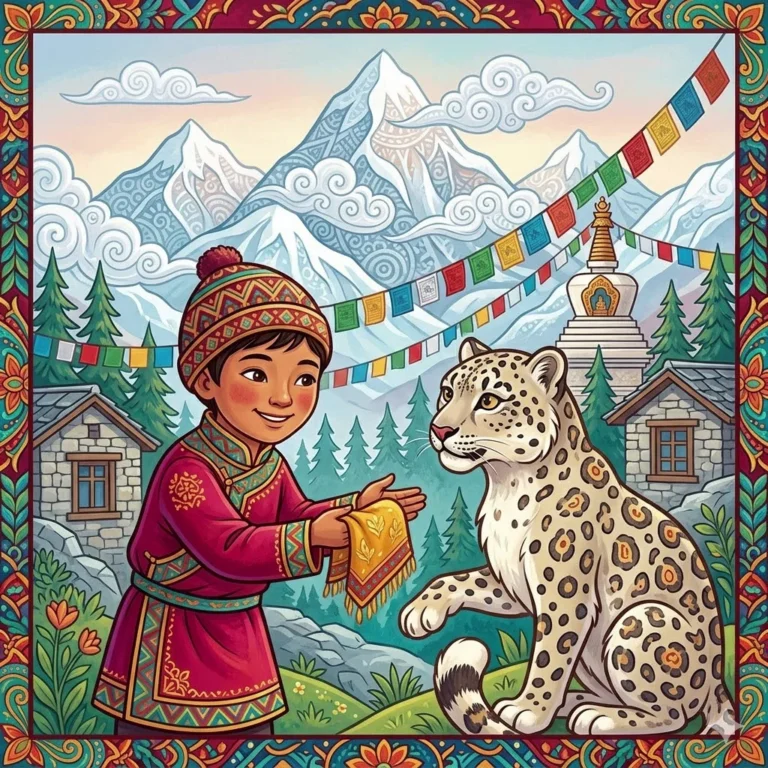
The Snow Leopard's Question
—
Tenzin was nine years old, with knees perpetually scabbed and a mind that never stopped turning like a prayer wheel. He lived in a stone village clinging to a mountain so tall that clouds snagged on its peak like torn wool. Every morning he drove the family's three yaks to graze on a narrow meadow above the village, while below, the valley breathed with the distant tinkle of monastery bells.
One autumn morning, the meadow was wrapped in a silence that felt different — thick and watching. The grass was silver with frost, and Tenzin's breath bloomed in small clouds. Then he saw it: a snow leopard, pale as moonlight, standing absolutely still at the far edge of the meadow. Its grey-spotted coat shimmered, and its ice-pale eyes were fixed not on the yaks, but directly on Tenzin.
His heart hammered. Every muscle in his legs screamed *run*.
But he didn't run. He stood, trembling, and he watched.
The leopard opened its mouth — not in a snarl, but in a wide, curious yawn that showed teeth like ivory needles — and then it sat down. It simply sat, the way a cat sits on a warm stone, tail wrapping around its paws.
Tenzin swallowed. "Are you going to eat my yaks?" he whispered.
The leopard blinked its slow, golden blink. It did not move.
Tenzin took one careful step forward. The frozen grass crunched beneath his boot like broken glass. The leopard's ears swivelled but it held its ground.
"My father says your kind are the guardians of the mountain," Tenzin said, a little louder this time, surprised by the steadiness in his own voice. "He says you only appear when someone is being tested."
Still the leopard watched.
Tenzin's mind raced. The yaks had bunched together, lowing nervously, their warm breath steaming in the cold air. He could smell their earthy fur and the sharp frost on the grass. He was their guardian today, same as every day. If he ran, what would become of them?
He took another step. And another. Until he stood only ten arm-lengths from the great cat.
Up close, the leopard was enormous — far larger than it had appeared from a distance. Its paws were the size of Tenzin's face, and each rosette on its coat was a tiny universe of shadow and silver. Tenzin noticed something else: a thin red line across one of its front legs. Not deep, but raw. The leopard had been hurt.
"Oh," Tenzin breathed. "You're not testing me. You're in trouble."
He thought hard. He had nothing but his satchel — dried meat, a skin of salted tea, and the cotton scarf his grandmother had tied around his neck that morning, still warm and smelling of juniper smoke. He pulled out the scarf slowly, so slowly that time seemed to press flat like dough.
The leopard watched his hands.
Tenzin crouched down, making himself small. He tore a strip of cloth with his teeth, wincing at the bitter cold of the air on his bare fingers. Then, with his heart in his throat, he placed the cloth strip on the ground and slid it gently toward the leopard's paw with a long, thin stick.
The leopard sniffed it. It lowered its great head and regarded Tenzin with those impossible eyes.
"I know you don't need me," Tenzin said softly, his voice barely louder than the wind threading through the peaks above. "But I'm here anyway."
For a long, held-breath moment, nothing moved — not the clouds, not the leopard, not Tenzin.
Then the leopard stood, turned, and walked to the edge of the meadow. Before it disappeared into the boulder field, it paused. It looked back once. Then it was gone, absorbed into the grey and white of the mountain as if it had never existed at all.
Tenzin sat down hard in the frozen grass. His legs had decided, quite independently, that they were done holding him up.
—
That evening, the village elder — old Rinchen, whose face was a map of every winter he had survived — called Tenzin to sit beside him at the fire. The smell of burning juniper and roasted tsampa flour filled the low room. Butter-lamps threw warm, trembling shadows on the painted walls.
"I heard you met the mountain's guardian today," Rinchen said. He had eyes like polished obsidian.
Tenzin nodded. "I was frightened."
"Of course you were," Rinchen said simply.
"But I didn't run."
"No," Rinchen agreed, stirring his tea. "You didn't."
"I don't know why," Tenzin admitted. "My legs wanted to."
Rinchen was quiet for a while. The fire popped and hissed. Outside, wind moved through the pines with a sound like rushing water.
"The mountain doesn't ask whether you are afraid," Rinchen said at last. "It only asks what you do while you are afraid." He handed Tenzin a bowl of warm buttered tea. "That is the only question that matters."
Tenzin held the bowl in both hands and let the warmth move into his cold fingers. He thought about the leopard's eyes — golden, clear, unreadable. He thought about the strip of cloth on the frozen ground. He thought about how the bravest thing he had ever done had felt, in the moment, exactly like the most ordinary thing in the world.
He drank his tea.
📚 Recommended Books
Handpicked for readers like you
As an Amazon Associate, we earn from qualifying purchases. These recommendations are personalized based on this story's themes and your reading history.
Above the village, the mountain rose into a sky crowded with stars, vast and ancient and patient, asking its quiet question to anyone willing to stand still long enough to hear it.