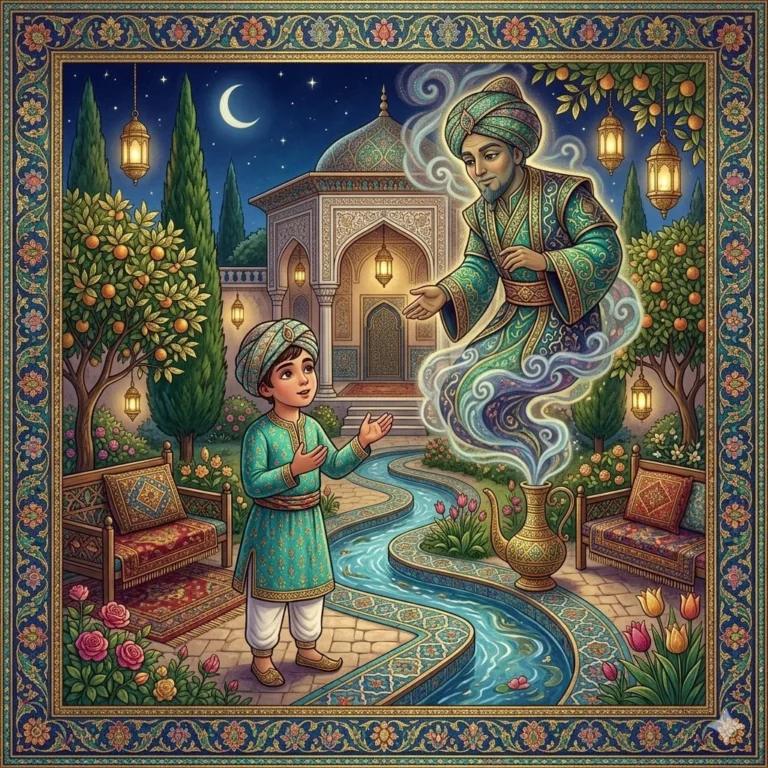
The Boy Who Answered the Djinn
—
Long ago, in the sun-baked city of Shiraz, there lived a boy named Cyrus whose father was a date merchant. The city smelled always of rosewater and warm bread, of saffron drifting from open kitchen windows, of the sweet rot of fallen figs in summer. It was a good place to grow up — until the year the great well at the city's heart went dry.
The well had fed Shiraz for a thousand years. When the bucket came up with nothing but dust and the groan of old rope, the elders gathered in the square and argued for three days. Some said dig deeper. Some said pray harder. Some said nothing could be done.
Cyrus's father said nothing at all, because by then he was lying in bed, grey with thirst and fever, his cracked lips barely moving.
On the fourth night, Cyrus wrapped a scarf around his head against the cold desert air and slipped out of the city gates. He had heard the camel drivers whisper about the Fountain of Clear Sight — a spring in the hills to the east that never ran dry. He had also heard them say that a djinn guarded it, and that the djinn ate foolish boys for breakfast.
Cyrus walked all night. The sand beneath his sandals was cold and fine as flour, and the only sounds were the distant yip of jackals and the crunch of his own footsteps. By dawn, the hills turned the color of pomegranate skin, and there, coiled around a shimmering blue pool like smoke around a flame, sat the djinn.
It was enormous. Its body shifted between shapes — a lion, a column of smoke, an old man with a beard of stars. The pool behind it smelled of cold stone and deep earth, achingly clean.
"Who wakes me before the sun has finished rising?" the djinn rumbled. Its voice was like boulders rolling downhill.
Cyrus's knees wanted very badly to run. He made them stay still. "My name is Cyrus, son of Bahram the merchant. My city is dying of thirst, and my father is dying of fever. I've come for water."
The djinn laughed, and the sound scattered a flock of starlings from a nearby acacia tree. "Everyone who comes here wants something. Very well, small boy. I will ask you three questions. Answer them correctly, and you may fill every vessel in the province. Answer wrong—" it smiled with too many teeth— "and you become my ninth decorative garden stone."
Cyrus looked at the eight smooth grey stones arranged at the pool's edge. He swallowed. "Ask."
The djinn leaned close. Its breath smelled of lightning and old bones. "First question: *What is heavier — a mountain, or a secret?*"
Cyrus thought of his father in the dim room, of the weight his father carried each time he looked at Cyrus and said nothing about how bad things were. He thought of how that silence filled the whole house like smoke.
"A secret," Cyrus said. "Because a mountain only sits on the ground. A secret sits inside a person."
The djinn blinked, slowly, like a cat. "Second question: *What travels fastest — wind, light, or a rumor?*"
Cyrus almost said *light* — that was the clever answer, the quick answer. But he paused. He thought of how, the morning the well went dry, half the city had known before the sun touched the rooftops.
"A rumor," he said. "Light can't go around corners. A rumor goes everywhere."
The djinn was very still now. The shapes it shifted between had slowed, as if it were paying closer attention.
"Third question," it said, and its voice was quieter now, almost gentle: "*What is braver — a lion who has never been afraid, or a child who is afraid and walks forward anyway?*"
Cyrus felt his heart hammering in his chest. He looked at his hands, which were trembling slightly. He looked at the eight garden stones that had once been boys — probably boys who had charged forward without thinking, or who had turned and fled.
"The child," he said. "Because the lion doesn't know what it costs."
The desert went completely silent.
Then the djinn exhaled — a long, slow breath that smelled like rain on hot stone — and moved aside from the fountain.
"Fill your vessels," it said. "And tell your city: I have been waiting three hundred years for someone who understood the difference between boldness and wisdom. They are not the same thing. But the best heroes carry both."
Cyrus filled his waterskin until it was round and heavy as a melon. He turned to thank the djinn, but it was already gone — only the pool remained, glittering in the morning light, and the eight stones, which, he noticed now, had small cracks in them, as if something inside each one was beginning, very slowly, to breathe.
—
Grandmother Maryam's voice always softened at this part.
Did the cracks grow wider? Did the nine former boys eventually stretch and yawn and walk back to their own thirsty cities? She would smile and say: "That part of the story is still happening."
Outside, the desert wind had dropped. The grandchildren were warm and heavy-lidded, nested against her like birds.
"Did Cyrus save his father?" the youngest always asked.
"He brought the water home before noon," she said, smoothing the blanket over small shoulders. "His father drank, and the color came back to his face like sunrise."
She blew out the lamp.
📚 Recommended Books
Handpicked for readers like you
As an Amazon Associate, we earn from qualifying purchases. These recommendations are personalized based on this story's themes and your reading history.
In the darkness, the story settled into the children like water into dry earth — quietly, completely, and all the way down.