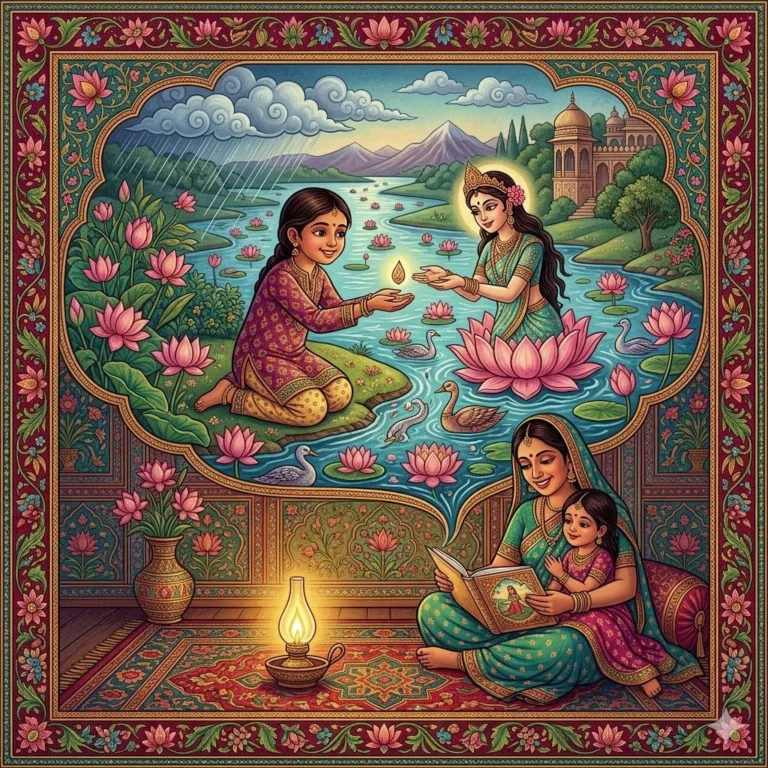
Tara and the River's Secret
—
The river had gone dry.
Not slowly, the way rivers sometimes do in the deep heat of summer, but overnight — as if the earth itself had swallowed it whole. The Nilajal, which had sung through Chandrapur for a thousand years, was now nothing but cracked mud and the smell of fish and sorrow. The mango orchards wilted. The buffaloes lowed in their pens. The village well dropped to a whisper.
Tara was ten years old, with ink-stained fingers and a grandmother named Parvati Dadi who told her stories while braiding her thick black hair each morning. It was Dadi who had always said, *"The frightened mind sees monsters. The still mind sees the path."*
The elders of Chandrapur held a council under the old peepal tree, whose bark was silver-gray and rough as a elephant's knee. Tara sat outside the circle of turbans, listening to the men argue in low, worried voices.
"The Yaksha who guards the river's source has been angered," said the headman, stroking his white moustache. "No one must go near the hills. The last man who tried — Gopal's father, twenty years ago — came back with his hair turned white and would never speak of what he saw."
Tara said nothing. She looked at the cracked riverbed, where a kingfisher sat on a bare rock, tilting its brilliant head as if asking a question.
That night, while the village slept under a sky thick with restless stars, Tara tied her sandals, wrapped a shawl around her shoulders, and walked toward the hills.
The path climbed through a forest of neem and sal trees. The bark smelled sharp and medicinal. Crickets filled the dark with their scratching music, and the earth under her feet was soft with fallen leaves — cool, almost damp, as if the memory of water still lived in the soil. She was afraid. Her palms were sweating and her breath came too quickly. But she kept walking.
At the river's source — a pool cut deep into the hillside — she found him.
The Yaksha was immense, seated on a slab of dark stone, his skin the color of storm clouds, his eyes two gold lamps burning without heat. Around him, the air smelled of iron and wet stone. The pool behind him was full — full and still and dark as ink, going nowhere.
"Child," he said, and his voice was the sound a boulder makes when it rolls into water. "You should be home."
Tara's knees felt like river reeds in a current. But she stepped closer and bowed respectfully, hands pressed together.
"Yaksha-dev," she said, "the village is thirsty. The children are thirsty. I have come to ask why the river no longer flows."
The Yaksha narrowed his golden eyes. "Ask me nothing. Go home."
"I cannot," said Tara. "Not without water."
A long silence. Frogs that should have been singing were silent. Even the wind held its breath.
"Then answer my riddle," the Yaksha said slowly, as if deciding something. "I give riddles to all who come here. None have answered. Answer mine, and I will release the river. Fail, and you will sleep in stone until the next age of the world."
Tara's throat was dry. She thought of Dadi's voice: *The still mind sees the path.*
"Ask," she said.
The Yaksha leaned forward. "What is stronger than iron, softer than silk, invisible as air, and the only thing that can move a mountain without touching it?"
The silence stretched. An owl called once from the darkness of the sal forest. Tara thought of her grandmother telling stories. She thought of the headman's trembling hands. She thought of the kingfisher, tilting its head.
"Patience," she said at last. "Patience is stronger than iron because it outlasts every blow. It is softer than silk because it comforts. It is invisible. And it moves mountains — because the one who waits long enough sees the mountain change."
The golden lamps of the Yaksha's eyes flickered.
And then — slowly, like the first breath after a long illness — he smiled.
"Child," he said, and his voice was gentler now, something almost human beneath it, "you are the first in two hundred years to answer." He rose from the stone, and as he rose, the air around him shifted. The pool behind him shivered. A crack appeared in the rock, and the Nilajal came spilling out — cold and silver and singing, tumbling down the hillside in a rush of sound and spray and the green smell of living water.
Tara pressed her hands to her mouth. The water swirled around her sandaled feet, cold as a secret, and she laughed — she couldn't help it.
"Why did you stop the river?" she asked.
"I did not," said the Yaksha. He was already fading, growing transparent as moonlight through cloth. "I was only the lock. You, child, were the key."
—
By dawn, the Nilajal was running through Chandrapur again, full and bright and cold. The whole village gathered at the bank, cupping water in their palms, drinking, laughing, weeping.
The headman asked Tara what had happened. She thought for a moment, then smiled.
"I asked politely," she said, "and I waited for the answer."
This is the kind of tale — the sort made for kids ages 6–12 who know that going to sleep brave is harder and better than going to sleep safe — that Chandrapur still tells by lamplight when the monsoon comes and the river runs high.
Tara grew up to be the village's wisest elder.
📚 Recommended Books
Handpicked for readers like you
As an Amazon Associate, we earn from qualifying purchases. These recommendations are personalized based on this story's themes and your reading history.
She never once told them what the riddle was.