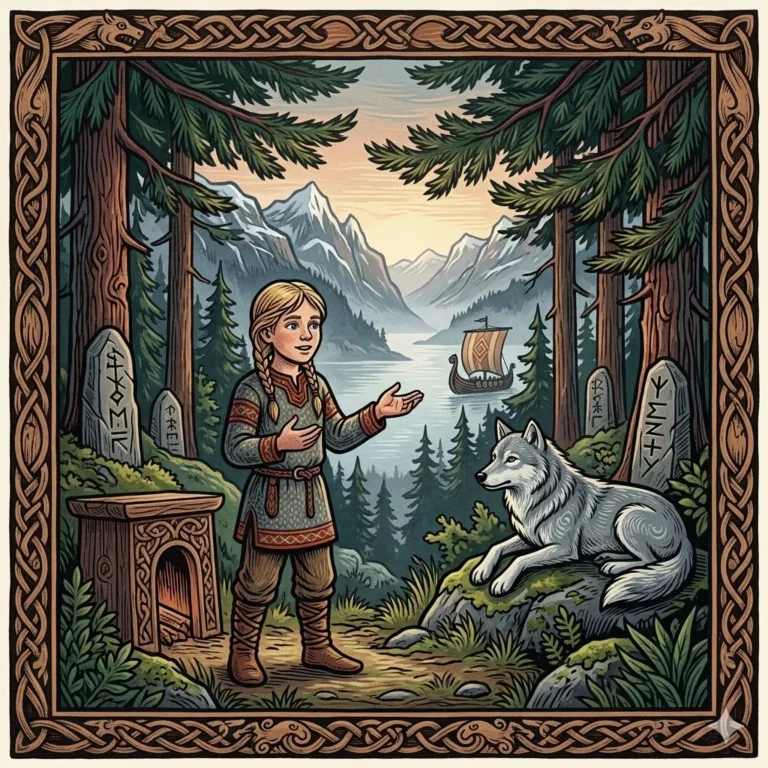
Leif and the Midnight Wolf
—
Leif was nine years old, quick-footed and sharp-eyed, the youngest son of a herder who lived at the edge of a village called Hvitdal. The village sat in the crook of two mountains, and every winter the mountains breathed cold air down into the valley like sleeping giants sighing in their dreams.
One evening in deep winter, Leif went to check on the goats in the barn. The air outside smelled of frozen pine and something else — something wild and rank, like wet fur and old bones pressed together in the dark. He held his lantern high. Its amber light caught the falling snow in golden sparks.
Then he saw the tracks.
They were enormous. Larger than a grown man's spread hand, five deep claw-marks gouging the snow like the fingers of something ancient and unhurried. They circled the barn once, twice — then led off toward the village center.
Leif's stomach dropped like a stone into a well.
He had heard the elders speak of Skoll — a great wolf descended from the old line of Fenrir, grey as glacier ice, that came down from the high passes when the cold drove its prey lower. Not a myth. A real creature. And now it had come to Hvitdal.
He could run to his father's longhouse. He could shout and wake the adults. But the tracks led *toward* the longhouse. The wolf was already between him and home.
He stood very still, breathing clouds of steam into the darkness. The lantern flame shivered.
*Think*, he told himself. *Think before you move.*
The old skald — the village storyteller, who smelled always of smoke and salted fish — had said something once, scratching his grey beard by the fire. *A wolf follows its nose. But it chases with its ears what it cannot understand. Confusion makes a beast cautious.*
Leif looked around the barn. Inside, hanging on a peg near the door, were the copper bells the goats wore in summer. He counted three. He grabbed them all, stuffed two into his coat pocket, and gripped the third by its clapper so it would not ring yet.
Then he followed the wolf's tracks.
This was the part that made his legs feel hollow. Each footstep crunched loudly in the snow. The cold bit at his ears and the tips of his fingers until they ached. The pine trees on either side of the path stood like dark sentinels, their branches loaded with snow so heavy it sagged like sleeping white creatures draped across the boughs.
He found the wolf near the old well at the village center. It was enormous — bigger than he had imagined, with fur the color of ash and eyes that caught his lantern light and turned it to burnished copper. It was sniffing at the door of the nearest longhouse, its shoulders rolling with each slow breath.
It heard him and swung its great head around.
Leif held its gaze. His heart hammered so hard he half-expected the wolf to hear it. Then, carefully, he set his lantern in the snow. He released the clapper.
*CLANG. CLANG. CLANG.*
The wolf flinched — ears flat — startled by something it had no name for.
"HEY!" Leif bellowed in the deepest voice he could summon. "OVER HERE!"
The wolf stepped toward him. Leif turned and ran — not toward the longhouses, but toward the frozen river at the village's edge. He rang the bell as he ran, *CLANG CLANG CLANG*, the sound shattering the winter silence, impossibly loud and bewildering.
He could hear the wolf loping behind him, drawn by the noise, by the sheer strangeness of this small creature that ran without screaming, that made impossible clamoring sounds in the dark.
At the river's edge, Leif stopped. He pulled the two remaining bells from his coat and hurled them as hard as he could across the ice. They hit and skittered and bounced, ringing and ringing as they slid off into the darkness of the far bank — a cascade of sound retreating into the black.
The wolf skidded to a halt beside him. So close Leif could feel heat radiating from its massive flank, could smell its breath — ancient, wild, like the inside of a cave that had never seen sunlight.
Then it bounded out onto the ice, chasing the sound.
Leif ran back, screaming now at the top of his lungs. Doors burst open. Torches flared orange against the snow. Men came out with spears and bows, their boots crunching the ice-hard ground. By the time the wolf turned back from the far bank, Hvitdal was awake and bristling with light.
It did not return.
—
Later, by the fire, Leif's father held a bowl of warm broth in his large, calloused hands and stared at his youngest son for a long, quiet moment.
"You could have been killed," his father said at last.
"I know," said Leif. His hands had almost stopped shaking.
"What made you follow those tracks instead of running?"
Leif turned the question over in his mind. "Being scared of the wolf wasn't useful," he said slowly. "But being scared of what the wolf might do to *you* — that was something I could act on."
His father was quiet for a long time. Then: "Where did you learn to think like that?"
Leif looked at him. "From you," he said. "You always say — choose your fear wisely."
📚 Recommended Books
Handpicked for readers like you
As an Amazon Associate, we earn from qualifying purchases. These recommendations are personalized based on this story's themes and your reading history.
His father set down the bowl. He wrapped one arm around Leif's shoulders, and neither of them spoke again for a while, and the fire crackled warmly between the stones, and outside the great pine trees stood their ancient watch over Hvitdal, and the wolf did not come back that winter, nor the next.