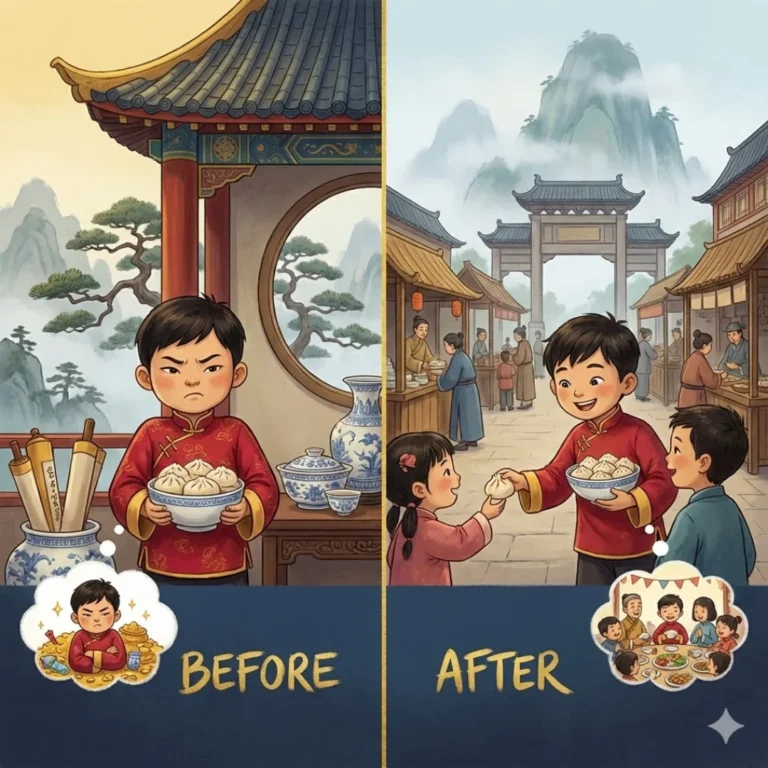
In ancient Persia, where the desert winds whispered secrets through the streets of Shiraz, and where roses bloomed in gardens so beautiful they seemed painted by angels themselves, there lived a young boy named Reza. He was clever, it’s true, very clever indeed. But cleverness, as you shall see, is not quite the same thing as wisdom.
Reza was apprenticed to a merchant named Hadji Baba, a kind man with a long white beard that flowed like moonlight, and eyes that crinkled with perpetual amusement. Hadji Baba traded in carpets, spices, and precious silks along the ancient Silk Road, and he was known throughout the bazaar not just for his fair dealings, but for his wisdom.
Now, Reza thought himself quite knowledgeable already. He could calculate numbers faster than anyone, could speak three languages by the age of twelve, and had memorized poetry that would take hours to recite. When the other merchants praised Hadji Baba’s wisdom, Reza would think privately, “What is wisdom but knowledge? And I have plenty of knowledge already!”
One golden morning, when the call to prayer echoed across the city and the bazaar was just beginning to stir, Hadji Baba called Reza to him.
“My young friend,” he said, stroking his magnificent beard, “you have been with me for three years now. You are clever and quick. But there is something I must tell you: cleverness is knowing the right answers, but wisdom is asking the right questions.”
Reza frowned. This seemed like the sort of riddle old people liked to tell. “Master,” he said, trying to be respectful, “I know many things already. I can calculate the price of carpets, I can identify spices by smell alone, I can—”
“Can you answer seven questions?” Hadji Baba interrupted gently.
“Of course!” said Reza confidently.
“Ah, but I will not ask you seven questions,” said Hadji Baba, his eyes twinkling mysteriously. “Instead, I will give you seven tasks. After each task, you must ask yourself one question. Only by asking the right questions will you find what you seek.”
“What am I seeking?” Reza asked, confused.
“That, my dear boy, is the first question you must answer for yourself.”
And with that cryptic message, Hadji Baba handed Reza a small purse of coins and seven sealed envelopes, each marked with a number from one to seven.
“Take these envelopes,” said the merchant. “Each contains an address in the city. Visit each place in order, complete the task written inside, and then ask yourself the question that task inspires. When you have finished all seven, return to me.”
Reza took the envelopes eagerly. This seemed like an adventure! He opened the first envelope immediately.
It read: “Go to the rose garden in the Street of Poets. Give the gardener there one coin. Ask him to show you how he tends the roses. Spend the entire morning watching him work.”
Reza nearly laughed. Watch a gardener work? What could he possibly learn from that? He knew how roses grew—everyone did! But he went anyway, for he had promised.
The gardener was an old man with soil-stained hands and a peaceful face. When Reza gave him the coin and explained his task, the gardener smiled and said, “Come then, young master. Watch, if you will.”
For hours, Reza watched the gardener work. He watched him carefully prune branches, gently water roots, tenderly remove weeds, patiently wait. The gardener didn’t rush. He didn’t force the roses to grow faster. He simply created the conditions for them to flourish, with steady, practiced care.
As the morning sun climbed higher, something stirred in Reza’s heart. Without quite meaning to, he found himself asking: “What would happen if I approached my learning not with impatience, but with patient care, like this gardener with his roses?”
He wrote this question in his journal, feeling a strange warmth in his chest.
The second envelope sent him to a calligrapher’s workshop. The task was to watch the master calligrapher create a single line of poetry in beautiful Persian script. It took three hours. Three hours for one line! Reza’s clever mind wanted to rush, to say, “I understand already!” But he stayed and watched.
He saw how each stroke mattered, how precision and beauty required time, how mistakes meant starting again. And the question came to him: “Have I been rushing through knowledge, trying to collect it quickly, without taking time to truly understand its beauty?”
The third envelope brought him to a mosque, where he was to sit and listen to a scholar teach young students the basics of mathematics—things Reza already knew! But as he listened, he noticed how the scholar used stories and examples, how he made sure every child understood before moving forward, how he showed different ways to solve the same problem.
Reza’s question emerged: “Is knowledge truly mine if I cannot share it in ways that others can understand?”
The fourth task was perhaps the strangest. He had to visit a workshop where broken pottery was repaired using the art of kintsugi, where cracks were filled with gold, making the broken pieces more beautiful than before. The craftsman told him, “We honor the breaks, for they are part of the object’s story.”
Reza thought of his own mistakes in learning, which he always tried to hide. His question came clearly: “What if mistakes and not-knowing are not shameful, but are valuable parts of the journey to wisdom?”
The fifth envelope sent him to the marketplace, where he was to help an elderly spice merchant for the day. The merchant was slow and his hands trembled, but customers sought him out specifically. Reza realized why: the old man listened to each person, asked about their families, remembered their preferences, cared about their lives.
“Is knowledge valuable if it doesn’t help me understand and serve other people?” Reza asked himself.
The sixth task took him to a library, where he was instructed to find a book on a subject he knew nothing about—he chose astronomy—and to read it for hours. The experience was humbling. So much existed that he didn’t know! The universe was vast beyond imagining, and his knowledge was but a tiny grain of sand on an endless beach.
His question trembled with new understanding: “How can I have been so proud of what little I know, when there is so much more to learn?”
The seventh and final envelope contained an address Reza recognized: it was Hadji Baba’s own home. The task read: “Come to dinner. Share what you have learned.”
That evening, Reza sat with his master in a beautiful garden courtyard, where a fountain played its gentle song and the stars began to appear like diamonds sewn onto dark velvet.
“Tell me, Reza,” said Hadji Baba kindly, “what have you learned?”
Reza opened his journal, where he had written his seven questions. As he read them aloud, he felt tears prick his eyes—not tears of sadness, but of awakening.
“Master,” he said softly, “I thought I was wise because I knew many facts. But wisdom isn’t about collecting information like coins in a purse. Wisdom is… wisdom is understanding that learning never ends, that patience matters, that mistakes teach us, that knowledge should serve others, that there is always more to discover. Wisdom comes from experience, from paying attention, from asking questions, from remaining humble.”
Hadji Baba smiled, and his whole face seemed to glow with joy. “Now you are beginning to understand, my young friend. You see, when you first came to me, you had a clever mind—and that is good! But a clever mind alone can become arrogant. True wisdom is the fruit that grows when cleverness is planted in the soil of humility and watered by experience.”
“But Master,” Reza said, “if wisdom comes from experience, and I am young with little experience, how can I become wise?”
Hadji Baba laughed, a warm, rich sound. “Ah! Now that is a wise question! You see? You are learning already. The answer is this: seek experiences that teach you, approach each day as a student, ask questions, remain humble, learn from everyone—gardeners, calligraphers, scholars, craftsmen, merchants, even from the stars themselves. Wisdom is not a destination you reach, but a journey you walk every day.”
From that night forward, Reza was different. He still studied hard and learned much, but now he approached knowledge with humility and wonder. He asked more questions. He listened more carefully. He paid attention to lessons that came from unexpected places.
Years later, Reza became a great merchant himself, known throughout Persia for his fairness and wisdom. He kept a journal with those seven questions written in gold ink on the first page, and he read them often to remember.
And when young apprentices came to him, clever and quick and certain they knew everything, he would smile—that same gentle smile Hadji Baba had given him—and he would offer them seven envelopes, seven tasks, and seven opportunities to ask the questions that would transform their cleverness into wisdom.
For as the old Persian saying goes: “Knowledge is knowing that a tomato is a fruit. Wisdom is knowing not to put it in a fruit salad.” But perhaps the deepest wisdom of all is knowing that you will never stop learning, and that every day brings new questions worth asking.
And so Reza’s story reminds us still, across the centuries and the miles, that true wisdom comes not from having all the answers, but from learning through experience, asking thoughtful questions, and remaining humble before the vast mystery of all there is to know.
Moral of the Story
True wisdom comes from learning and experience
Frequently Asked Questions
What is the moral lesson of The Merchant’s Apprentice and the Seven Wise Questions – Persian Wisdom Story for Kids?
What age is this story appropriate for?
How long does it take to read The Merchant’s Apprentice and the Seven Wise Questions – Persian Wisdom Story for Kids?
What culture does this story come from?
Can I use this story for teaching?
Frequently Asked Questions
What is The Merchant’s Apprentice and the Seven Wise Questions about?
It’s a Persian folktale set in ancient Shiraz about a clever boy named Reza who apprentices under a wise merchant called Hadji Baba. The story explores the difference between raw knowledge and true wisdom through seven meaningful questions Reza must learn to understand.
What is the moral lesson of The Merchant’s Apprentice and the Seven Wise Questions?
The story teaches children that cleverness and knowledge are not the same as wisdom. Reza is talented and smart, but he must discover that real wisdom involves humility, judgment, and knowing how to apply what you know — lessons no amount of memorization can fully teach.
Is this story suitable for young children?
Yes, The Merchant’s Apprentice is written in warm, engaging language perfect for kids aged 6 and up. It uses a relatable young hero and a gentle mentor to deliver its message, making it ideal for bedtime reading or classroom discussions about values and growing up.
📚 Recommended Books
Handpicked for readers like you
As an Amazon Associate, we earn from qualifying purchases. These recommendations are personalized based on this story's themes and your reading history.
What are the seven wise questions in the story?
The seven questions are a central part of the story’s journey and are revealed as Reza learns from Hadji Baba along the Silk Road. Reading the full story will show you each question and why they matter — each one builds on the last to reveal deeper layers of wisdom.
Where does The Merchant’s Apprentice story take place?
The story is set in ancient Persia, specifically the city of Shiraz, a real historical city famous for its gardens, poetry, and culture. The backdrop of the Silk Road and the bustling bazaar adds rich atmosphere and gives children a vivid glimpse into Persian history and tradition.