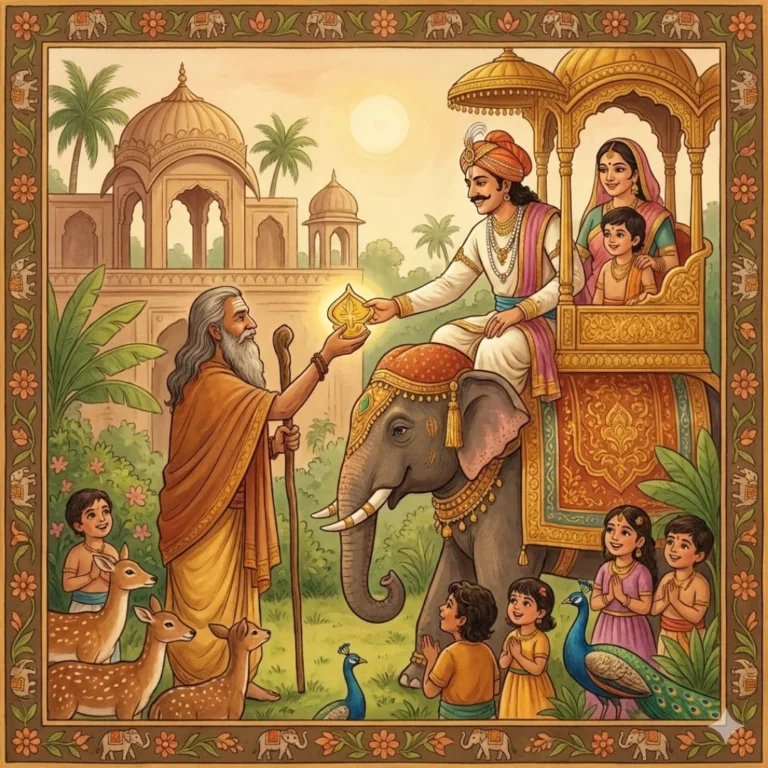
This moral story for children ages 6-12 combines entertainment with important values.
In ancient India, King Harishchandra ruled the golden city of Ayodhya with wisdom and compassion. His people loved him because he had never spoken a single lie in his entire life. Truth lived in his heart like a sacred flame.
One morning, the king stood on his palace balcony with his wife, Queen Shaivya, and their young son, Prince Rohitashwa. The boy was playing with a wooden sword.
“Father, when I grow up, will I be as truthful as you?” Rohitashwa asked.
Harishchandra knelt down. “Truth isn’t something you become when you grow up, my son. It’s a choice you make every single day, even when lying seems easier.”
These words were heard by Sage Vishwamitra, a powerful holy man meditating nearby. “King Harishchandra speaks boldly of truth,” the sage muttered. “Let’s see if his truth survives when everything is taken from him.”
Vishwamitra appeared at the palace gates. Harishchandra welcomed him with great respect. “Your Majesty,” Vishwamitra said, “I had a divine dream. In it, you promised to give me whatever I desired. I want your entire kingdom.”
The court erupted in shocked whispers. But Harishchandra stood tall. “If that is what you ask, then it is yours. I gave my word.”
By sunset, Harishchandra, Shaivya, and Rohitashwa walked out of the palace wearing simple clothes. But Vishwamitra appeared again. “Wait! You still owe me the dakshina—one hundred thousand gold coins! You have one month to pay.”
They traveled to the great city of Kashi. Days passed, and Harishchandra found no work. “We have only one choice,” he told his wife. “I must sell myself as a servant.”
“Then I will sell myself too,” Shaivya said firmly.
Harishchandra sold himself to Chandala, the keeper of the cremation grounds—the lowest work in the kingdom. Shaivya sold herself as a servant to a Brahmin family. Rohitashwa went with his mother.
Harishchandra gave all the money to Vishwamitra, who vanished without thanks.
The cremation grounds were dark and sorrowful. All day and night, Harishchandra burned the bodies of the dead, collecting fees from grieving families. Months passed.
One horrible evening, a woman stumbled in carrying a small, wrapped bundle. “Please,” she sobbed, “cremate my son. He was bitten by a snake. But I have no money!”
Harishchandra’s chest tightened. “I am sorry, but I must collect the fee. Those are my orders.”
The woman fell to her knees. “Please! Have mercy!”
As lightning flashed, illuminating her face, Harishchandra’s blood turned to ice. The woman was Shaivya. The dead child was Rohitashwa.
“No!” he screamed. He grabbed his wife, and they sobbed over their son’s body.
“How did this happen?” he choked out.
“A snake in the kitchen garden,” Shaivya wept. “I ran here because I knew you were the only one who might help, but I have no money!”
Harishchandra’s mind spun with anguish. His son was dead. His wife was a servant. He had nothing. And yet… there was still truth.
“I cannot cremate him without payment,” Harishchandra whispered, his voice breaking. “It would be a lie to my master. Even now, even for this, I cannot abandon truth.”
Shaivya stared in disbelief. “You would deny your own son’s last rites?”
“I would deny myself air to breathe for the sake of truth,” Harishchandra said, tears streaming. “Truth is all I have left. If I surrender it now, then our suffering has meant nothing.”
He stood, shaking. “You have no money, but I must collect payment. The only thing of value you have is your sari. I must take half of it.”
With trembling hands, Harishchandra cut his wife’s sari in half. Then he prepared the funeral pyre for his own son, his tears hissing as they fell on the flames.
But as he lit the fire, the sky exploded with light!
The gods descended from heaven—Dharma, Indra, and countless others, all shining like a thousand suns. Vishwamitra appeared, his stern face now soft with respect.
“Enough!” Dharma’s voice boomed. “King Harishchandra, you have proven that truth lives in you more firmly than your own heartbeat. You did not break.”
Vishwamitra bowed. “I apologize, great king. I was sent by the gods to test if your virtue was real. You have passed a trial that would have destroyed any other mortal.”
Dharma waved his hand over Prince Rohitashwa, and the boy’s eyes opened! “Father? Mother? Why are you crying?”
“All of this was a test,” Indra explained. “And you, Harishchandra, have shown that truth is not just something you speak, but something you are.”
The gods restored everything—the kingdom appeared more beautiful than before. The palace gleamed with new gold. The people cheered.
But Harishchandra didn’t smile at the wealth. He smiled at his son’s laughter, at his wife’s warm hand, at the knowledge that he had kept his truth intact.
A young girl from the crowd called out, “Was it worth it? All that suffering just to keep from telling one small lie?”
Harishchandra knelt to her level. “Truth is like a muscle. Every time you break it, even a little bit, it gets weaker. But every time you keep it, even when it’s terribly hard, it gets stronger. I suffered greatly, yes. But I am still myself. I still know who I am. And that is worth more than any kingdom.”
From that day forward, Harishchandra ruled for many more years, and his story was told to children across India. Whenever someone was tempted to tell a lie, they would remember the king who lost everything but kept his truth, and in keeping it, gained everything that truly mattered.
Frequently Asked Questions
What is the moral lesson of King Harishchandra: The King Who…?
What age is this story appropriate for?
How long does it take to read King Harishchandra: The King Who…?
What culture does this story come from?
Can I use this story for teaching?
Frequently Asked Questions
What is the story of King Harishchandra about?
King Harishchandra is an ancient Indian moral story about a king from Ayodhya who was famous for never telling a lie. The story follows his incredible trials when a powerful sage tests whether he can truly keep his commitment to truth even when he loses everything he holds dear.
What moral lesson does the King Harishchandra story teach children?
The King Harishchandra story teaches children that honesty and truthfulness are choices we make every single day, not just when it’s easy. It shows that staying true to your values, even during hardship and loss, is the mark of real integrity and strength of character.
Is King Harishchandra a real historical figure?
King Harishchandra is a legendary figure from ancient Indian tradition, primarily found in Hindu scriptures like the Puranas. While he may not be a verified historical king, he has been celebrated for thousands of years as the ultimate symbol of truthfulness and righteousness in Indian culture.
📚 Recommended Books
Handpicked for readers like you
As an Amazon Associate, we earn from qualifying purchases. These recommendations are personalized based on this story's themes and your reading history.
What age group is the King Harishchandra story suitable for?
The King Harishchandra moral story is written for children aged 6 to 12 years old. It combines entertaining storytelling with important values like honesty and courage, making it easy for young readers to understand while also sparking meaningful conversations between kids and parents.
Who tests King Harishchandra’s truthfulness in the story?
Sage Vishwamitra, a powerful and wise holy man, tests King Harishchandra’s commitment to truth. After overhearing the king speak boldly about honesty to his son, Vishwamitra decides to put Harishchandra through severe trials to see if his dedication to truthfulness holds up under extreme pressure.