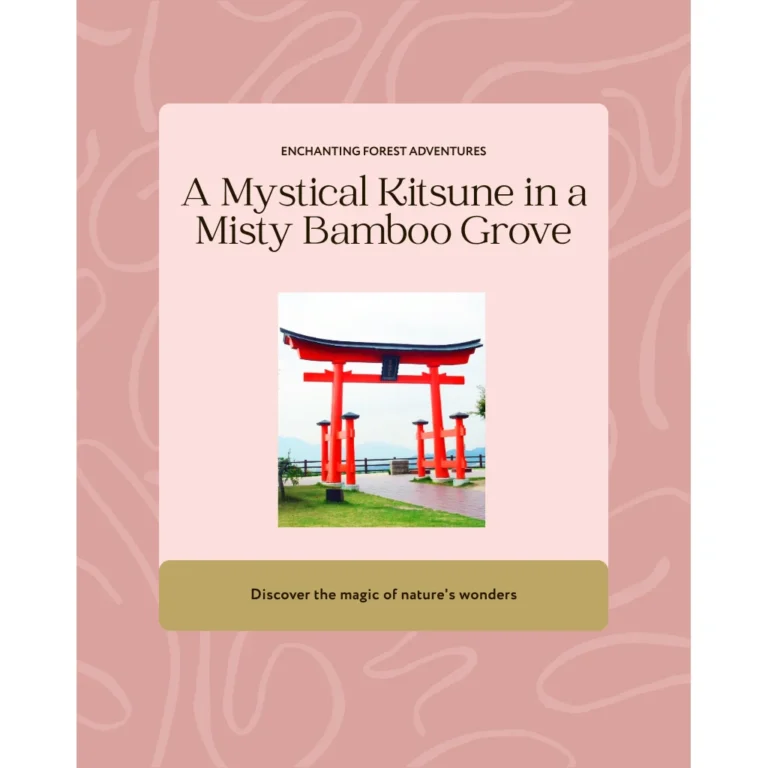
The Fox at the Broken Gate
The gate was the colour of rust and old blood. It stood at the edge of the cedar forest just beyond the village, two tall pillars held together by a crossbeam that had begun to split down the middle. Everyone walked past it quickly. They said the shrine behind it had been abandoned for so long that the kami who lived there had grown unpredictable.
Hiro's grandmother had told him this. Twice.
But on the coldest morning of the year — a morning when his breath made small white clouds and the frozen mud crackled under his boots — Hiro saw something beneath the gate that made him stop dead.
A fox. Small, white as new paper, and very, very still.
Its eyes were open, bright as polished amber. A thin line of blood matted the fur on its left foreleg. It watched him without blinking.
Hiro's heart thumped. He knew that foxes were the messengers of Inari, the great kami of rice and harvests and all the things that grew from the earth. He also knew that a fox who looked at you *that* steadily was not an ordinary fox.
He should have walked away. He very nearly did.
Instead, he knelt in the snow beside it.
"Are you hurt?" he asked.
The fox blinked once. Slowly. As if the question was obvious but it appreciated the politeness.
Hiro pulled off his scarf — the red wool one his mother had knitted with a pattern of pine needles — and very gently wrapped it around the fox's leg. The fox flinched but did not snap. It smelled of pine resin and something else, something warm and sweet like rice steaming in a pot.
—
He told no one. He came back the next morning with a small bowl of rice from his own breakfast. He came back the morning after that with water from the well, carrying it carefully so it didn't slosh in the cold. He had to wake before dawn to do it, when the sky was the deep blue of ink and the stars still hung above the cedar trees like scattered salt.
On the third morning, he arrived to find the fox sitting up perfectly straight, its leg fully healed. The red scarf lay folded neatly beside it — as neatly as if someone with very careful hands had done the folding.
"How did you—" Hiro began.
"You have a kind heart," said the fox.
Hiro sat down suddenly in the snow, because his legs stopped working properly.
"You can *talk*," he said.
"Obviously," said the fox. "I am a servant of Inari-Ōkami. We have always been able to talk. Most humans simply never bother to listen."
—
The fox — who said her name was Shiro, which simply meant *white* — explained that the shrine had not been abandoned by the kami. It had been abandoned by people.
"When people stop visiting," Shiro said, her amber eyes steady on his face, "the kami grow quiet. Not cross. Just… quiet. Like a fire when no one adds wood."
The cedar trees beyond the gate were sick, she said, because no one had pressed a single paper ofuda charm to their bark or spoken a word of thanks to the spirit living in their roots. The crossbeam was splitting because no one had lifted a hand to mend it.
"Can it be fixed?" Hiro asked.
"That," said Shiro, "depends on you."
It was not the answer he had hoped for. He was nine years old and not particularly large for his age. He said so.
"Courage," said Shiro pleasantly, "has nothing to do with size."
—
This, for kids who enjoy a proper adventure, is where the story gets interesting.
Hiro went home and thought for a long time, which he was actually quite good at. Then he went to see old Tanaka-san, who had lived in the village longer than anyone else and knew far more about Shinto rituals than he ever let on.
Old Tanaka-san listened to the whole story without interrupting, which was unusual for him.
"You fed a white fox from your own bowl," he said at last.
"Yes," said Hiro.
"And wrapped it in your own scarf."
"Yes."
Tanaka-san was quiet. Then he stood up, his joints crackling like dry twigs, and went to a low cupboard in the corner of his house. He came back with a worn wooden box that smelled of cedar and old ink. Inside were three ofuda — paper charms covered in careful brushstrokes, the kind made at a proper shrine.
"I have been keeping these," he said gruffly, "waiting for someone worth giving them to."
—
The next morning, Hiro returned to the gate. Shiro was waiting. Together — the boy and the white fox — they pressed an ofuda to the bark of each of the three tallest cedars. Hiro clapped his hands twice, bowed deeply the way Tanaka-san had shown him, and spoke aloud to the kami he could not see, thanking it for the trees and the cold air and the way frost made the spider webs look like silver lace.
As he spoke, he felt a warmth spreading through his chest — the same warmth as a cup of hot tea, spreading slowly from the inside out.
The crumbling crossbeam did not magically repair itself. That is not how Shinto works. But when Hiro returned two weeks later with three friends, a pot of red paint, and some good strong rope, the gate seemed to stand a little straighter. Or perhaps it was only that they looked at it differently now.
Shiro was gone.
But the red scarf — his red scarf — was still folded neatly at the base of the gate, smooth and careful, right where she had left it.
Hiro looked at it for a long moment. Then he left it there.
Some gifts, he had decided, were meant to stay.
📚 Recommended Books
Handpicked for readers like you
As an Amazon Associate, we earn from qualifying purchases. These recommendations are personalized based on this story's themes and your reading history.