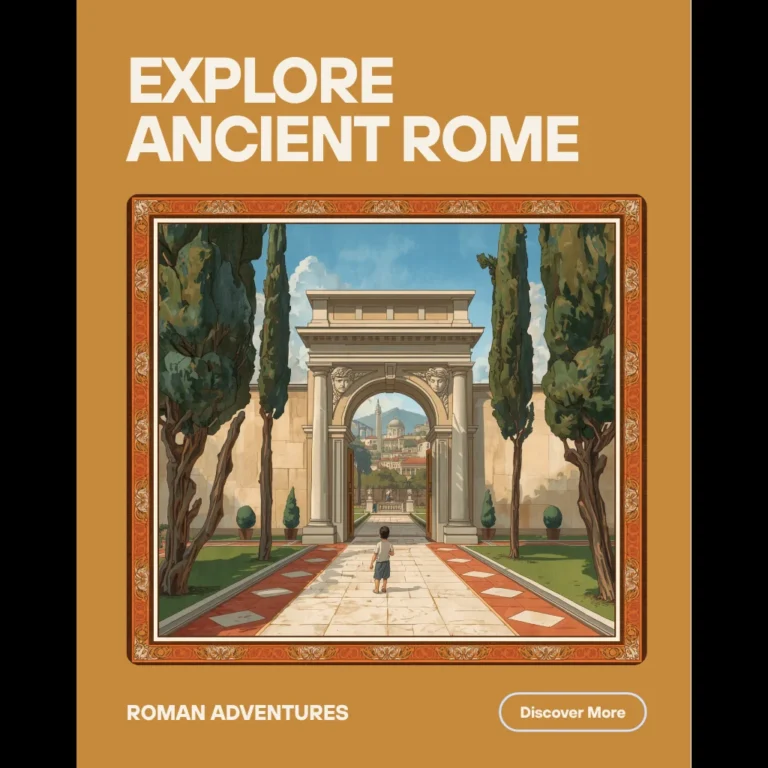
The Gate with Two Faces
Lucia noticed the crying faces every single morning.
She walked past the gate each day to carry bread to the Forum — Rome's great open heart, where senators argued in loud voices and merchants haggled over spices, and the smell of roasting meat and crushed herbs drifted through the warm, golden air. Everyone avoided the gate. They squeezed through the narrow alley beside it, muttering prayers, keeping their eyes low.
"Don't look at the faces," Lucia's mother always said. "They see everything."
But Lucia always looked.
—
One grey morning in October, when the Tiber smelled of cold mud and wet leaves and the sky sat heavy and white over the city's red rooftops, Lucia found an old man sitting beneath the gate. He was hunched inside a thin brown cloak, cradling a clay jug with both hands. His sandals were broken. His white hair was wild as winter grass. He shivered with every breath.
The whole city walked past him. Every single person squeezed through the alley and looked at their feet.
Lucia stopped.
"Are you hurt?" she asked.
The old man lifted his head slowly. His eyes were strange — one pale grey like early dawn, one deep amber like the last light before dusk. "Only cold," he said. "And a little forgotten."
She pulled the small loaf from her basket — the one she was meant to sell — and held it out. He took it with both hands, gently, as though he hadn't been offered anything in a very long time.
"This gate," Lucia said, tilting her head back toward the stone arch. "Why are the faces crying?"
The old man tore the bread and chewed quietly before answering. The Forum hummed and clattered around them, oblivious. "They cry," he said at last, "because the city forgot how to be brave. Long ago, soldiers marched through this arch to protect those who had no one else. The gate was opened with songs and offerings of laurel and salt. Now everyone is afraid of what they do not understand."
"I'm afraid of it too," Lucia admitted.
The old man looked at her with those strange, mismatched eyes. "Yes," he said softly. "But you stopped anyway."
—
Just then, a terrible crash rang out from the Forum.
A cart had overturned — clay pots exploding against the cobblestones in bright orange shards, oil spreading in dark pools across the stone. A young boy lay trapped beneath a heavy wooden wheel, crying out in a thin, desperate voice that cut right through the noise of the crowd. People pressed together to look, shoulders bumping, sandals scuffing the ground. But nobody moved to lift the wheel.
Nobody went to him.
Lucia looked at the gate. It was the fastest way through. The only fast way.
Her legs turned to cold stone.
The two carved faces stared down at her, tears pressed deep into their cheeks by whoever had made them, long ago.
She walked through the gate anyway.
The arch hummed above her head like a long, held breath. The air inside smelled of old smoke and iron — and then something else entirely, something unexpected and sweet, like the garlands of flowers left on temple doorways during festival season. For one dizzying moment, the stone faces seemed to lean inward, watching her pass.
Then she was through, and running.
She reached the boy and drove her shoulder against the cart wheel. The weight of it was enormous — it made her jaw ache and her arms burn — but she pushed. A man nearby saw her and joined. Then three more people. The wheel ground sideways across the wet cobblestones with a great scraping groan, and the boy rolled free, gasping. His knee was scraped and bleeding. His eyes were enormous with relief.
"Thank you," he breathed. "Everyone just… stood there."
"I know," said Lucia.
—
When she turned back, the old man was standing at the gate. He seemed taller somehow — or perhaps it was only that the sun had finally broken through the October clouds, and gold light was pouring across the Forum like warm water.
He placed one weathered hand on each of the stone faces.
The weeping stopped.
"Who are you?" Lucia asked.
The old man smiled. For just a heartbeat — she would never quite be sure of this — she thought she saw two faces where there had only been one. "I am the door between what was and what could be," he said quietly. "I am Janus. I stand at every beginning. And I have been waiting a long time for someone to remember what the gate is for."
The light shifted. Lucia blinked.
He was gone.
But the gate was different. The two carved faces were dry at last. And they were smiling — one toward the morning, one toward the evening, as if they were keeping watch over everything in between.
After that day, people walked through the gate again. Nobody could quite explain why the fear had lifted — it simply had. And when a child asked why the stone faces on the arch were smiling, there was always someone nearby who knew the answer.
"Because a girl walked through," they would say, "when everyone else walked around."
📚 Recommended Books
Handpicked for readers like you
As an Amazon Associate, we earn from qualifying purchases. These recommendations are personalized based on this story's themes and your reading history.