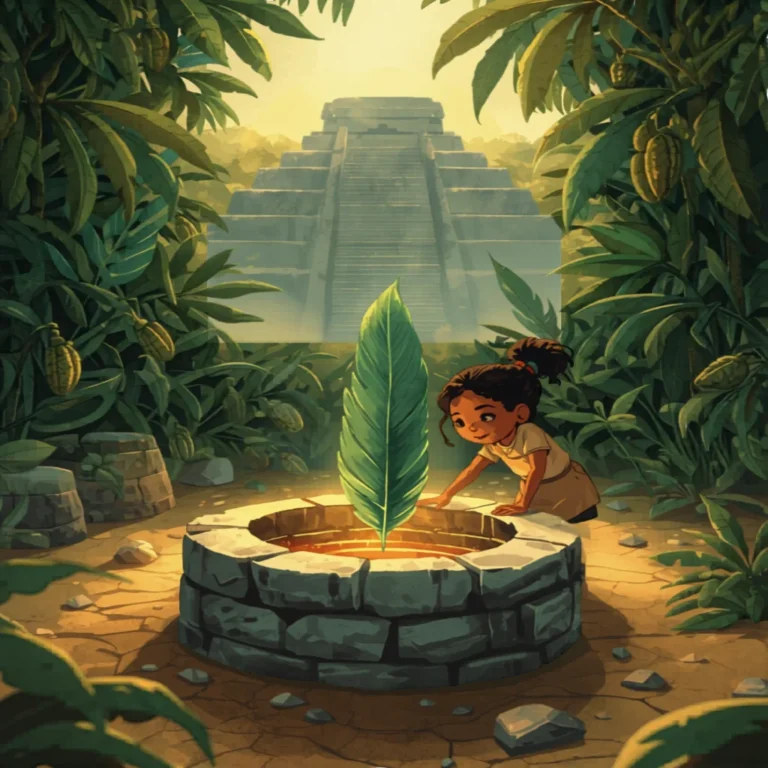
The Feather at the Bottom of the Well
Ix Yol crept closer. Her sandals crunched over the dry red earth. The air smelled of dust and copal smoke from the temple priests' prayers, and her tongue felt thick in her mouth from thirst — everyone's did. The corn was turning yellow. The dogs had stopped barking. Even the birds had gone quiet, as if the whole world was holding its breath.
"Get away from there!"
Old Balam came stomping up the path, his walking stick raising little puffs of dust with every step. He was the cenote keeper, and he took that job very seriously — especially the part about keeping everyone else away.
"That sacred well belongs to Chaac himself and the lords of Xibalba," he snapped. "Not to nosy little girls."
"But there's something glowing down there," Ix Yol said.
"I don't care if Itzamna himself is doing cartwheels down there. Step *away.*"
That night, when old Balam was snoring loud enough to rattle the palm leaves off his roof, Ix Yol crept back to the cenote. The green glow was still there, steady as a heartbeat. She tied her rope around the great ceiba tree at the edge — that magnificent tree whose roots touch the underworld and whose branches hold up the sky — and lowered herself into the dark.
The walls were cold and damp, which was strange because everything else for miles was scorching hot. She shivered. The rope burned her palms. The glow grew brighter as she dropped lower, until her sandals finally touched the cracked floor.
The feather lay in the mud beside a tiny creature, no bigger than her hand. It looked something like a lizard and something like a frog and something like neither. Its scales shimmered green and blue. Its enormous eyes were the colour of jade. And it was trembling.
"Water," it croaked. Its voice was like the first tap of rain on a dry leaf — small, and desperate.
Ix Yol had one small clay flask tied to her belt. It was the last of the water she'd been saving since morning. She looked at it. She thought about the long climb back up, and the dark walk home, and how thirsty she already was.
Then she poured every last drop into the creature's cracked mouth.
The trembling slowed. The jade eyes blinked.
"Why?" it asked. "You needed that."
"You needed it more," she said. It was just the truth.
The creature's scales glowed brighter. It pulled one leg free from the mud, then another.
"Three questions," it said. "Answer honestly."
"Okay," said Ix Yol.
"What do you want most in all the world?"
She thought about saying something noble, like *the rains to return.* But those jade eyes seemed to see right through her chest.
"I want my little brother to stop coughing," she said quietly. "He's been sick since the water ran out."
"What are you most afraid of?"
She took a breath. "That I'm too small to help anyone."
"Last question." The creature was nearly free now, and the glow was spreading up the cenote walls, lighting up old carvings of Chaac's face — his long curling nose, his axe raised to the sky. "What would you give up to save your village?"
Ix Yol didn't hesitate. "Anything I have."
That was when a rope dropped down from above, and old Balam came grunting down it, his eyes locked on the glowing creature like a hawk on a rabbit.
"Ha! I *knew* it!" he wheezed. "A jade spirit! Worth more than a king's ransom! Get away, girl—"
He lunged.
The creature opened its mouth.
What came out was not a croak. It was thunder.
Balam's rope snapped. He sat down very hard in the mud — which, suddenly, was not dry mud at all. It was cool, wet, glorious mud. Water was seeping up through the cracked floor, rising around his ankles. He made a noise like a very surprised turkey.
The creature turned to Ix Yol. It was growing now — quietly, powerfully, the way a storm cloud swells before it finally breaks open.
"I am the nahual of Chaac," it said. Its voice was low and warm like distant thunder rolling over a mountain. "His spirit messenger. I came to see if your village deserved rain. But selfishness had blocked this cenote's path and trapped me in the cracking mud." It lowered its great head until those jade eyes were level with hers. "You gave your last water. You spoke the truth. You climbed into the dark when you did not have to."
Then it looked up at the circle of night sky above, opened its mouth, and the thunder that rolled out shook the stars loose.
By the time Ix Yol pulled herself back up the rope, fat drops were already falling on her face and hands and shoulders. Children tumbled out of their houses, laughing and spinning with their arms wide. Old women lifted their palms to the sky. Dogs barked like they'd never barked before.
Her little brother appeared in the doorway, blinking in amazement at the rain.
"Is it real?" he called.
"Completely," she said, and ran to pull him out into it.
As for Balam — the villagers found him the next morning sitting at the edge of the cenote, his fine clothes ruined with mud, his walking stick floating gently down a new, bubbling stream. He was very quiet for a very long time. And when he finally spoke, it was to carry the first jug of water himself to the oldest grandmother in the village.
He had spent a long, wet, muddy night thinking. And whatever he thought about, it changed him.
Down in the cenote, the jade feather still lay on the mud. The villagers placed it in the temple, up high where everyone could see it. On stormy nights — the good, soaking, life-giving kind — they say it still glows green in the dark.
This tale, perfect for ages 6-12 to hear on a warm, rainy night, has been whispered ever since in doorways and around fires. About the girl who climbed down into the dark with nothing but a rope, an empty flask, and a kind heart. And found that that was more than enough.
📚 Recommended Books
Handpicked for readers like you
As an Amazon Associate, we earn from qualifying purchases. These recommendations are personalized based on this story's themes and your reading history.