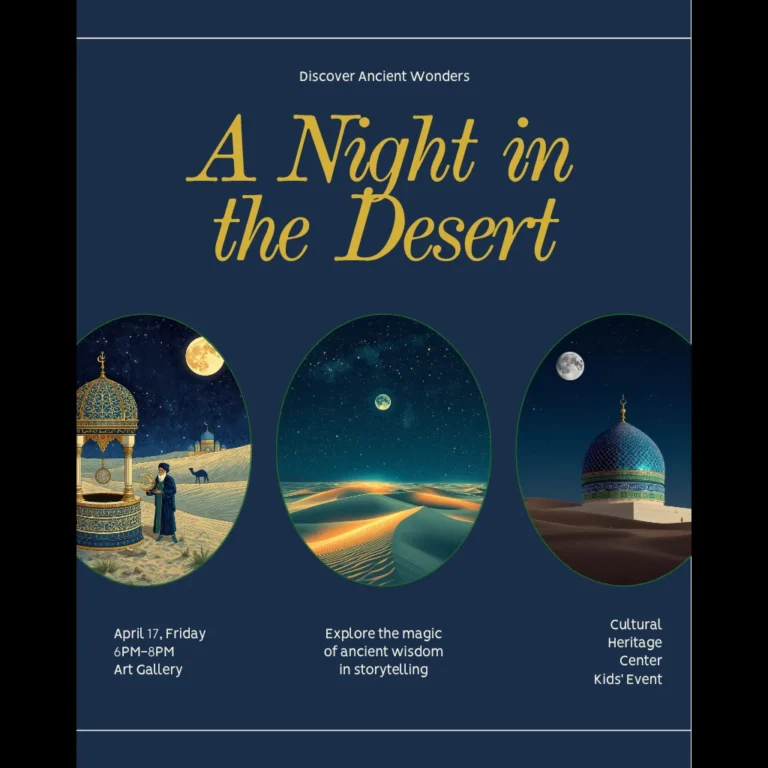
The Well at the Edge of Everything
—
On the far side of the village of Saqiya, past the date palms and the crumbling mud-brick wall where the lizards slept in the afternoon sun, there was a well that nobody used.
It was perfectly round. The stones around its rim were black as ink, though no one could say why. Sometimes, at dusk, a faint blue light would drift up from the darkness inside — soft and slow, like a sleeping breath.
The villagers said a djinn lived in it.
They said it with their eyes wide and their voices low.
Tariq was nine years old, and he did not believe them.
Not because he was foolish. But because the village had not had water for eleven days. The river had pulled away. The other wells had gone dry and cracked. The goats were thin. The children were thirsty. And Tariq's little sister, Noor, pressed her small hot face against his arm at night and said nothing, because she was too tired to complain.
Someone had to do something.
So on the twelfth morning, before the sky had decided what color to be, Tariq walked to the well at the edge of everything. His sandals made soft sounds in the sand. The air smelled of dust and cold stone. He could feel his heart knocking inside his chest like a bird trying to get out.
He looked down into the well.
The blue light looked back up at him.
"I was wondering when one of you would come," said a voice.
It was like water moving over smooth rocks. Cool and clear and a little surprising.
Tariq grabbed the rim so he wouldn't fall. "Who's there?"
"I am Zahir," said the voice. "I have been here since before your village was a village. Since before that wall was a wall. I am a djinn, child. And I am very, very bored."
Tariq swallowed. He had heard that Sulayman — the great prophet who spoke the language of winds and djinn and birds — had once commanded thousands of such spirits with only a word. Tariq knew no such words. He only knew that his sister was thirsty.
"We need water," Tariq said. His voice came out steadier than he felt.
"I know," said Zahir. "I have watched you all suffer. I have watched the mothers fill cups with almost-nothing. I have watched the old men pray toward the empty sky." A pause. The blue light pulsed once, gently. "And still, none of you came to ask me."
"Because everyone is afraid of you."
"Yes." The voice was quiet for a moment. "Fear is a strange thing. It keeps people from the very help they need."
Tariq thought about that. He thought about the eleven days. He thought about Noor's small, dry lips.
"Are you dangerous?" he asked.
"I could be," said Zahir. "Most things could be. Fire could be. The desert could be. Water itself could be." Another pause, softer. "But I am also lonely, child. And lonely things rarely want to cause harm. They want the opposite."
Something in Tariq's chest loosened — not all the way, but enough. "Then why didn't you offer to help before? Why did you wait?"
"Because," said Zahir, and now there was something almost like a smile in the voice, "help that is not asked for is not always welcome. I learned that a very long time ago."
Tariq leaned closer. The stone rim was cool and rough against his palms. He could smell something coming from the well — dark earth, old minerals, something clean underneath it all, like rain before it falls.
"I'm asking," Tariq said. "Please. Help us."
The blue light bloomed wide and bright, filling the well like a lantern lit from inside the earth.
And then Tariq heard it.
Water.
First a trickle. Then a rush. Then a sound like joy itself — clear and cold and impossible, rising up through the old stones, climbing toward the light.
"There," said Zahir. "The underground river has always been there. I only moved myself out of the way."
Tariq stared. His eyes went hot. He blinked quickly. "Why — why didn't you do that before?"
"I told you," said the djinn gently. "No one asked. And more than that — no one came to me with courage instead of fear. With a real question instead of a stone thrown in the dark." The blue light began to fade, slowly, like a fire settling into embers. "You came, child. And you spoke to me as though I might be worth speaking to."
Tariq ran. He ran back through the palm trees, his sandals slapping the sand, shouting so loud the lizards scattered from the wall.
The village came. They came with pots and pitchers and cupped hands. They came with children on their hips and old men moving faster than old men should. The water was cold and tasted like stone and time and mercy all at once.
Noor drank until her eyes brightened. She pressed her wet hands against Tariq's face and laughed.
That evening, Tariq went back to the well alone. He sat on the cool rim and said, quietly, into the dark: "Thank you, Zahir."
There was a long silence. Then, soft as wind:
"Come back sometime. And bring something to tell me. Something good."
Tariq smiled up at the first stars appearing, one by one, like questions being answered.
"I will," he said. "I promise."
And he did. Every evening. For a very long time.
📚 Recommended Books
Handpicked for readers like you
As an Amazon Associate, we earn from qualifying purchases. These recommendations are personalized based on this story's themes and your reading history.